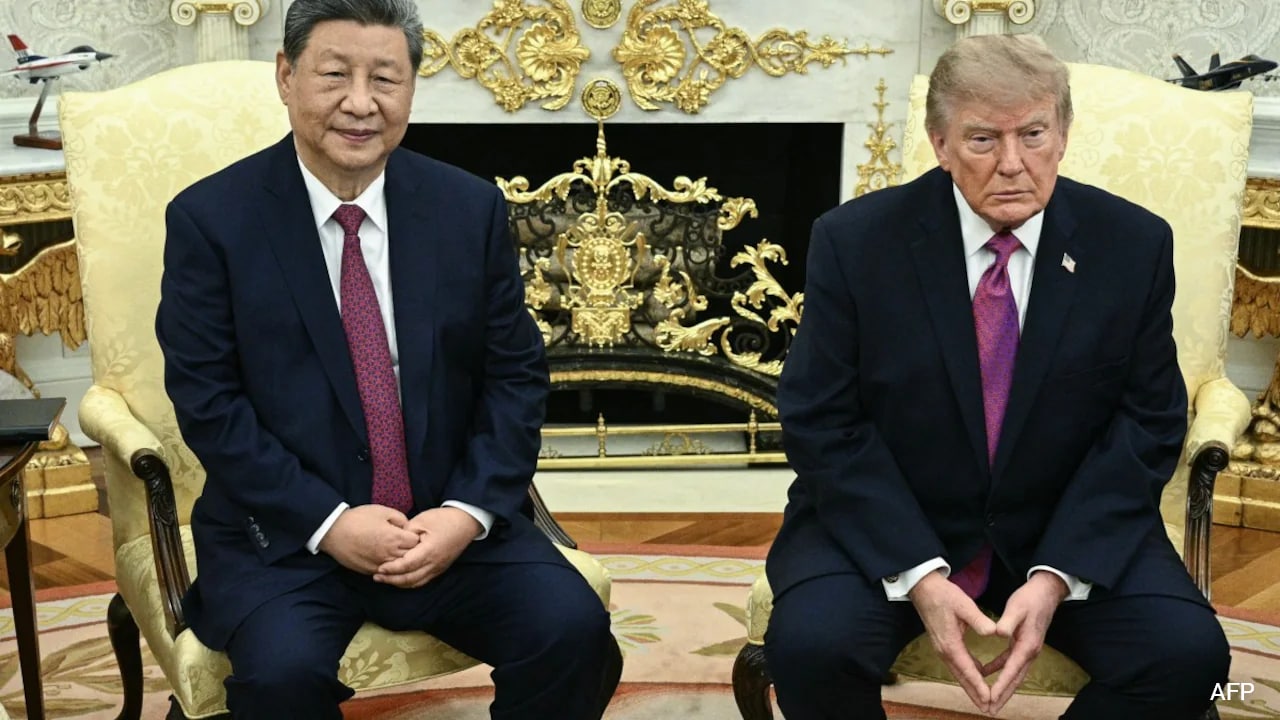
Bilateral statecraft between the United States and China operates within a rigid matrix of structural constraints, economic interdependencies, and technological bifurcation. When leadership summits materialize around high-stakes vectors like commercial trade parity, artificial intelligence governance, and regional security flashpoints such as Iran, media coverage routinely reduces complex geopolitical mechanics to episodic drama. This analysis deconstructs the actual mechanics of US-China high-level engagement, moving past superficial summit tracking to examine the underlying cost functions, systemic bottlenecks, and strategic levers governing the relationship.
The Tripartite Matrix of Bilateral Friction
Negotiating parameters between Washington and Beijing are defined by three distinct domains that function under entirely different economic and political rules. Conflating these domains leads to analytical failure. You might also find this similar coverage insightful: Why Ukraine's Drone War on Moscow Is Changing Everything You Thought You Knew.
Commercial Trade and Structural Decoupling
The trade vector is governed by asymmetric economic interdependence. US consumption capacity remains a primary driver of Chinese industrial output, while Chinese supply chain dominance in critical minerals, active pharmaceutical ingredients, and manufacturing inputs creates acute vulnerabilities for Western industrial base continuity.
- The Tariff Mechanism: Tariffs act as a tax on domestic consumption or an artificial wedge forcing supply chain reconfiguration. They do not eliminate trade deficits; they alter routing paths and compress margins for intermediaries.
- The Export Control Bottleneck: US administration of advanced semiconductor manufacturing equipment controls creates a technological ceiling for Chinese domestic capabilities. This policy operates on a zero-sum logic: maintaining a structural technological lead rather than achieving market equilibrium.
- Market Access Parity: Structural asymmetries persist regarding foreign entity operation, state-owned enterprise subsidies, and intellectual property protection frameworks. Beijing views industrial policy as a non-negotiable vector of national security, rendering standard Western trade concessions politically unviable within China's governance model.
Artificial Intelligence and the Strategic Technology Ceiling
Artificial intelligence governance represents a departure from traditional arms control. Unlike nuclear stockpiles, AI development is decentralized, commercially driven, and heavily reliant on dual-use infrastructure—specifically compute power, advanced lithography, and proprietary algorithmic architectures. As extensively documented in recent reports by The Washington Post, the effects are significant.
- Compute as Capital: Access to extreme-scale computing clusters functions as the gold standard of modern strategic capability. US restrictions on advanced graphics processing units and design software force Chinese state and private actors to optimize legacy hardware architectures and accelerate indigenous substitution models.
- Algorithmic Standardization: Divergent regulatory frameworks regarding data harvesting, privacy, and algorithmic safety create two distinct technological spheres. A single global standard for AI governance is structurally impossible given conflicting state security mandates.
- The Dual-Use Dilemma: Commercial breakthroughs in large language models and autonomous systems translate directly into military command, control, communications, and intelligence capabilities. Consequently, commercial cooperation in AI is bounded by national security imperatives, neutralizing traditional corporate diplomacy.
Geopolitical Alignment and Regional Flashpoints
Regional stability vectors, exemplified by the Middle East and energy transit corridors like Iran, test the limits of great power crisis management. China's energy security relies heavily on Middle Eastern hydrocarbon imports, creating a structural imperative for Beijing to maintain stable diplomatic and economic channels with actors sanctioned or opposed by the United States.
- The Free-Rider Paradox: Washington historically bears the security cost of maintaining global maritime transit lanes, while Beijing captures asymmetric economic benefits through trade access without proportionate security expenditures.
- Proxy and Diplomatic Signaling: Bilateral talks concerning regional conflicts do not yield genuine alignment of interests. Instead, they function as communication channels to establish red lines, prevent unintended military escalation, and signal resolve to domestic constituencies.
The Economic Cost Function of Bilateral Confrontation
To understand why summits persist despite structural hostility, one must examine the mathematical reality of total decoupling. Neither economy can absorb the friction of instantaneous separation without catastrophic systemic shock.
$$\text{Systemic Cost} = \int_{t_0}^{t_1} \left( \Delta C_{\text{supply}} + \Delta C_{\text{technology}} + \Delta C_{\text{capital}} \right) dt$$
Where $\Delta C_{\text{supply}}$ represents the cost of rerouting manufacturing infrastructure, $\Delta C_{\text{technology}}$ measures the efficiency loss of duplicated research and development ecosystems, and $\Delta C_{\text{capital}}$ accounts for the contraction of cross-border investment liquidity.
Because this cost function scales exponentially in the short term, both state actors utilize bilateral summits not to resolve foundational ideological differences, but to manage the gradient of decoupling. The objective is friction mitigation, not structural reconciliation.
Operational Limitations of Summit Diplomacy
High-level bilateral meetings are frequently misdiagnosed as turning points. In practice, their efficacy is bounded by severe institutional constraints:
- Domestic Political Constraints: In both political systems, leadership vulnerability precludes perceived weakness. Concessions made at the negotiating table must be framed domestically as victories, severely narrowing the design space for diplomatic compromise.
- Bureaucratic Inertia: Defense establishments, intelligence agencies, and industrial policy planners in both capitals operate with institutional momentum that routinely overrides temporary diplomatic thaw.
- Verifiability Deficits: Agreements on emerging technologies and intelligence-sharing parameters suffer from a lack of mutual verification mechanisms. Without trust architecture, self-enforcing treaties are structurally unworkable.
Strategic Forecast
The trajectory of US-China relations points toward managed managed strategic competition rather than conflict or convergence. Future engagements will focus exclusively on tactical containment protocols: establishing military crisis hotlines, coordinating macro-prudential financial stability measures during market stress, and carving out narrow exemptions for non-sensitive commercial exchange.
For corporate strategists and policy analysts, planning must account for a permanent operating environment characterized by structural volatility, regulatory bifurcation, and continuous supply chain risk mitigation. The primary operational priority is building institutional resilience against sudden policy shifts, treating bilateral summits as volatility indicators rather than fundamental pivots.