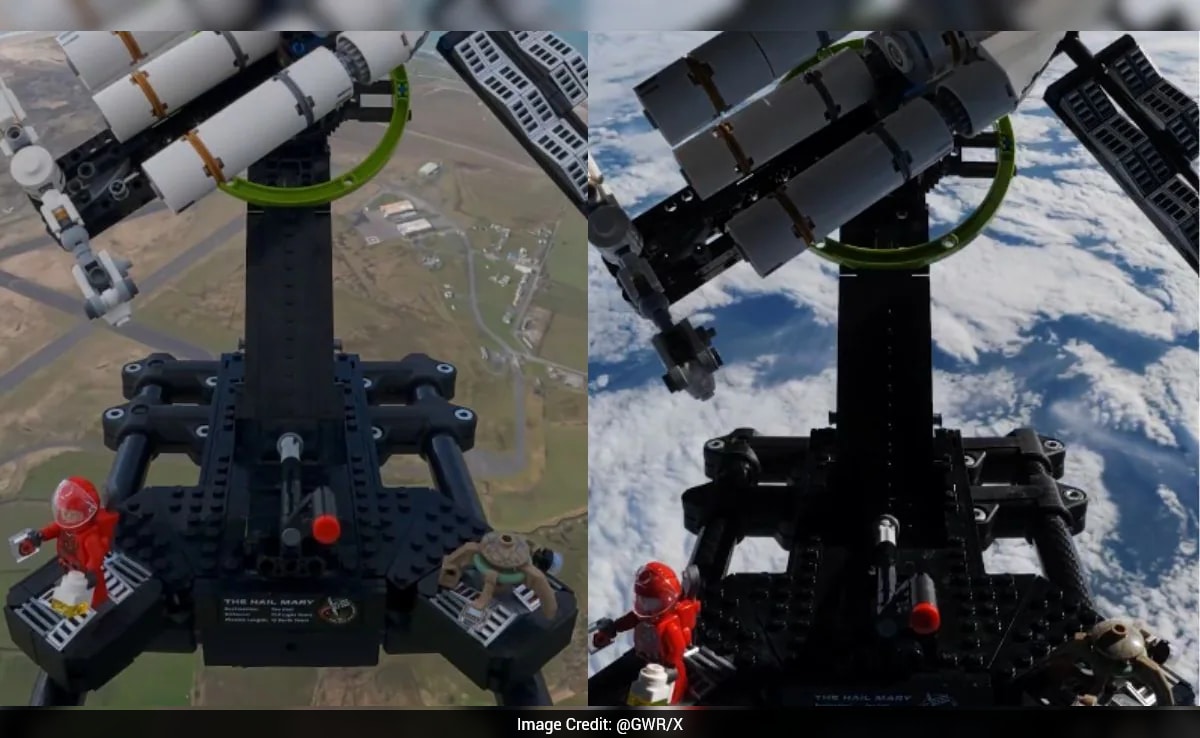
The successful ascent of a LEGO minifigure representing Ryland Grace from Andy Weir’s Project Hail Mary to an altitude of 34,135 meters establishes a new benchmark for cross-media promotional stunts. While the popular narrative focuses on the novelty of a "toy in space," a rigorous analysis reveals this event as a high-stakes integration of atmospheric physics, precision engineering, and psychological brand positioning. The mission’s success was not a product of luck but of managing three critical variables: the burst altitude of the latex carrier, the thermal resilience of the payload, and the GPS recovery logic in high-velocity descent.
The Physics of the Near Space Envelope
The stratospheric environment presents a hostile operational theatre that dictates the engineering requirements of the launch vehicle. At an altitude of 112,000 feet, the payload resides in the "near space" region, characterized by atmospheric pressures less than 1% of those at sea level and temperatures plummeting to -60°C.
The carrier mechanism relies on a high-altitude weather balloon filled with helium or hydrogen. The primary constraint here is the Pressure-Volume Relationship. As the balloon rises, external atmospheric pressure drops, causing the internal gas to expand. The burst altitude is predetermined by the material’s elastic limit; once the balloon reaches its maximum diameter, it ruptures, initiating the recovery phase.
- Lift-to-Weight Ratio: The team must calculate the precise volume of gas to provide sufficient "free lift." Too little lift results in a slow ascent, increasing the risk of lateral drift into restricted airspace or inaccessible terrain. Too much lift causes a rapid ascent, reaching the burst point before optimal footage or data can be captured.
- Thermal Management: Standard LEGO ABS (Acrylonitrile Butadiene Styrene) plastic has a glass transition temperature near 100°C but becomes increasingly brittle in extreme cold. The structural integrity of the Ryland Grace minifigure depends on the isolation of the mounting bracket to prevent vibration-induced fractures during the violent turbulence of the burst sequence.
Structural Analysis of the Payload Rig
A "space-bound" LEGO figure is not a standalone object but a component of a complex sensor-and-camera array. The engineering of the "gondola"—the housing for the payload—requires a balance between aerodynamic stability and mass minimization.
The primary failure points in near-space missions are electronic in nature. At high altitudes, the lack of air molecules means convection cooling is non-existent. Paradoxically, while the outside air is freezing, internal electronics can overheat because there is no medium to carry heat away from the processors. The Project Hail Mary mission required a rig that addressed:
- Radiation Shielding: Increased exposure to cosmic rays at 34km can cause bit-flips in non-hardened SD cards and GPS modules.
- Optic Condensation: As the rig passes through the tropopause (the coldest layer of the atmosphere), any residual moisture inside the camera lenses freezes, creating "fogging" that can ruin the visual verification of the record. This is mitigated through the use of desiccant packs and sealed thermal chambers.
- Parachute Deployment Dynamics: Post-burst, the payload enters a freefall in a vacuum-like environment. The parachute is effectively useless until it reaches thicker air, typically around 50,000 to 60,000 feet. The rig must be designed to remain stable during this high-velocity tumble to prevent the parachute lines from tangling—a "death spiral" that results in total asset loss.
Quantifying the Guinness World Record Metric
The certification of this flight as a Guinness World Record for the "Highest Altitude reached by a LEGO Minifigure" introduces a formal layer of verification that separates professional marketing from hobbyist launches. To achieve this, the mission had to adhere to a strict evidentiary protocol:
- Continuous Data Logging: A flight computer must record GPS coordinates and altitude at regular intervals (usually every 1 to 5 seconds) to create a verifiable flight path.
- Visual Continuity: Cameras must provide uninterrupted footage of the minifigure against the curvature of the Earth, proving that the figure remained attached throughout the ascent to the peak altitude.
- Recovery and Authentication: The specific minifigure launched must be recovered and its serial markers verified by independent witnesses to ensure no "swap" occurred post-landing.
This record serves as a "Proof of Concept" for the durability of the source material. By placing a plastic figure in the extreme conditions of the stratosphere, the campaign creates a physical metaphor for the resilience of the character in Andy Weir’s novel.
The Strategic Marketing Logic: Tangible Transmedia
The launch of the Ryland Grace figure is a masterclass in Tangible Transmedia. In a digital-heavy marketing environment, physical stunts provide "earned media" that transcends traditional advertising. The strategic value is broken down into three pillars:
- Narrative Alignment: Project Hail Mary is a story about scientific improvisation and the isolation of space. By sending a physical avatar of the protagonist into a near-space environment, the marketing team mirrors the book's plot. This creates a resonant feedback loop for the core audience (science enthusiasts and "hard" sci-fi readers).
- Visual Asset Generation: The high-definition footage of a LEGO figure with the blackness of space and the blue limb of the Earth in the background is "high-click" content. These assets are significantly more cost-effective than high-budget CGI trailers while carrying more authenticity.
- Community Engagement: This type of event triggers the "Maker" and "STEM" communities. By detailing the technical hurdles—such as the flight path and the hardware used—the campaign engages an influential demographic that values technical accuracy over superficial promotion.
The Bottleneck of Recovery: The Final Mile Problem
The most significant risk in high-altitude ballooning is the recovery phase. Even with a successful ascent, the mission is a failure if the payload is not retrieved. The "landing footprint" is a function of wind vectors at different atmospheric altitudes.
A typical flight might travel 50 to 100 miles horizontally from the launch site. The recovery team uses predictive modeling software (like CUSF Landing Predictor) to estimate the landing zone. However, the "Final Mile" remains unpredictable.
- Signal Loss: GPS trackers often lose signal as the rig nears the ground due to terrain masking (hills or trees) or the loss of line-of-sight to cellular towers.
- Environmental Hazards: Landing in a body of water, a dense forest canopy, or on private property creates logistical and legal hurdles that can delay or prevent the retrieval of the flight data.
- The "Black Box" Requirement: All data must be stored locally on the rig. While telemetry can send low-res updates during flight, the high-resolution evidence required for the World Record exists only on the physical SD cards within the gondola.
Tactical Application for Future Campaigns
The Project Hail Mary launch demonstrates that the "Spectacle Economy" is shifting toward verifiable, data-driven feats. For brands looking to replicate this success, the strategy must move beyond the launch itself and focus on the secondary data.
The integration of environmental sensors (UV radiation, pressure, CO2 levels) during the flight allows a brand to claim a "scientific contribution" alongside the marketing stunt. This dual-purpose mission profile increases the likelihood of being picked up by both news outlets and scientific journals, doubling the reach of the initial investment.
The success of this mission confirms that high-altitude marketing is no longer about the "if," but about the "how." By mastering the interplay of atmospheric physics and structural engineering, a brand can achieve a level of authority that digital-only campaigns cannot match.
The strategic play here is to leverage the "Hero's Journey" of the physical object. The minifigure is no longer just a piece of plastic; it is a survivor of a 112,000-foot vacuum. This physical history adds a layer of "story-matter" to the object, turning a mass-produced toy into a unique historical artifact. Future campaigns should prioritize this "provenance of the object," using the flight data not just as a record, but as a biography of the asset.