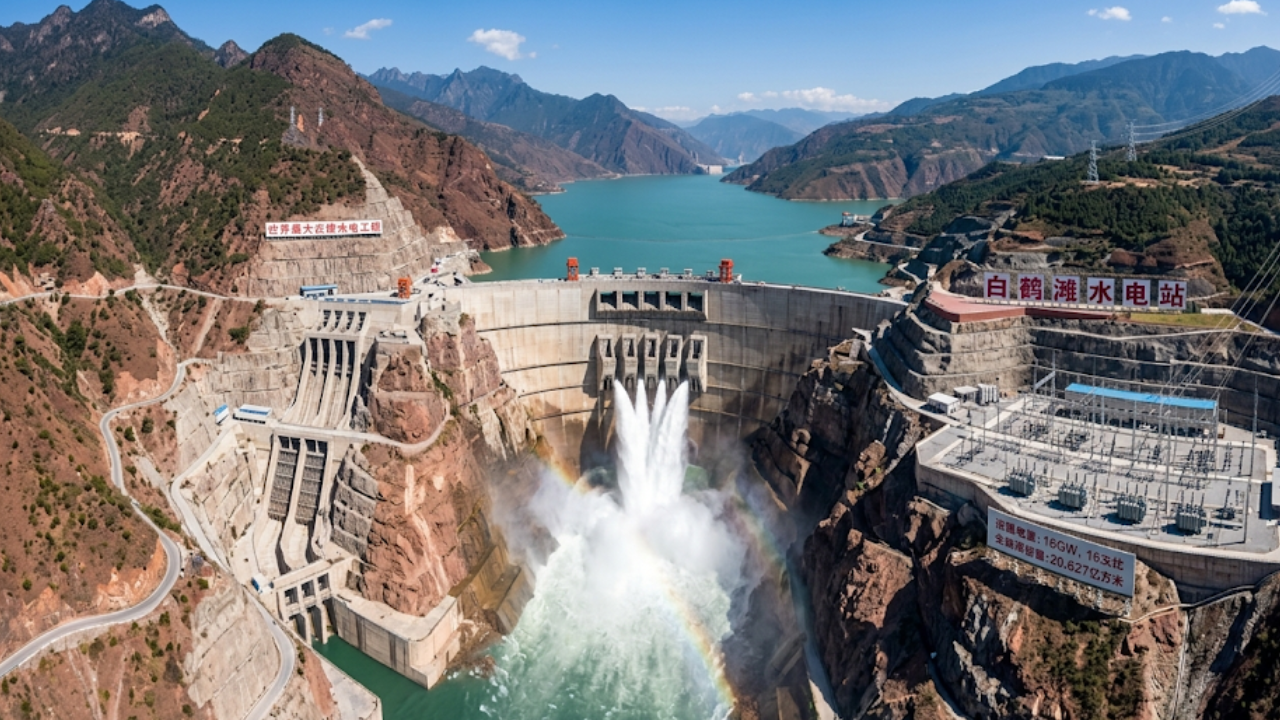
The proposed Yarlung Tsangpo hydropower project in the Tibet Autonomous Region represents a departure from traditional civil engineering toward planetary-scale atmospheric and crustal intervention. At a projected capacity of 60 gigawatts (GW), the facility would generate three times the power of the Three Gorges Dam, currently the world's largest power station. This scale of energy density—concentrated in a singular, high-altitude tectonic throat—creates a trifecta of risks: seismic induction, hydrological weaponization, and localized shifts in the Earth's rotational inertia.
The project centers on the "Great Bend," where the Yarlung Tsangpo river drops 2,000 meters in elevation over a short distance before entering India as the Brahmaputra. The fundamental logic of the project rests on the Hydraulic Head Differential. Since power generation is a function of water flow rate multiplied by the height of the fall (head), the unique topography of the Tibetan plateau allows for unprecedented energy extraction without the massive reservoirs typically required for 60GW outputs. However, the structural execution of this project requires tunneling through the Namcha Barwa syntaxis, one of the most geologically unstable regions on the planet.
The Triad of Engineering Constraints
The viability of the Motuo project is governed by three intersecting variables that dictate its feasibility and risk profile.
1. The Tectonic Loading Factor
The dam site sits atop the meeting point of the Indian and Eurasian plates. The region is characterized by high rates of uplift and frequent seismic activity.
- Reservoir-Induced Seismicity (RIS): The sheer mass of water in a concentrated area can lubricate existing fault lines or increase pore pressure, triggering "man-made" earthquakes.
- Crustal Stress: Unlike the Three Gorges, which sits on a relatively stable cratonic block, the Motuo site is a "tectonic knot." The addition of billions of tons of hydrostatic pressure introduces a variable that standard seismic modeling cannot fully predict.
2. Sediment Transport and Siltation Dynamics
The Yarlung Tsangpo carries one of the highest sediment loads in the world.
- Abrasive Erosion: High-velocity silt acts as an industrial abrasive on turbine blades, necessitating frequent and costly maintenance cycles.
- Storage Degradation: If the project utilizes a traditional reservoir, siltation will reduce its effective capacity within decades. China’s strategy likely involves a "Run-of-the-River" (ROR) model or a series of diversion tunnels to bypass the need for a massive, silt-trapping lake, though this complicates the constant output required for a national grid backbone.
3. High-Voltage Direct Current (HVDC) Transmission Efficiency
Generating 300 billion kilowatt-hours annually is futile without a mechanism to transport it to China’s industrial heartlands on the eastern seaboard, over 3,000 kilometers away.
- Line Loss: Power dissipation over long distances is the primary bottleneck.
- Solution: The project necessitates the development of Ultra-High-Voltage Direct Current (UHVDC) lines operating at 1,100kV or higher. This infrastructure is as much a part of the "dam" as the concrete itself, representing a significant portion of the $165 billion capital expenditure.
Hydrological Sovereignty and Geopolitical Leverage
The Yarlung Tsangpo is an international waterway. China’s status as the "upstream hegemon" allows it to control the "on/off" switch of the Brahmaputra’s headwaters. This creates a Hydrological Dependency Loop for downstream nations, specifically India and Bangladesh.
The Weaponization of Flow
During periods of regional tension, the ability to withhold water (causing droughts) or release excessive amounts (causing flash floods) provides a non-kinetic form of coercion. Even without malicious intent, the natural operation of a peak-load hydropower plant involves "hydro-peaking"—releasing water in surges to meet electricity demand. This disrupts the natural pulse of the river downstream, destroying seasonal agriculture and silt-based fertilization cycles in the Assam valley.
Data Asymmetry
China maintains control over hydrological data. By treating flow rates and silt levels as state secrets, Beijing prevents downstream neighbors from accurately modeling their own flood defense or irrigation strategies. The construction of the Motuo project cements this informational advantage, making the downstream survival of millions of people contingent on Beijing’s transparency.
Environmental Externalities and Earth Dynamics
The claim that a $165 billion dam could "reshape Earth's dynamics" is not hyperbole; it is a matter of angular momentum.
Rotational Inertia
Mass redistribution on the Earth's surface affects the planet's moment of inertia. When a massive amount of water is moved from sea level to high altitude, or concentrated in a specific coordinate, it subtly alters the length of a day (on the scale of microseconds) and the position of the Earth's axis. While the Three Gorges Dam shifted the Earth's pole by approximately 2 centimeters, the Motuo project, due to its extreme altitude and mass concentration, could theoretically produce a similar or greater perturbation.
Micro-Climate Alteration
The creation of a large body of water in a high-altitude canyon changes the local albedo (reflectivity) and humidity.
- Evaporative Forcing: Increased water vapor can lead to localized "cloud forests" or shift the patterns of the Indian Monsoon.
- Biodiversity Loss: The Yarlung Tsangpo Grand Canyon is a biological corridor. Submerging portions of this canyon or diverting its flow effectively severs the evolutionary link between the Tibetan plateau and the tropical forests of the eastern Himalayas.
The Economic Reality of the $165 Billion Price Tag
The fiscal logic behind such an enormous investment goes beyond simple electricity sales. The project acts as a massive Keynesian stimulus for China’s state-owned enterprises (SOEs) in the construction and engineering sectors.
- LCOE Analysis: The Levelized Cost of Energy for Himalayan hydro is high compared to coastal wind or solar. However, hydro provides "firm" baseload power that intermittent renewables cannot.
- Grid Stability: As China transitions away from coal, it requires a massive, reliable "battery." The Motuo project functions as a gravitational battery, providing the frequency regulation needed to stabilize a national grid increasingly reliant on volatile solar and wind inputs.
Strategic Forecast: The Infrastructure Cold War
The Motuo project will not exist in a vacuum. Its commencement will likely trigger a "Dam Race" in the Himalayas. India has already signaled the construction of its own massive storage projects on the Siang (the Brahmaputra's main stem) to "capture" water rights and mitigate the impact of Chinese upstream releases.
The primary risk is no longer just ecological; it is the Strategic Fragility of the region. A single catastrophic failure—whether due to a massive landslide, a glacial lake outburst flood (GLOF), or a seismic event—could send a wall of water down the Himalayas that would dwarf any natural disaster in recorded history.
For the global observer, the Yarlung Tsangpo project is the ultimate test of the Technological Sublime: the belief that engineering can fully subordinate planetary systems. The project will likely move forward in phases, with China first establishing the UHVDC transmission corridors and smaller "feeder" dams to test tectonic stability before attempting the final 60GW installation at the Great Bend. The strategic move for downstream stakeholders is not to block the project—an impossibility given China’s territorial sovereignty—but to demand a multilateral "Himalayan Water Treaty" that codifies flow minimums and real-time data sharing as a prerequisite for regional stability.