Civil unrest does not materialize from a vacuum; it is the physical manifestation of structural failure within institutional resource allocation. When thousands of students mobilize across France, barricading school entrances and engaging in direct clashes with law enforcement, the phenomenon is frequently misdiagnosed by mainstream commentators as sudden teenage volatility. A rigorous evaluation reveals a precise economic and operational breakdown: decaying physical infrastructure, an acute teacher deficit, and an unsustainable structural feedback loop between systemic administrative underinvestment and civil friction. Deconstructing this crisis requires analyzing the underlying variables that turn administrative neglect into nationwide disruption.
The Input Deficit: Infrastructure and Resource Constraints
The primary driver of the mobilisation is an accumulation of chronic underfunding within the secondary education system, colloquially known as the lycée network. Educational institutions operate under severe physical constraints that directly impede service delivery.
- Thermal Efficiency Failures: School buildings across France were constructed largely during mid-century demographic booms with little adaptability to extreme climate shifts. Classrooms routinely experience extreme ambient temperatures during heatwaves, rendering cognitive retention and standard testing environments untenable.
- Staff-to-Student Ratios: Chronic teacher shortages create an unstable operational cadence. When unreplaced absenteeism mounts, class sizes swell, instructional hours are compressed, and specialized curriculum paths are abandoned.
These infrastructural deficits create a high-friction environment. Students do not strike because of abstract political discontent; they strike because the marginal utility of attending a degrading educational institution approaches zero. When physical conditions breach acceptable baselines—such as unmanageable heat or absent faculties—student bodies utilize the only high-leverage tool available: total operational stoppage via blockades.
The Operational Escalation: From Boycott to Urban Confrontation
A localized strike mechanism inherently possesses a high risk of capture by external factions. When students establish blockades, they alter the local security equilibrium. This dynamic introduces a three-tier actor model during major civil disturbances:
- The Primary Agential Core: High school students whose grievances center explicitly on institutional inputs, resource deficits, and examination conditions. Their tactical repertoire is low-mobility and defensive: human chains, desk barricades, and symbolic school closures.
- The Opportunistic Fringe: Non-student actors, fringe political elements, and groups commonly identified by state apparatuses as the ultra-left or urban agitators. These entities hijack the spatial footprint of student demonstrations.
- The State Enforcement Apparatus: National police and specialized intervention units deployed to maintain public order. Their tactical deployment relies on crowd-control munitions, perimeter containment, and mass containment protocols.
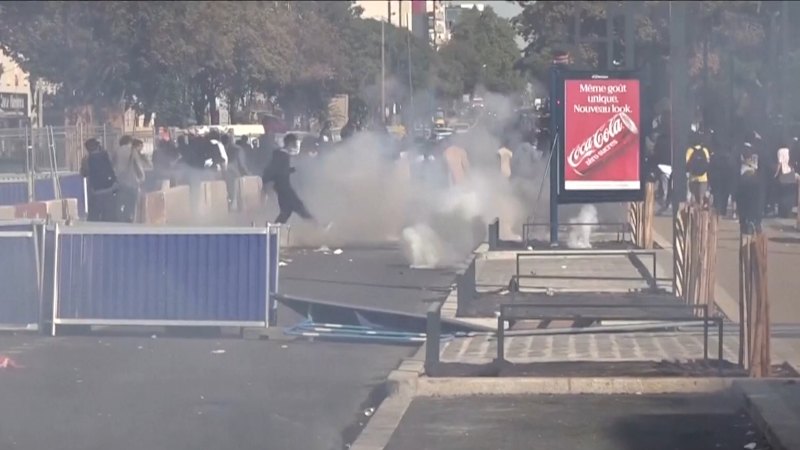
This multi-tiered environment generates a predictable friction coefficient. As police forces attempt to clear transport arteries and institutional perimeters, the tactical engagement shifts from peaceful obstruction to violent symmetry. The introduction of projectiles, pyrotechnics, and industrial bins converted into bonfires transforms a labor-dispute equivalent into urban guerrilla friction. The state responds with proportional—and occasionally excessive—force, including tear gas dispersion and mass administrative detentions.
The Economic Cost Function of State Concessions
The French administrative model operates on a reactive crisis-management cycle. When pressure reaches critical thresholds—measured by the volume of institutional closures and injuries—the state attempts to restore equilibrium through fiscal injections.
[Decaying Infrastructure]
       │
       ▼
[Student Mobilisation & Blockades]
       │
       ▼
[External Agitator Infiltration]
       │
       ▼
[State Coercive Response & Arrests]
       │
       ▼
[Reactive Fiscal Palliatives (e.g., Supply Teacher Allocations)]
This cycle reveals a fundamental flaw in state budgeting. Incremental concessions—such as the promised allocation of emergency supply teachers—fail to alter the systemic trajectory because they address symptoms rather than the structural capital deficit. The state's balance sheet is constrained by broader macro-fiscal targets, preventing the massive capital expenditure required to modernize thousands of secondary facilities simultaneously. Consequently, minor concessions are perceived by student unions and labor federations as inadequate, guaranteeing future iterations of the protest cycle.
Strategic Forecast and Systemic Resilience
The convergence of student grievances with broader cost-of-living protests and trade union strikes creates a compounded systemic risk for the executive branch. When localized grievances merge into a generalized anti-austerity coalition, the complexity of state negotiation increases exponentially.
To break this recurring cycle of civil disruption, the state must transition from tactical containment to preemptive infrastructural auditing. Until the structural degradation of public services is met with proportional capital expenditure rather than retrospective policing, educational institutions will remain focal points of civil volatility. The strategic directive for state planners is clear: allocate capital to foundational infrastructure before the cost of civil disruption exceeds the price of structural reform.