The qualification cycle for continental football tournaments exposes a systemic failure in public asset management across numerous sovereign states. As national teams prepare for tournament qualifiers, a significant proportion of federations find themselves administratively and physically barred from hosting matches within their own borders. This displacement is not an accidental anomaly or a temporary logistical oversight. It is the predictable outcome of a structural mismatch between the stringent regulatory mandates imposed by governing bodies and the fiscal realities governing public infrastructure spending in developing economies.
The Regulatory Compliance Gap
The Confederation of African Football enforces a standardized matrix of stadium requirements. These regulations encompass specialized turf performance metrics, high-output illumination thresholds for broadcasting, closed-circuit security monitoring architectures, and designated media zones. While these benchmarks align with international standards required for elite television production and spectator safety, they impose a capital expenditure profile that outstrips municipal maintenance budgets. Meanwhile, you can explore related events here: High School Flag Football Rankings By The Numbers What Traditional Media Misses.
When a national stadium fails inspection, the root cause typically traces back to three distinct failure points:
- Deferred maintenance loops caused by cyclical budget reallocations away from public recreation facilities.
- The absence of localized supply chains capable of servicing specialized agronomic inputs, such as hybrid turf systems and automated drainage sub-layers.
- Power grid volatility that renders high-capacity floodlighting systems and digital infrastructure unreliable without redundant, high-cost industrial generator backups.
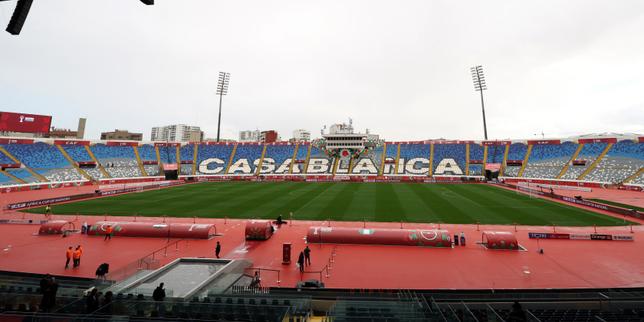
Faced with these mandates, many governments encounter a binary choice. They can commit scarce public capital to overhaul a single asset to elite specifications, or they can redirect those funds toward primary health, education, and transport infrastructure. Rational fiscal policy dictates the latter. Consequently, sports facilities deteriorate past the threshold of homologation, forcing federations to relocate their home matches to neutral territories—most frequently nations like Morocco that maintain an over-concentration of certified venues. To explore the complete picture, check out the excellent report by ESPN.
The Economic Mechanics of Exile
Playing home fixtures abroad introduces a heavy financial and competitive penalty. The direct cost function comprises three primary variables: international logistics, lost economic multipliers, and competitive disadvantage.
[Local Federation] ---> (Home Stadium Uncertified) ---> [Exile to Neutral Venue]
                                                               |
        +------------------------------------------------------+
        |
        +---> Increased Travel Expenditure (Flights, Accommodation)
        +---> Zero Domestic Ticket Revenue Generation
        +---> Neutralizing the Home-Pitch Advantage (Supporter Density Deficit)
Transport overheads consume a disproportionate share of a typical federation operating budget. Moving athletes, technical staff, and administrative personnel across regional corridors requires hard currency outlays for commercial air charters and extended hotel stays. These expenditures drain liquidity from grassroots development programs.
Simultaneously, the host nation loses the domestic economic multipliers associated with a major sporting event. Match-day consumption—spanning hospitality, local transport, and retail—evaporates from the domestic market. Worse still, the ticket sales revenue that would normally accrue to the local federation is either lost entirely or diverted to cover the rental fees of the neutral stadium.
From a sporting perspective, the elimination of home-pitch advantage degrades performance probabilities. Quantitative studies across global football demonstrate that playing in front of a domestic crowd yields a statistically significant boost in goal differential and refereeing bias mitigation. Relocating to an empty stadium in a foreign country neutralizes this variable entirely, compounding the difficulty of securing qualification.
The Maintenance Deficit and Capital Trap
A primary driver of this crisis is the historical reliance on monumental architecture designed for single-use or sporadic events. Governments frequently construct massive arenas for political prestige or one-off tournaments without establishing an endowment or commercial revenue model to fund ongoing upkeep.
Stadiums are capital-intensive industrial assets. Without a continuous stream of commercial tenants—such as domestic league clubs capable of filling high-capacity stands—and non-matchday event revenue, these structures operate as net negative cash-flow generators.
[Capital Injection: Initial Build]
       ↓
[Zero Commercial Revenue / No Anchor Tenant]
       ↓
[Deferred Maintenance Cycle]
       ↓
[CAF De-homologation]
       ↓
[Exile and Asset Decay]
When local leagues lack the commercial pull to generate sustainable gate receipts, stadium operators cannot finance basic preventative maintenance. Waterproofing fails, concrete degrades under extreme weather conditions, and electronic installations experience power surges without replacement parts available locally. The asset enters a terminal decline phase long before its structural design life expires.
Decentralized Modular Solutions
Resolving this recurring displacement requires a complete inversion of infrastructure strategy. National sports ministries must abandon the pursuit of monolithic, multi-thousand-seat arenas in favor of modular, right-sized facilities engineered for low operational complexity.
The path forward depends on several operational pivots:
- Enforce public-private partnerships where commercial entities or professional clubs manage stadium operations, tying maintenance budgets directly to commercial yields rather than ministerial allocations.
- Downscale seating capacity to match actual domestic league attendance averages, dramatically reducing the per-match cleaning, security, and structural upkeep overhead.
- Standardize construction around climate-resilient materials and low-energy maintenance profiles, eliminating reliance on imported turf management technologies that local technicians cannot service independently.
- Establish regional maintenance syndicates where multiple federations share specialized turf-maintenance equipment and engineering talent to reduce fixed overhead costs.
Until capital allocation models shift away from vanity builds and toward lifecycle asset management, the migration of sovereign fixtures to foreign soil will remain a structural fixture of continental competition. The solution is not more international leniency, but a permanent recalibration of facility economics to match fiscal reality.