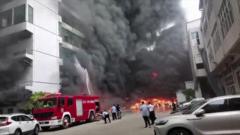
Industrial fires that result in mass casualties are rarely the result of a single isolated mistake. They represent systemic failures across regulatory oversight, architectural safety engineering, and operational compliance. When an industrial facility in a major manufacturing hub experiences a catastrophic fire resulting in dozens of fatalities, the event exposes deep structural vulnerabilities in the supply chain safety framework. Deconstructing these events requires moving past surface-level news reporting to analyze the specific mechanics of containment, egress, and operational incentives that dictate industrial hazard levels.
Structural Determinants of Industrial Fire Mortality
Mass-casualty industrial fires operate through three distinct physical mechanisms: rapid fuel loading, vertical exit compromise, and toxic gas incapacitation. High-density manufacturing environments—particularly footwear and apparel plants—present elevated fuel loads due to the concentrated volume of volatile organic compounds, synthetic polymers, rubber, and solvent-based adhesives.
Polymer Fuel Load Acceleration
The combustion dynamics in a footwear production facility differ fundamentally from standard commercial real estate. Solvents such as toluene and ethyl acetate, combined with polyurethane and synthetic rubber compounds, create high heat-release rates (HRR).
When a thermal event initiates:
- Solvents vaporize rapidly, forming a combustible gaseous layer near ceiling spaces.
- Flashover—the near-simultaneous ignition of all exposed combustible material in an enclosed space—occurs within minutes, far faster than in typical office or residential environments.
- Toxic smoke production, rich in hydrogen cyanide and carbon monoxide, causes rapid cognitive impairment and physical incapacitation before direct flame exposure occurs.
Egress Bottlenecks and Architectural Vulnerabilities
Fatality counts in industrial facilities correlate directly with the failure of emergency egress routes. Multi-story light industrial buildings often suffer from structural design flaws that convert stairwells into chimneys rather than safe escape corridors.
+-------------------------------------------------------+
|                Enclosed Facility Floor                |
|                                                       |
|  [Flammable Solvent Storage] -> [Combustion Event]    |
|                                      |                |
|                                      v                |
|  [Blocked Stairwell] <--- [Rapid Smoke Spread]        |
|          |                           |                |
|          v                           v                |
| [Trapped Occupants]       [Primary Exit Impassable]   |
+-------------------------------------------------------+
Systemic egress failures typically occur along three primary vectors:
- Physical Obstruction: Storage of raw materials or inventory in emergency stairwells reduces effective exit width to zero.
- Improper Compartmentation: Lack of fire-rated doors or unsealed utility penetrations allows smoke to migrate into vertical escape routes, rendering them unusable.
- Illegal Lockouts: Facility management routinely locks fire doors to prevent inventory theft or unauthorized worker exit, directly violating fundamental life-safety codes.
Economic Incentives vs Regulatory Enforcement
The persistence of severe fire hazards in dense manufacturing clusters stems from an economic mismatch between compliance costs and non-compliance risks. In high-volume, low-margin light manufacturing, operating margins are continuously squeezed by global buyer pricing expectations and rising raw material expenses.
The Cost-Benefit Calculus of Non-Compliance
For a mid-sized subcontractor, installing code-compliant automatic sprinkler systems, maintaining rated fire separation assemblies, and reducing floor storage density requires significant capital expenditure and ongoing operational downtime.
- Capital Expenditure (CapEx) Friction: Retrofitting legacy multi-story industrial space with automated suppression systems requires substantial capital investment that offers no direct productivity yield.
- Operational Expense (OpEx) Trade-offs: Regular maintenance of fire alarms, smoke extraction systems, and dedicated safety personnel adds recurring operational overhead.
- Calculated Risk Enforcement: When local regulatory inspection frequencies are low, or penalties for structural infractions are negligible relative to CapEx savings, facility managers accept the tail risk of catastrophic loss to preserve immediate liquidity.
Enforcement Deficits in Concentrated Industrial Clusters
Manufacturing hubs often face regulatory capture or institutional capacity constraints. When municipal administration prioritizes local economic output, regional GDP targets, and tax base preservation, local safety enforcement agencies face competing institutional incentives.
This environment fosters structural inspection failures:
- Inspections become pre-scheduled operational formalities rather than unannounced rigorous audits.
- Fines function as routine operating costs rather than forcing hardware retrofits.
- Temporary operational permits are repeatedly renewed despite persistent life-safety violations.
Quantifying Supply Chain Risk Exposure
For multinational brand owners and primary sourcing agents, industrial disaster events represent severe systemic operational risks. The immediate operational loss of production capacity is routinely compounded by brand equity damage and legal liabilities.
The Vulnerability Matrix of Multi-Tiered Sourcing
Primary brands typically maintain strict compliance requirements for Tier-1 suppliers (final assembly plants). However, risk increases dramatically deeper in the supply base:
- Tier-1 Operations: Generally subject to direct third-party social compliance audits, possess dedicated safety management, and maintain basic fire suppression infrastructure.
- Tier-2 Subcontractors: Frequently used for specialized processes (e.g., sole molding, stitching, solvent application). Operational visibility by primary brand owners drops sharply.
- Tier-3 Raw Material Suppliers: Almost entirely opaque to end-brand auditing regimes, operating with minimal oversight and high hazardous material concentrations.
A catastrophe at a Tier-2 or Tier-3 facility can halt the entire production pipeline while exposing the primary brand to severe reputational damage.
Protocol for Industrial Hazard Mitigation
Resolving structural safety deficiencies across high-risk manufacturing environments requires moving away from periodic checklist audits toward continuous, engineering-led risk management strategies.
Operational Separation of Volatile Processes
Hazardous materials—specifically volatile solvents, adhesives, and bulk polymer inventory—must be physically separated from main assembly spaces where human occupancy density is highest.
- Construction of fire-rated containment vaults equipped with continuous low-level mechanical ventilation to prevent solvent vapor accumulation.
- Installation of localized deluge water spray or foam suppression systems above high-risk chemical storage zones.
- Implementation of strict daily volatile organic compound (VOC) volumetric limits on active assembly floors.
Real-Time Egress Monitoring Engineering
Traditional static annual audits fail to detect day-to-day exit obstructions. Facilities must deploy passive, automated safety validation systems:
- Integration of Computer Vision (CV) cameras pointed at critical egress paths to flag inventory placement or door obstructions automatically in real time.
- Installation of magnetic door-release mechanisms wired directly to the main fire alarm panel, ensuring that security locks release instantly upon alarm activation without manual human intervention.
- Deployment of positive-pressure smoke control systems in stairwells to prevent smoke ingress even if doors are briefly held open during evacuation.
Structural Audit Independence and Incentive Alignment
Safety auditing frameworks must be restructured to eliminate conflicts of interest between auditors and facility operators.
- Audit firms must be contracted through centralized risk pools or brand consortiums rather than directly paid by the factory management being inspected.
- Third-party physical inspections must incorporate unannounced off-shift audits to observe operational realities during peak volume periods.
- Unannounced exit access testing must carry binding contractual penalties, including immediate termination of vendor production authorization upon detection of locked or blocked life-safety exits.
Brands that continue relying on self-reported vendor compliance or periodic paper-based audits remain directly exposed to catastrophic supply-chain failure and human loss. The immediate operational imperative requires transitioning to physical hazard separation, automated monitoring, and unannounced independent verification.