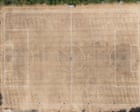
Local football fixture cancellations driven by unyielding, desiccation-hardened turf expose a systemic vulnerability in community asset management. When ground surfaces transition from resilient biological media into rigid mineral matrices due to prolonged precipitation deficits and thermal loading, participation models break down entirely. This is not merely a weather event. It is a failure of surface typology and risk governance that exposes the financial and operational fragility of municipal pitch maintenance.
The Mechanical Mechanics of Subgrade Failure
To understand why a pitch becomes unplayable, one must evaluate the soil physics. Athletic turf relies on a balanced root zone composed of sand, organic matter, and aggregate structure that absorbs kinetic energy through elastic deformation.
When sustained high temperatures and low soil moisture occur concurrently, two distinct processes compromise this balance:
- Capillary Collapse: Pore water evaporates, causing air voids to expand and capillary tension to pull soil particles into a dense, compressed state.
- Clay Mineral Fixation: In loamy or clay-heavy soils, shrinking clays bond tightly as water leaves the lattice, transforming the topsoil into a high-density solid state.
When a player's cleat impacts a surface with a compaction rating exceeding critical thresholds, the ground fails to dissipate the load. Instead, the energy reflects directly back through the skeletal system of the athlete.
The Kinetic Energy Return Equation
Standard safety protocols mandate that playing surfaces maintain a specific force-reduction profile. When natural turf dries to a density approaching that of unyielding asphalt, the impact attenuation drops close to zero.
Impact Force = (Mass x Acceleration) / Surface Compliance Index
As the surface compliance index approaches zero, the resulting force spike transferred to the ankle, knee, and lower back joints escalates exponentially. Municipal leagues postpone matches not out of an abundance of caution regarding muddy conditions, but because the mechanical rigidity of the pitch introduces severe liability through acute joint trauma.
The Economic Externality of Reactive Scheduling
Amateur sports ecosystems operate on thin operational margins. Facilities management across municipal authorities typically relies on reactive maintenance budgets rather than predictive soil conditioning.
When matches face wholesale postponement, a cascading economic inefficiency ripples through the local sporting economy:
- Capital Underutilization: Facilities maintain fixed operational overhead while revenue-generating fixtures sit dormant.
- Scheduling Compression: Postponed matches require mid-week reallocation, causing fixture congestion that degrades remaining turf integrity even faster during recovery windows.
- Volunteer Attrition: Unpredictable scheduling erodes the availability of match officials, coaches, and support staff who operate on strict personal calendars.
League administrators treat postponement as a binary switch: play or cancel. This binary approach ignores the gradient of risk management available through tactical infrastructure adjustments.
Operational Interventions and Surface Mitigation
Solving the hard-pitch dilemma requires shifting from calendar-driven management to data-driven soil moisture profiling. Facilities that successfully maintain playability during thermal stress implement three distinct operational tiers.
Tier One: Sub-Surface Moisture Retention
Relying on overhead manual irrigation during peak daylight hours creates high evaporation losses before water reaches the root zone. Effective mitigation demands automated subsurface drip irrigation combined with wetting agents that break surface tension in hydrophobic dry soils.
Tier Two: Mechanical Aeration Dynamics
Compacted soil cannot be corrected by water alone. Deep-tine aeration with solid or hollow needles physically fractures the hardened crust, reintroducing pore space for oxygen and future moisture infiltration. Doing this proactively before a heat wave hits prevents the soil from locking into a catastrophic solid state.
Tier Three: Variable Load Routing
High-traffic zones such as goalmouths and central midfields suffer the highest compaction rates. Ground controllers must enforce rotational training grids, moving portable goals and shifting practice footprints laterally across the pitch to distribute wear evenly before thermal hardening locks the damage in place.
Predictive Resource Allocation for League Operators
The recurring disruption of winter or summer fixtures due to surface hardening points to a deeper institutional flaw in how community infrastructure is funded. Facilities cannot rely on municipal general funds that fluctuate with political cycles.
League operators must transition to a risk-hedged maintenance model where pitch availability is insured through standardized hardness testing. By deploying Clegg hammers to quantify surface deceleration values before match days, administrators remove subjectivity from the cancellation process. Decisions become empirical, liability is mitigated, and capital investment is directed strictly toward high-risk drainage and irrigation zones.
The immediate operational priority is the adoption of continuous soil moisture telemetry. Manual checks are obsolete. Automated sensors embedded at root depth provide early warning indicators three weeks before a pitch reaches the critical hardening threshold, allowing groundstaff to intervene while chemical and mechanical remediation remains cost-effective.