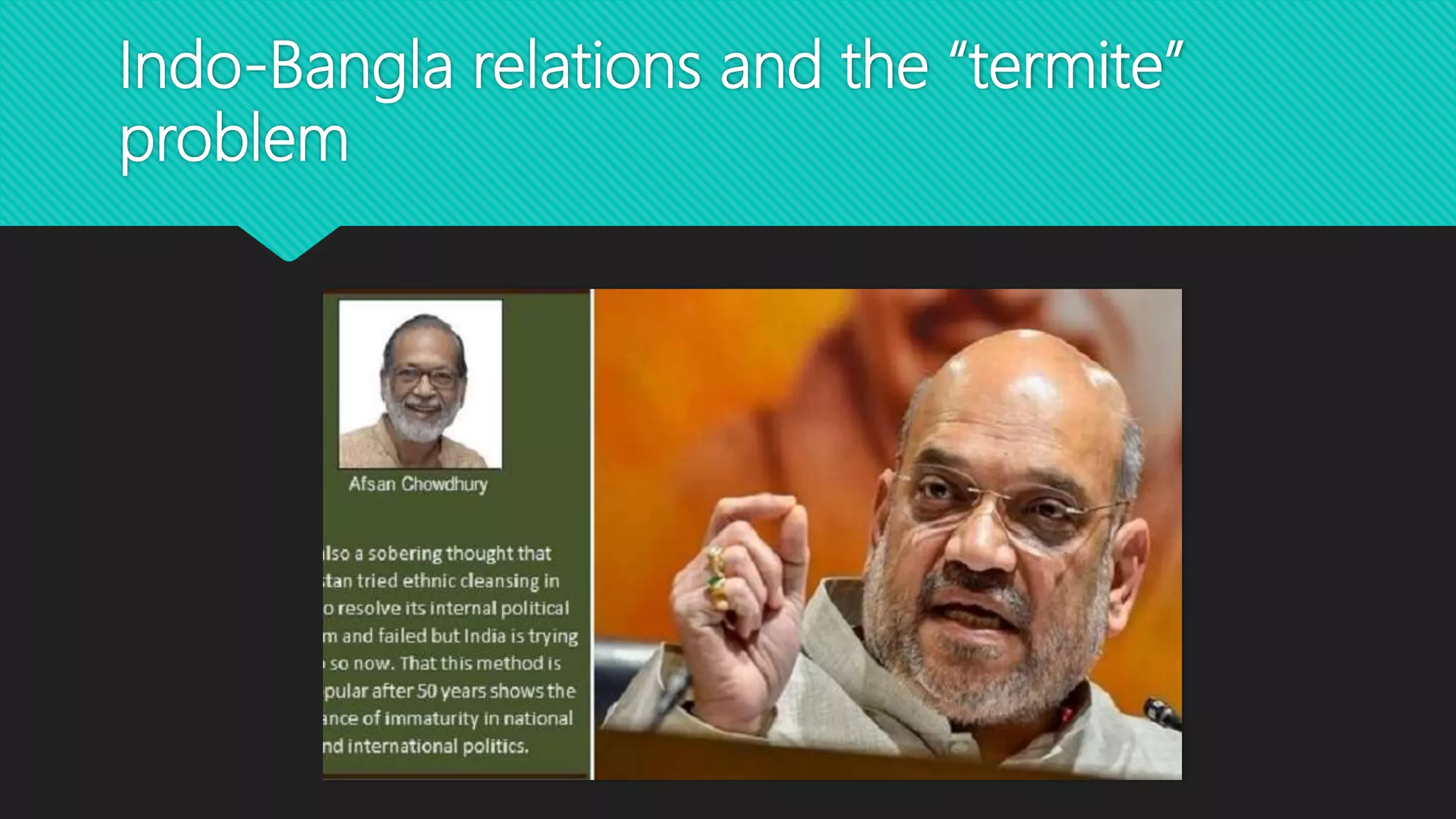
The assumption that a shift in provincial leadership within a federal neighbor dictates the foreign policy trajectory of a sovereign state ignores the institutional inertia and economic gravity of the Indo-Bangla relationship. When the Bangladesh Ministry of Foreign Affairs asserts that a political transition in West Bengal—specifically a hypothetical BJP victory—would not alter their diplomatic stance, they are not making a political gesture. They are acknowledging a high-density matrix of bilateral dependencies that operate independently of which party occupies the Nabanna (the West Bengal state secretariat).
The stability of this relationship is governed by three primary structural anchors: the Sovereign-to-Sovereign Centralization, the Cross-Border Economic Integrated Loop, and the Securitization of the Eastern Frontier.
The Sovereign-to-Sovereign Centralization Framework
Foreign policy is a Union subject under the Indian Constitution. This legal reality creates a firewall between provincial political rhetoric and New Delhi’s strategic objectives. While state leaders in West Bengal can influence the pacing of specific agreements—most notably the Teesta River water-sharing treaty—they do not hold the mandate to redefine the broader diplomatic architecture.
The Decoupling of Provincial Politics and Federal Diplomacy
Dhaka’s strategic calculus rests on the understanding that the Indian Ministry of External Affairs (MEA) views Bangladesh as the linchpin of its "Neighborhood First" and "Act East" policies. This federal priority remains constant regardless of whether the Trinamool Congress (TMC) or the Bharatiya Janata Party (BJP) holds power in Kolkata.
- The Institutional Buffer: Diplomatic engagement is conducted through institutional channels (the MEA and the Bangladesh High Commission). These channels are designed to absorb and neutralize provincial populist rhetoric for the sake of long-term regional stability.
- The Ratchet Effect: Once bilateral agreements reach a certain level of integration—such as the Land Boundary Agreement (LBA) or the inauguration of trans-border energy pipelines—the cost of reversal becomes prohibitively high for any incoming provincial administration.
The Economic Integrated Loop: Trade over Ideology
The economic relationship between Bangladesh and India, specifically involving West Bengal as the transit hub, is driven by a massive trade imbalance that ironically serves as a stabilizing force. West Bengal serves as the primary gateway for Indian exports to Bangladesh, which reached approximately $12 billion in recent cycles.
The Cost Function of Disruption
Any provincial attempt to significantly alter the "status quo" on the border would trigger an immediate negative feedback loop in the local West Bengal economy.
- Supply Chain Dependence: Bangladesh is a critical market for West Bengal’s agricultural surplus and manufactured goods. A hostile provincial stance that leads to border bottlenecks would result in a domestic price collapse for West Bengal’s producers.
- Infrastructure Sunk Costs: Massive investments in Integrated Check Posts (ICPs) like Petrapole-Benapole represent fixed capital that requires high-volume throughput to justify.
- The Remittance and Services Factor: A significant portion of West Bengal’s medical tourism and retail sector is buoyed by Bangladeshi nationals. The economic cost of a "hard border" policy would be felt most acutely by the very constituency a provincial party seeks to represent.
The Securitization of the Eastern Frontier
From a strategic perspective, the BJP-led federal government in India and the administration in Dhaka share a convergent interest in the "Zero Tolerance" policy toward insurgency. The internal security of India’s North East is inextricably linked to the cooperation of the Bangladesh security apparatus.
The Strategic Trade-off
The BJP’s national platform often emphasizes the regulation of migration, a point of friction for Dhaka. However, the mechanism of realpolitik dictates that India cannot afford to destabilize the Sheikh Hasina administration (or any stable government in Dhaka) because the alternative is a security vacuum that hostile non-state actors could exploit.
- Counter-Terrorism Synergy: The intelligence-sharing framework between the Research and Analysis Wing (R&AW) and the Directorate General of Forces Intelligence (DGFI) has been the most successful component of the bilateral relationship over the last decade.
- Transit and Connectivity: The granting of transit rights for Indian goods to reach the Seven Sister states via Bangladesh territory (Ashuganj and Chittagong ports) is a strategic concession that Dhaka uses as leverage. No provincial government can unilaterally sever these transit lines without undermining India’s national security.
The Teesta Bottleneck: A Case Study in Provincial Veto Power
The primary counter-argument to the "Continuity Thesis" is the unresolved Teesta River water-sharing agreement. It is the one area where provincial politics has successfully stalled federal diplomacy.
The TMC government famously blocked the 2011 agreement, citing the water needs of North Bengal farmers. If the BJP were to take power in West Bengal, they would inherit the same hydrological constraints. The "Cost of Political Survival" in the agrarian belts of North Bengal is the same for any party. Therefore, a change in party does not automatically resolve the deadlock; it merely changes the face of the negotiator.
Hydrological Realities vs. Political Posturing
The Teesta issue is governed by a zero-sum logic during the lean season.
- The Lean Season Deficit: The flow of the Teesta drops significantly during the dry months, leaving insufficient volume to satisfy the irrigation demands of both West Bengal’s Gitaldaha region and Bangladesh’s Rangpur division.
- The Federal Workaround: Because the water sharing is stuck, the federal response has been to "offset" the grievance by increasing cooperation in other sectors—electricity exports, credit lines ($8 billion+), and vaccine diplomacy. This "Sectoral Offsetting" is the mechanism that allows the relationship to progress even when one high-profile issue is stalled.
Demographic Rhetoric vs. Administrative Reality
The most visible friction point between a potential BJP provincial government and Dhaka is the discourse surrounding the National Register of Citizens (NRC) and the Citizenship Amendment Act (CAA). While this rhetoric is potent during election cycles, its operationalization faces massive logistical and diplomatic barriers.
The Repatriation Paradox
India lacks a formal repatriation treaty with Bangladesh. Any attempt by a provincial government to "deport" individuals would require the explicit cooperation of the central government and the acceptance of the receiving state. Dhaka has consistently maintained that there are no "illegal Bangladeshis" in India.
- Diplomatic Veto: Bangladesh can simply refuse to accept any individual without verified documentation, a process that can be dragged out indefinitely through bureaucratic friction.
- The Sovereignty Shield: By asserting that their foreign policy won't change, the Bangladesh foreign ministry is signaling that they will not engage with provincial leaders on sovereign issues like citizenship or border status. They deal exclusively with New Delhi.
The Strategic Recommendation for Regional Actors
The evidence suggests that Indo-Bangla relations have reached a state of "Institutionalized Maturity." The relationship is no longer a "Fair Weather" alliance but a structural necessity for both nations.
For investors and regional strategists, the focus should shift away from provincial election outcomes and toward the Comprehensive Economic Partnership Agreement (CEPA) currently under negotiation. This agreement will likely define the next twenty years of the relationship by:
- Reducing non-tariff barriers that currently impede the flow of Bangladeshi textiles into the Indian market.
- Harmonizing standards for digital trade and financial services.
- Creating a legal framework for the protection of cross-border energy investments.
The move toward a CEPA indicates that both New Delhi and Dhaka are looking to "lock in" their gains, making the relationship "election-proof." The strategic play is to ignore the noise of the campaign trail and monitor the progress of the Joint Working Groups on trade and connectivity. These are the true indicators of the bilateral health, far removed from the rhetoric of the political podium in Kolkata. The roadmap for the next decade is already etched into the geography and the balance sheets of the two nations; a change of guard in a border state is a variable, but it is not a disruption.


