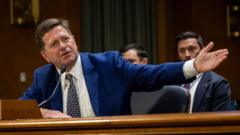
The Senate confirmation of Jay Clayton as Director of National Intelligence marks a structural pivot point for the executive oversight apparatus managing the eighteen constituent agencies of the United States intelligence community. Passing by a strict party-line margin of 51 to 47, the vote resolves a temporary leadership vacuum characterized by the brief, contentious tenure of acting director Bill Pulte. Beyond political friction, this transition forces a hard look at the operational mechanics of national security leadership, the administrative cost of legislative deadlocks, and the friction points governing foreign surveillance reauthorization.
The Tripartite Background Matrix
Evaluating Clayton requires moving past generalized political commentary to examine his professional trajectory across three distinct institutional domains. Each domain imparts specific operational habits that dictate how an administrator manages risk, processes classified information, and interacts with the legislative branch.
- Capital Markets Regulation: Clayton served as Chairman of the Securities and Exchange Commission from 2017 to 2020. In this capacity, his primary objective was enforcing disclosure rules, managing institutional compliance, and arbitrating disputes between corporate entities and regulatory mandates. This environment prioritizes legal precision, systemic predictability, and transparency metrics.
- Federal Prosecution: His tenure as the United States Attorney for the Southern District of New York injected direct prosecutorial experience into his resume. Operating in this district involves managing high-complexity criminal investigations, coordinating with federal law enforcement agencies, and evaluating the evidentiary thresholds required for indictments related to international terrorism and financial crimes.
- Corporate Legal Practice: Over two decades at Sullivan and Cromwell, Clayton specialized in transactional law, mergers, and cross-border capital allocations. This background instills a framework focused on negotiation efficiency, structural risk mitigation, and managing legal exposure for large organizations.
These three vectors explain the appeal of his nomination to the executive branch. Unlike career intelligence officers or traditional national security bureaucrats, Clayton brings an institutional background rooted in corporate governance and federal litigation. This combination shapes how he approaches the Office of the Director of National Intelligence, favoring formal administrative control over entrenched agency traditions.
The Legislative Impasse and Section 702
The most immediate policy variable impacted by this confirmation is the legislative status of Section 702 of the Foreign Intelligence Surveillance Act. The statutory authority governing warrantless collection of foreign intelligence concerning non-Americans overseas expired earlier in the summer. This expiration created a functional surveillance gap that leadership in both chambers of Congress sought to resolve.
The mechanics of this legislative stall involve two competing priorities within the federal government:
- Operational Intelligence Collection: Intelligence agencies argue that the lapse of Section 702 degrades threat-monitoring capabilities against foreign adversaries, transnational criminal networks, and hostile state actors. Without warrantless access to communications traversing U.S.-based infrastructure, the analytical latency required to track threats increases exponentially.
- Civil Liberties and Institutional Oversight: Lawmakers on both sides of the aisle, particularly within the Democratic caucus and libertarian factions of the Republican party, demand strict limitations on incidental collection affecting American citizens. These demands became acute following controversies surrounding previous administrative abuses and the actions of interim leadership under Bill Pulte, who executed staff reductions and declassifications that alienated moderate legislators.
Senate leadership intends to use Clayton’s confirmation to break this legislative gridlock. Because Clayton lacks the polarizing background of the acting director he replaces, Republican managers calculate that his institutional credibility as a former prosecutor and SEC chair will provide the necessary assurance to secure the votes required for reauthorization. However, opposition remains entrenched over broader policy demands, such as tying intelligence reauthorization to domestic voting integrity legislation like the SAVE America Act.
Institutional Friction and Political Independence
The primary vector of criticism during Clayton's confirmation hearings centered on executive loyalty and institutional independence. During questioning before the Senate Intelligence Committee, lawmakers probed his willingness to resist political pressure from the executive branch, specifically regarding questions of election integrity and the handling of historical investigative files.
The core operational tension of the Director of National Intelligence role lies in the friction between political responsiveness and analytical objectivity. The director must serve as the primary intelligence advisor to the president while maintaining the structural integrity of the President's Daily Brief. When nominees decline to provide categorical answers on politically sensitive historical questions, legislative opposition hardens along predictable partisan lines.
This dynamic establishes a difficult operational environment for the incoming director:
- Internal Alignment: Managing eighteen disparate agencies requires overcoming internal resistance from career personnel who view outside political appointees with skepticism. Following the structural churn and staff reductions executed during the brief tenure of his predecessor, rebuilding operational morale is an immediate prerequisite.
- External Credibility: The utility of intelligence reporting depends entirely on its perceived objectivity by Congress. If the legislative branch concludes that intelligence assessments are being shaped to fit specific political narratives, oversight committees can withhold funding, block structural reforms, and stall critical statutory renewals.
Strategic Outlook
The elevation of Jay Clayton shifts the management style of the nation's intelligence apparatus from volatile administrative disruption toward legalistic compliance and structured oversight. The primary metric of success for his tenure will not be internal restructuring alone, but whether his administrative profile can successfully bridge the gap with Capitol Hill to restore expired surveillance authorities. To prevent further operational degradation, the office must balance executive policy mandates against the structural demand for institutional autonomy.
Reestablish formal liaison channels with congressional intelligence committees to decouple the reauthorization of Section 702 from unrelated domestic legislative packages, thereby restoring baseline surveillance authorities before the current threat environment outpaces collection capabilities.
Senate confirms Jay Clayton as director of national intelligence
This video broadcast provides live news coverage and congressional commentary surrounding the Senate's final confirmation vote on Jay Clayton's appointment.
http://googleusercontent.com/youtube_content/1