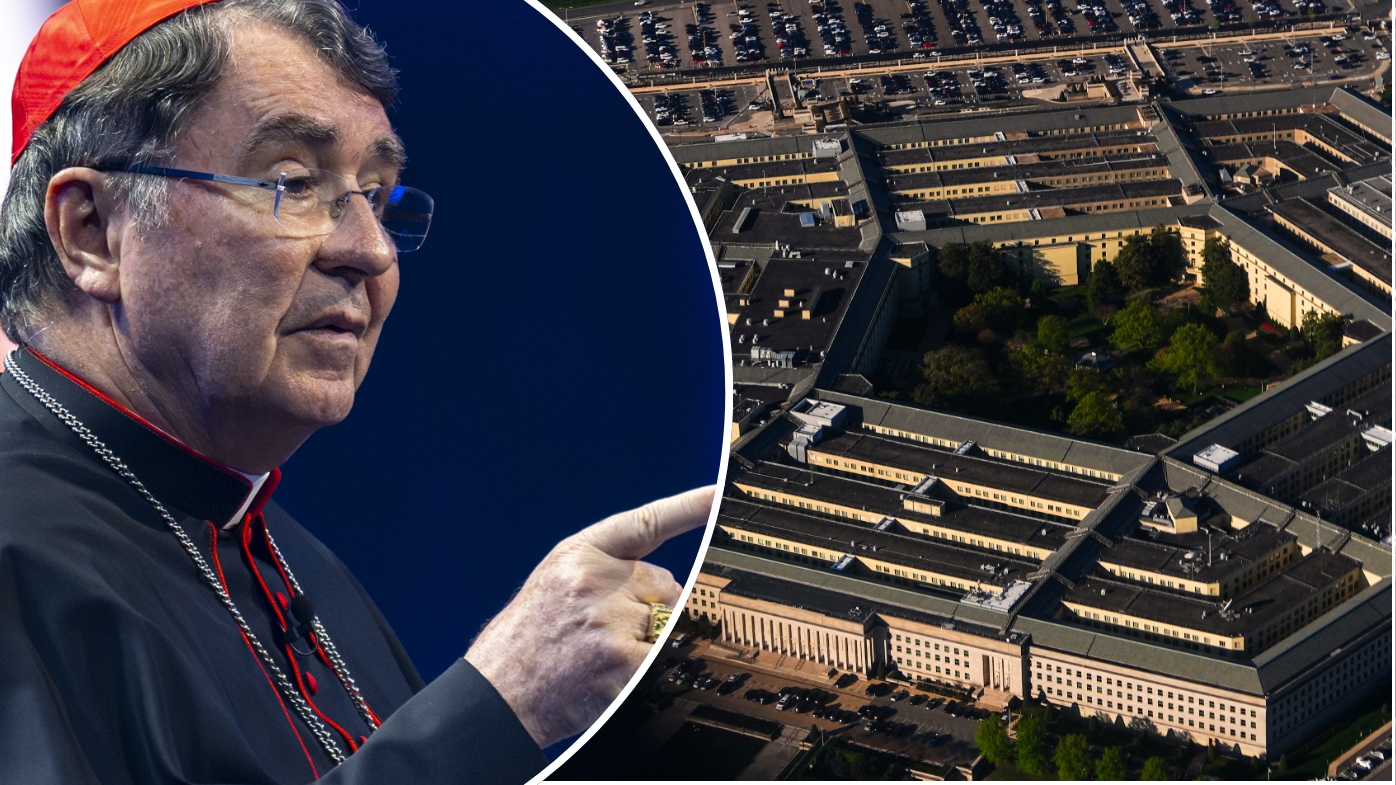
The recent Department of Defense (DoD) confirmation regarding formal communication with the Apostolic Nunciature—the Vatican’s diplomatic mission to the United States—marks a departure from standard military-to-civilian liaison protocols. While public discourse often gravitates toward sensationalism or theological speculation, a clinical analysis reveals a calculated move driven by three strategic imperatives: the management of Unidentified Anomalous Phenomena (UAP) historical records, the calibration of international normative frameworks for emerging technologies, and the mitigation of institutional risk regarding non-human intelligence (NHI) contingencies.
The Strategic Triad of Papal Engagement
The Pentagon’s decision to engage the Holy See is not an admission of metaphysical truth but an exercise in geopolitical risk management. The Vatican operates one of the oldest and most expansive intelligence-gathering and archival networks in the world. For the DoD, the Apostolic Nunciature represents a unique node in the global information architecture that intersects with several sensitive defense vectors.
1. Archival Asset Discovery and Verification
The Vatican Apostolic Archive (formerly the Secret Archive) and the Vatican Observatory represent significant repositories of historical data that predate modern electronic sensors. If the DoD is investigating long-term trends in atmospheric or space-based anomalies, the Catholic Church offers a longitudinal data set spanning centuries.
The mechanism here is simple: if "Legacy Programs" related to UAP recovery or observation exist, as suggested by recent whistleblower testimony and legislative inquiries in the U.S. Congress, the Vatican provides a neutral, non-state verifying body. Engaging the Pope’s representative allows the Pentagon to cross-reference modern sensor data with historical sightings documented in ecclesiastical records, effectively extending the "sensor range" of the U.S. military back by hundreds of years.
2. Moral and Ethical Boundary Mapping
Defense technology is currently outpacing international law. As the DoD integrates Autonomous Weapon Systems (AWS) and explores the implications of potential non-human technologies, it encounters a "moral vacuum." The Vatican remains a primary architect of Just War Theory and global bioethics.
By summoning the Nuncio, the Pentagon is performing a "stress test" on its own ethical frameworks. The objective is to understand how the world’s largest religious institution—and by extension, a significant portion of the global population—would react to specific technological or biological disclosures. This is a cold, calculated move to prevent social instability that could compromise national security readiness.
3. Diplomatic Back-Channeling
The Holy See maintains diplomatic relations with nearly every nation, including those hostile to U.S. interests (e.g., China, through informal channels, and various Middle Eastern actors). The Apostolic Nunciature serves as a high-trust, low-friction channel for communicating complex, sensitive information that cannot be shared through traditional State Department cables without immediate leakage.
Quantitative Constraints and Information Cascades
The flow of information between the Pentagon and the Vatican is governed by strict classification tiers. We can model the probability of disclosure through the following variables:
- V: The volume of historical data held by the Vatican.
- C: The classification level of current U.S. aerospace assets.
- P: The political pressure from the U.S. House Oversight Committee.
- S: The stability of the global social fabric.
The Pentagon's engagement indicates that $P$ has reached a threshold where the cost of silence exceeds the risk of limited disclosure to a trusted third party. The logic follows that the Vatican is being utilized as a "buffer state" for information. If the DoD were to release radical data directly to the public, the shock could trigger an uncontrolled information cascade. By involving the Nuncio, they create a controlled release valve.
The UAP Disclosure Framework and the Vatican Role
The 2024 National Defense Authorization Act (NDAA) and subsequent amendments have placed the Pentagon in a legal pincer move. They are mandated to declassify records related to "transmedium" objects. The involvement of the Pope’s representative suggests that the scope of these records is not merely technical but cultural and historical.
The Problem of Transmedium Data
Traditional radar and SIGINT (Signals Intelligence) are designed to track human-made or natural objects with predictable ballistic or aerodynamic profiles. When objects exhibit "instantaneous acceleration" or "transmedium travel" (moving from space to atmosphere to water without structural failure), the standard physics-based models of the DoD break down.
The Vatican’s interest in the "theology of the extraterrestrial" provides the Pentagon with a soft-power framework to discuss these anomalies without needing to redefine terrestrial physics in a way that would reveal sensitive sensor capabilities to adversaries like Russia or China.
The Bottleneck of Institutional Credibility
A primary friction point in this engagement is the internal resistance within the DoD’s own intelligence branches. The "Intelligence Community" (IC) is not a monolith; it is a collection of silos with competing interests.
- The Air Force Perspective: Focuses on "Domain Awareness" and the threat of adversarial drones (UAS). They view Vatican engagement as a distraction from the hardware-centric mission of air superiority.
- The Navy Perspective: Concerned with "Undersea Domain Awareness." Their sensors have recorded high-speed underwater anomalies that defy current cavitation models.
- AARO (All-domain Anomaly Resolution Office): Tasked with scientific rigor, they require the Vatican's historical records to determine if current sightings are "new technology" or a persistent environmental phenomenon.
The Nuncio’s involvement acts as a bridge between these silos. Because the Vatican is a "sovereign of the spirit," it can bypass the territorial infighting of the Pentagon's various directorates.
Operational Realities of the Summoning
When the Pentagon "summons" or invites a diplomatic representative of the Holy See, it is rarely a public affair. The fact that this has been admitted signals a shift in the "Overton Window"—the range of policies acceptable to the mainstream population.
The meeting likely focused on the UAP Disclosure Act requirements for "Review Board" appointments. The legislation requires experts from various fields, including historians and sociologists. The Vatican provides a pool of high-security-clearance-eligible intellectuals who are not beholden to the U.S. defense-industrial complex, offering a veneer of "objective oversight" that the American public currently lacks in its own institutions.
Data Categorization of the Meeting
If we categorize the potential agenda items based on military utility, the breakdown looks as follows:
- 50% - Historical Precedent: Evaluating the "Fatima" or "Lourdes" type events through the lens of modern electronic warfare and holographic projection capabilities.
- 30% - Global Governance: Preparing a joint statement on the "Common Heritage of Mankind" should NHI evidence become undeniable.
- 20% - Moral Law: The application of the Geneva Convention to non-human or non-state entities discovered in restricted airspace.
The Risk of Ontological Shock
The Pentagon is acutely aware of "Ontological Shock"—the collapse of an individual's or society's fundamental understanding of reality. In a data-driven environment, this shock manifests as a sharp decline in economic productivity, civil unrest, and a breakdown in the chain of command.
By engaging the Pope’s representative, the DoD is outsourcing the management of this shock. The Catholic Church has a 2,000-year history of assimilating disruptive truths into a stable narrative (e.g., the transition from a geocentric to a heliocentric universe). The Pentagon is effectively hiring the Vatican’s "Narrative Management" services to ensure that if the "UAP reality" is as disruptive as some whistleblowers suggest, the global infrastructure does not collapse.
Structural Failures in the Competitor Narrative
Previous reporting on this meeting has failed to account for the Information Security (INFOSEC) implications. Most articles treat the meeting as a "curiosity" or a "conspiracy theory." This is a failure of analysis. In the world of high-level defense strategy, curiosity does not exist; only requirement and response.
The competitor's narrative lacks a discussion of the Joint All-Domain Command and Control (JADC2) system. If the Pentagon is encountering objects that can jam or spoof JADC2, they need to know if these capabilities have been observed historically. The Vatican’s archives may contain descriptions of "celestial phenomena" that match the electronic signatures of modern UAP.
Strategic Trajectory
The Pentagon’s engagement with the Apostolic Nunciature will likely move from "ad hoc meetings" to a formalized "Liaison Office for Atmospheric Anomalies." This transition will be signaled by:
- The appointment of a high-ranking Jesuit scientist to an advisory board within AARO or the Space Force.
- An increase in funding for the Vatican Observatory's collaboration with NASA and the DoD on "Deep Space Tracking."
- A series of "Interfaith Statements" regarding the "Dignity of All Intelligence," which will serve as the legal precursor for recognizing non-human entities under international law.
The defense apparatus is currently building a "Legal and Moral Scaffold." They have the data (the hardware), but they lack the framework (the software) to integrate that data into the current world order. The Vatican is the primary provider of that software.
Military planners must now prepare for a reality where "Air Superiority" is no longer a matter of stealth coating and thrust-to-weight ratios, but a matter of understanding the intent of an "Other" that has been present in the historical record longer than the United States has existed as a sovereign power. The move to involve the Nunciature is the first visible step in a multi-decade plan to re-baseline human civilization for a post-disclosure environment.
Move all UAP-related archival research out of the "Special Access Program" (SAP) silos and into a "Multi-Lateral Collaborative Environment" involving the Holy See and other sovereign non-state actors. This reduces the legal liability of the DoD while maintaining control over the final narrative. Establish a "Biological Ethics Task Force" with the Nunciature immediately to draft the rules of engagement for non-terrestrial biological entities (NTBEs) before a kinetic encounter occurs.