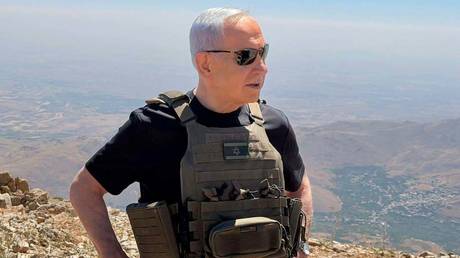
The operational posture of the Israeli military on the Syrian summit of Mount Hermon signals a structural shift in regional power dynamics. Prime Minister Benjamin Netanyahu’s declaration that Israel stands close to defeating the Iranian political and security apparatus reflects an aggressive forward-defense doctrine born out of the post-Assad vacuum. Rather than evaluating this address as mere rhetorical escalation, strategic analysts must deconstruct the underlying geography, logistics, and power asymmetries that dictate the current Middle Eastern theater.
The Geopolitical Geometry of the Mount Hermon Salient
Control of high-altitude terrain fundamentally alters the military balance of power by collapsing the reaction time required for defensive maneuvers. The seizure and subsequent fortification of the Syrian side of Mount Hermon, following the collapse of the central Damascus government, grants the Israel Defense Forces an unhindered electronic and visual line of sight running from the foothills of Damascus down to the Mediterranean basin.
This high-ground dominance eliminates the traditional buffer zone architecture established by the 1974 Disengagement Agreement. The operational mechanics of this transition rest on three distinct variables:
- Elevation Advantage: Uncontested radar and optical surveillance over southern Syria and Lebanon.
- Logistical Compression: Shortened interior lines of supply and communication for front-line operational units.
- Interdiction Capacity: The ability to preemptively neutralize hostile infrastructure before assembly or deployment.
The persistence of this military footprint transforms a temporary tactical intervention into an entrenched security perimeter. While international bodies categorize this presence as a belligerent occupation that violates state sovereignty, the strategic calculus from Tel Aviv prioritizes absolute border impermeability over diplomatic consensus.
Dismantling the Iranian Regional Axis
The stated objective to neutralize the Iranian network relies on exploiting structural vulnerabilities within Tehran's proxy logistics chain. For decades, the land corridor running through Iraq and Syria served as the primary transit route for precision munitions and personnel distribution to Mediterranean outposts. The collapse of allied state infrastructure in Damascus severed this logistical artery.
The cost function for Tehran has grown unsustainable. Economic pressures at home, combined with the systematic degradation of regional proxies, have compressed the operational capacity of the Islamic Revolutionary Guard Corps. Israel's campaign relies on capitalizing on this friction point, applying sustained kinetic pressure to prevent the reconstitution of cross-border paramilitary units.
The primary mechanisms driving this strategy include:
- Systematic Interdiction: Regular airstrikes targeting nodes of resupply and communication infrastructure.
- Forward Deterrence: Establishing physical outposts inside sovereign neighboring territory to intercept threats at their inception point.
- Diplomatic Isolation: Exploiting the power vacuum to forge localized accommodations with minority populations while marginalizing hostile state actors.
Domestic Pressures and Strategic Horizons
External military posturing cannot be divorced from domestic political survivability. Escalating security rhetoric serves to consolidate public backing during periods of severe societal stress and electoral friction. By framing the current military phase as the final push of an existential conflict, leadership aligns tactical operations with long-term national narrative goals.
However, maintaining an expanded forward posture in multiple sectors simultaneously introduces severe operational overreach risks. Sustaining prolonged garrisons in southern Syria and along northern fronts strains military reserves and tests the tolerance of international partners, including Washington.
The friction between immediate tactical security and long-term geopolitical stabilization defines the current strategic dilemma. Absolute military dominance over neighboring geographic features does not automatically translate into a durable political architecture.
Strategic Play
Consolidate the defensive perimeter along the Hermon-Yarmouk line while establishing formalized local governance frameworks with non-state regional actors to secure long-term buffer stability without requiring permanent, high-cost direct military administration.