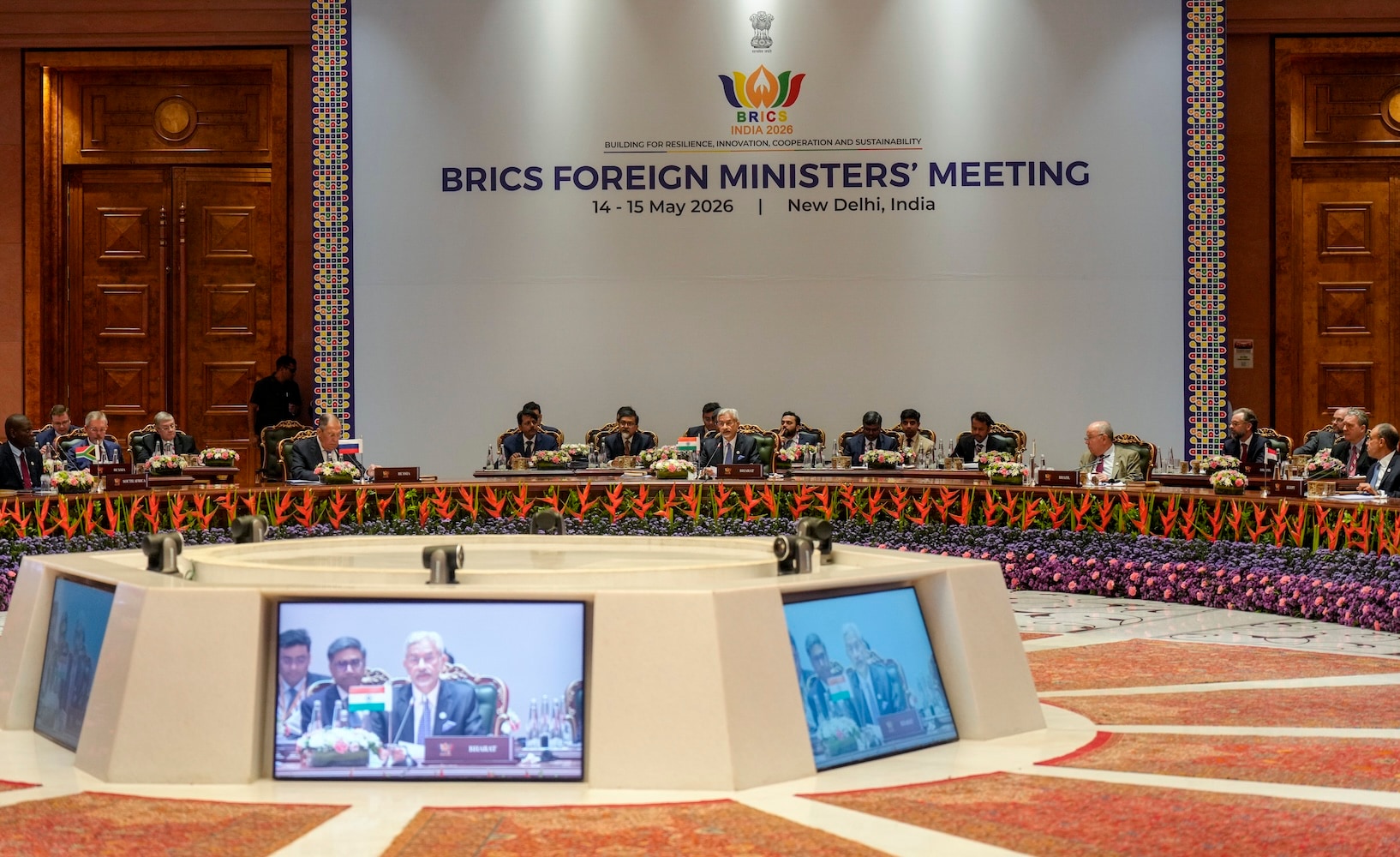
The convergence of top diplomats from the expanded BRICS bloc in New Delhi reveals the operational blueprint of India's structural foreign policy under the 2026 chairship. When Prime Minister Narendra Modi and External Affairs Minister S. Jaishankar convened with Russian Foreign Minister Sergey Lavrov and Iranian Foreign Minister Abbas Araghchi, the interaction served as a high-stakes mechanism to balance conflicting geopolitical vectors. Rather than a routine diplomatic gathering, this ministerial establishes how India executes multi-alignment when confronted with severe energy disruptions in West Asia, Western sanctions regimes, and shifting trade policies from Washington.
To evaluate the outcomes of this conclave requires bypassing rhetorical solidarity and analyzing the precise strategic variables at play. The expanded 11-nation BRICS framework—now containing 49.5 percent of the global population, 40 percent of global GDP, and 26 percent of global trade—functions not as a homogenous alliance, but as an optimization platform for emerging market economies to hedge against systemic macroeconomic risks. Learn more on a similar subject: this related article.
The Tri-Vector Equilibrium Framework
India's diplomatic strategy during this New Delhi ministerial operates across three distinct vectors, each presenting a complex optimization problem.
                  [ Vector 1: Continental Energy Security ]
                                    │
                                    │ (Chabahar / INSTC Corridor)
                                    ▼
[ Vector 3: Global South Leadership ] ◄────────► [ Vector 2: Maritime Chokepoint Defense ]
      (BRICS 11 Expansion / Reform)                     (Strait of Hormuz / Red Sea Flows)
Vector 1: Continental Energy Security and Sanctions Insulation
The primary structural constraint for New Delhi is maintaining non-dollar bilateral trade mechanisms with sanctioned energy exporters without triggering secondary Western sanctions. The presence of Iran’s Abbas Araghchi and Russia’s Sergey Lavrov represents the critical nodes of this continental vector. Further journalism by Reuters highlights similar views on this issue.
For India, the operational mechanism relies on the long-term development of the Chabahar Port and the International North-South Transport Corridor (INSTC). These transit routes bypass standard oceanic chokepoints dominated by Western naval assets, effectively cutting freight transit times by 40 percent and reducing logistics costs by 30 percent between the Indian Ocean and the Eurasian core.
Vector 2: Maritime Chokepoint Defense
Concurrently, India must insulate its maritime trade routes from active regional conflicts. The geopolitical friction in West Asia introduces a severe cost function regarding energy logistics. External Affairs Minister Jaishankar explicitly articulated this vulnerability by demanding unimpeded maritime flows through two specific choke points:
- The Strait of Hormuz: The transit corridor for over 20 percent of global petroleum liquids.
- The Red Sea / Bab-el-Mandeb: The vital artery for Asia-Europe container trade.
The strategic imperative here is defensive. Supply chain disruptions in these corridors directly inflate India's container freight rates and insurance premiums, threatening domestic macroeconomic stability. By engaging Iran directly within the BRICS framework, New Delhi seeks to leverage diplomatic capital into operational security assurances for Indian-flagged vessels and commercial interests in the Persian Gulf.
Vector 3: Global South Institutional Leadership
By chairing the 2026 BRICS lifecycle, India aims to position itself as the structural bridge between Western institutional frameworks (such as the G20) and the expanding non-Western alignment block. The tactical execution involves driving agenda items that focus on practical multilateral reforms, trade facilitation, and technology transfers, rather than allowing the platform to devolve into a purely anti-Western ideological front. This requires managing internal structural asymmetries, particularly the dominant economic weight of China, represented at this meeting by Ambassador Xu Feihong while Foreign Minister Wang Yi remained in Beijing during high-level bilateral engagements with the United States.
De-Dollarization Realities and Alternative Clearing Liquidity
A persistent narrative surrounding BRICS ministerial meetings is the imminent replacement of the US dollar ($USD$) as the global reserve currency. Quantitative analysis of global payment architectures suggests a more nuanced, structural limitation to this hypothesis.
The core bottleneck preventing a unified BRICS currency or complete de-dollarization is the Triffin Dilemma paired with severe capital account restrictions among member states. For a currency to function as a global reserve asset, the issuing nation or bloc must run persistent current account deficits to supply the global financial system with liquidity, while simultaneously maintaining deep, open, and transparent capital markets.
The structural realities within the expanded BRICS bloc demonstrate the friction in this mechanism:
- Asymmetric Trade Balances: Trade between India and Russia, or India and Iran, is heavily tilted in favor of the energy exporters. India runs a severe trade deficit with Russia due to discounted crude imports.
- Sovereign Inconvertibility: Clearing trade in national currencies (e.g., Indian Rupee ($INR$) or Russian Ruble ($RUB$)) creates an accumulation of non-convertible currency reserves. If Russia accumulates billions in $INR$, it cannot easily deploy that capital globally or repatriate it without facing Indian regulatory constraints on capital account convertibility.
- The Chinese Yuan ($CNY$) Alternative: While the Renminbi possesses the scale required to act as an alternative clearing asset, New Delhi views the over-reliance on $CNY$-denominated financial clearing systems (such as CIPS) as a strategic vulnerability. Geopolitical friction along the Line of Actual Control (LAC) prevents India from willingly integrating into a Beijing-centric financial infrastructure.
The operational objective of the New Delhi meeting was not the implementation of a single currency, but rather the optimization of Local Currency Settlement Systems (LCSS) and inter-bank messaging alternatives to SWIFT. These mechanisms function as localized risk-mitigation toolkits rather than a global structural replacement for the greenback. They are designed to insulate specific, high-priority bilateral transactions—such as defense procurement and hydrocarbon transfers—from external regulatory shocks.
The Economics of Enlargement: Managing the Structural Asymmetry
The transition from the original BRICS framework to the expanded 11-member cohort alters the alliance's internal bargaining dynamics. The inclusion of major energy producers (Iran, UAE) alongside key African and Southeast Asian economies (Ethiopia, Egypt, Indonesia) introduces a high degree of economic variance.
| Metric | Original BRICS Core (2009-2011) | Expanded BRICS Cohort (2026) |
|---|---|---|
| Global Population Share | ~42% | 49.5% |
| Global GDP Share (PPP) | ~31% | ~40% |
| Global Trade Share | ~17% | 26% |
| Primary Structural Driver | Macroeconomic growth alignment | Geopolitical hedging & supply chain insulation |
This expansion modifies the institutional cost-benefit analysis for India. In the smaller configuration, managing the strategic rivalry with China was a binary exercise. Within the expanded model, India can leverage a distributed network of middle powers—such as Brazil, South Africa, and recent entrant Indonesia—to build issue-based coalitions inside the bloc. This prevents the institutional capture of BRICS by any single superpower.
However, this structural heterogeneity creates execution bottlenecks. Reaching a consensus on core initiatives, such as the expansion of the New Development Bank (NDB) lending criteria or standardized customs protocols, becomes exponentially more difficult as the number of sovereign actors increases. Each new member brings distinct macroeconomic vulnerabilities, varying levels of debt distress, and divergent relationships with Western financial centers.
The Strategic Path Forward
The diplomatic maneuvering at the New Delhi ministerial indicates that India will reject the binary choice between Western integration and non-Western alignment. Instead, the operational strategy relies on tactical compartmentalization.
The definitive forecast for India's strategic play within the BRICS framework over the next production cycle involves three precise steps:
- Hardening Critical Infrastructure Channels: India will accelerate the institutional integration of the Chabahar Port authority with the INSTC transport network. This creates a secure, physical supply chain corridor that functions independently of oceanic disruption or maritime sanctions enforcement regimes in Western waters.
- Expanding the Cross-Border Payment Footprint: Rather than pursuing speculative digital reserve currencies, New Delhi will focus on the bilateral linkage of its Unified Payments Interface (UPI) with the real-time payment architectures of the UAE, Indonesia, and other partner states. This creates a functional, high-velocity clearing mechanism for retail and commercial settlement that bypasses legacy Western financial messaging systems without requiring capital account liberalization.
- Strict Enforcement of Geopolitical Neutrality: India will utilize its chairship to steer the upcoming September leader's summit away from explicit anti-Western resolutions. By anchoring the official agenda to international law, the protection of civilian maritime infrastructure, and the reform of Bretton Woods institutions, New Delhi maintains its credibility as a global swing state capable of collaborating with both the G7 and Eurasia simultaneously.

:max_bytes(150000):strip_icc():focal(819x186:821x188)/Murdaugh-Family-e90854a716884d608fb6fd925e18d840.jpg)
