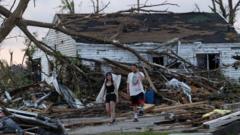
Every time a funnel cloud drops out of a muggy Midwest sky and chews through a stretch of dairy farms, the media playbook never changes. Within hours, the local news networks and digital aggregators roll out the mechanical birds. They buzz over the wreckage in Dunn County or Rock County, panning downward with high-definition sensors to capture the grand spectacle of splintered pine trees and ripped-off roofs.
The public treats this drone footage like sacred text. Viewers sit glued to screens, gasps escaping their lips as the camera tracks a foundation slab where a farmhouse used to sit. We stare at the aerial ruin because it satisfies a morbid, voyeuristic itch. It lets us survey the wrath of nature from the sterile safety of a couch.
Here is the inconvenient truth nobody in the broadcast booth wants to admit. Watching 4K drone footage of Wisconsin tornado damage does not inform you. It distracts you. It turns a localized human catastrophe into disaster porn, feeding a collective obsession with high-altitude aesthetics while masking the actual mechanics of recovery, building failure, and systemic failure.
If you think a quadcopter shot tells you the truth about severe weather resilience in the Upper Midwest, you are staring at the wrong altitude.
The Lazy Consensus Of Aerial Spectacle
The standard narrative accompanying these aerial clips follows a predictable, lazy arc. The anchor talks about the sheer power of Mother Nature. The meteorologist points at radar loops with a glowing stylus, explaining wind shear and hook echoes. Then, the drone video rolls, gliding smoothly over the rubble of a barn, accompanied by somber piano music or an urgent, breathless voiceover.
The underlying premise of this coverage is simple: the damage is massive, unpredictable, and entirely unavoidable. We are led to believe that when a high-end EF2 or EF3 rips through rural Wisconsin, human engineering is basically a paper bag in a hurricane.
I have spent years analyzing structural forensics after severe weather events. I have walked these debris fields on foot, long after the news choppers and consumer drones packed up their batteries and flew home. I have seen what the high-altitude lens completely misses.
The drone misses the rusted anchor bolts holding the sill plate to the foundation. It misses the lack of hurricane ties on roof rafters—hardware that costs pennies yet keeps entire structures intact. It misses the cheap oriented strand board rotting from decades of moisture infiltration before the wind even arrived.
When you watch a drone sweep over a flattened property in Dunn County, you are looking at a failure of construction standards, maintenance neglect, and municipal zoning enforcement. You are not just looking at the wrath of a thunderstorm. You are looking at a bill that came due for decades of cutting corners.
The Geography Of Vulnerability
Wisconsin weather possesses a distinct personality. We deal with volatile temperature swings off Lake Michigan and Lake Superior, colliding with warm, humid air streaming up from the Gulf of Mexico via the Mississippi River Valley. Tornado season in the Badger State is not a sudden anomaly; it is a predictable seasonal tax.
Yet, year after year, communities act surprised when severe storms level older housing stock and poorly anchored outbuildings.
Let us look at the structural data. A vast percentage of rural Wisconsin properties destroyed in these outbreaks share common vulnerabilities. They are built on crawlspaces with inadequate foundation connections. They rely on roof systems that depend entirely on gravity rather than mechanical fasteners to stay attached to the walls. When straight-line winds or embedded tornadoes hit 110 miles per hour—well within the common range for our regional storms—these buildings do not explode because of some mystical atmospheric magic. They fail because the physics of the assembly were fundamentally flawed from day one.
The drone footage flattens all of this context. From four hundred feet in the air, a poorly constructed pole barn and a meticulously engineered safe room look identical once the wind strips away the tin siding. The camera shows you the aftermath, but it hides the cause. It creates a narrative of random victimization.
That narrative is comforting. If tornadoes are completely random acts of God that turn everything into toothpicks regardless of what you do, then nobody is at fault. Local governments do not have to upgrade building codes. Builders do not have to change their framing techniques. Homeowners do not have to invest in structural hardening. We can just shrug, donate canned goods to a local shelter, and wait for the next storm to give the drones another flight path.
The Cost Of Disaster Porn
There is a darker economic side to our cultural addiction to drone-captured disaster footage. It fuels a cycle of sensationalized disaster capitalism and performative sympathy while starving long-term mitigation efforts of actual oxygen.
When a storm hits, attention spikes. Donations pour in for the first seventy-two hours. GoFundMe campaigns pop up by the dozen. Media outlets rake in advertising revenue off the back of viral clips showing neighborhoods reduced to matchsticks.
Then, the news cycle shifts. The drones move on to the next wildfire, flood, or economic crisis. The cameras disappear.
And the people whose lives were upended? They are left dealing with stubborn insurance adjusters, underpaid claims, and local contractors who cannot keep up with supply chain crunches. The millions of views on YouTube and TikTok do not rebuild a single foundation. They do not lower the cost of engineered roof trusses. They do not force local zoning boards to mandate safe rooms in new residential developments across Marathon or Outagamie counties.
In fact, the obsession with aerial destruction actively crowds out conversations about prevention. If you want to honor the people who lost their homes in Wisconsin, stop treating their tragedy as a visual thriller. Start asking why their homes were so fragile in the first place.
Dismantling The Safe Room Myth
A common question that surfaces after every major Wisconsin tornado outbreak revolves around shelter accessibility: "Why doesn't everyone just build a basement or an underground shelter?"
Like many common-sense solutions, this one falls apart upon close inspection of regional geography. A massive portion of Wisconsin sits on high water tables, dense clay soils, or direct granite and limestone bedrock shields, particularly as you move north toward the Canadian Shield or along major river basins. Digging a traditional underground basement in many of these zones is a hydrological nightmare and a financial black hole. Water intrusion, foundation cracking, and hydrostatic pressure make below-ground construction risky and expensive.
Relying on the generic advice to "get underground" ignores the physical realities of the terrain.
The real solution is not digging down; it is anchoring up. Modern structural engineering has perfected above-ground safe rooms—reinforced steel-and-concrete modules integrated directly into the core floor plan of a home, capable of withstanding projectile impacts and extreme wind loads without requiring a subterranean excavation.
Yet, builders rarely include them as standard options because buyers balk at the upfront cost, preferring to spend that capital on granite countertops or a third-car garage. Municipalities do not mandate them because local developers lobby hard against any regulation that increases building costs.
So when a tornado sweeps through and the drone captures the aftermath, remember what you are actually seeing. You are seeing the visible cost of prioritizing cosmetic upgrades over structural survival.
Actionable Defense Against The Next Outbreak
If you live in the Midwest, or if you simply want to stop consuming disaster coverage like empty calories, you need to change how you approach severe weather entirely.
First, stop evaluating your home safety based on whether your county has a tornado siren. Sirens are designed for people outdoors, not for sleeping families inside insulated modern homes with double-pane windows blaring white noise. If you rely on a siren to save your life, you are already playing a losing game.
Second, if you are building, remodeling, or buying in Wisconsin, look past the aesthetic finish. Inspect the roof-to-wall connections. Ask your contractor about continuous load paths. Verify whether your structure utilizes metal hurricane ties or simple toe-nailing. The difference between those two fastening methods often dictates whether your roof stays attached when a severe cell rolls through at two in the morning.
Third, starve the sensationalism. The next time a line of severe storms cuts through the state and the algorithms try to feed you endless, hypnotic loops of drone footage showing flattened acreage, scroll past it. Give your attention—and your resources—to organizations working on long-term structural hardening, zoning reform, and code enforcement.
The wind is going to blow. The storms will keep forming where warm and cold air masses collide over our lakes and plains. We cannot stop the atmosphere from doing what physics demands it do.
But we can stop pretending that destruction is an unsolvable mystery. We can stop hiding behind the lens of a flying camera, admiring the ruins from a safe distance while refusing to build anything that actually lasts. Put the drone away. Pick up a hammer. Fix the framing.


