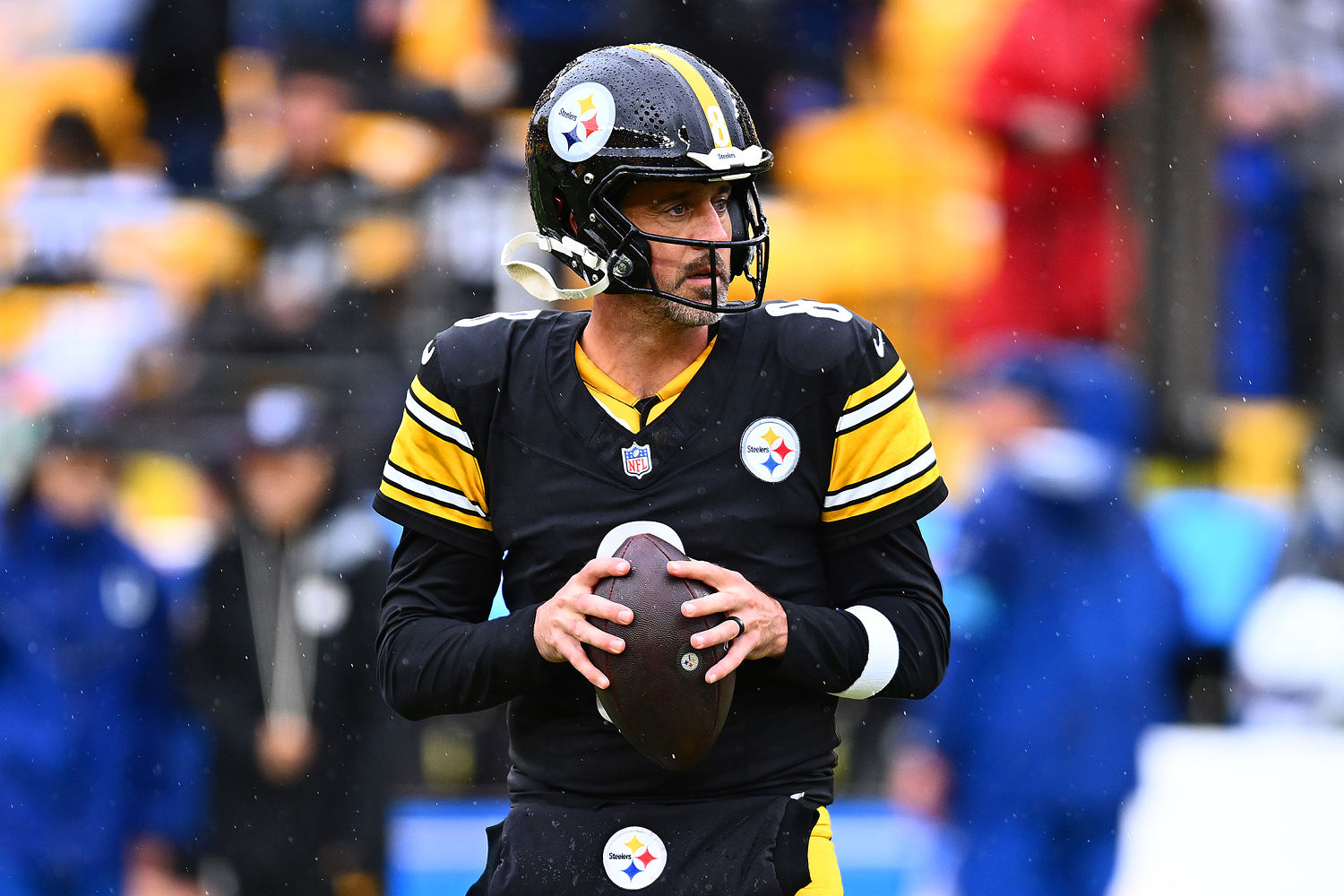
The lazy consensus machine demands parity in its narratives. Every Sunday afternoon, television producers and football analysts cram entirely distinct existential crises into neat little boxes. They pair a fading legend fighting his own biological clock with a rookie thrown into a dumpster fire, slap a hopeful headline on it, and pretend both are a bounce-back candidate away from relevance.
It is intellectual laziness packaged as optimism.
Aaron Rodgers and Drake Maye occupy opposite ends of the footballing spectrum. Grouping them together because both are facing early-season turbulence in their respective quarterback rooms ignores the physics of how NFL rosters actually win or die. One is a historical artifact managing decline behind a leaky wall of protection. The other is a high-ceiling prospect learning that the speed of professional linebackers renders college hero ball a dangerous illusion.
Treating their current trajectories as parallel errors in judgment. Let us dismantle the myth that writing off either man right now is premature. For one of them, writing them off is the only rational move left.
The Rodgers Illusion and the Cost of Nostalgia
Watch a Jets game for twenty consecutive minutes without letting the commentator’s reverence cloud your vision. What you see is not a masterclass in pre-snap manipulation masking declining physical traits. You see a quarterback who has traded the explosive rotational torque of his prime for selective aggression and an over-reliance on procedural control.
When people argue that Aaron Rodgers is just a few clean blocks away from mounting a vintage December run, they are ignoring the historical precedent of aging quarterbacks. Arm talent does not fall off a cliff overnight; it erodes in the micro-decisions. It shows up in the extra half-second hesitation before releasing the deep out. It shows up in the refusal to take cheap yards over the middle because the trust coefficient with young wide receivers sits near zero.
I have stood on sidelines and watched front offices mortgage their future draft capital because an aging superstar could still hit a garbage-time seam route in practice. It seduces you. It makes you believe that footwork anomalies and minor mechanical breakdowns can be coached away at age forty-two.
They cannot.
The offensive architecture required to protect Rodgers requires a pristine pocket and a running game that demands defensive respect. The Jets provide neither. But laying the blame entirely at the feet of the coaching staff or the offensive line lets the quarterback off the hook. Rodgers demands a system built entirely around his comfort zone, and that comfort zone no longer stretches far enough to beat elite modern defenses that disguise coverations post-snap with terrifying speed.
Counting him out is not reactionary. It is basic math. When a quarterback’s success relies on absolute perfection from ten other men just to deliver an average play, the margin for error has shrunk to zero. And zero is a number NFL teams rarely survive with.
Drake Maye and the Myth of Immediate Rescue
On the flip side of this manufactured coin sits Drake Maye. New England’s rookie signal-caller entered the league with a physical profile that scouts drool over: towering frame, a live arm capable of driving the ball through coastal gales, and enough functional athleticism to extend plays outside the structure.
Then reality hit.
The Patriots roster is a reconstruction project masquerading as a professional football team. Surrounding a rookie quarterback with a subpar supporting cast and expecting him to develop organically is like teaching someone to swim by throwing them into the open Atlantic during a squall. Some people learn. Most drown while swallowing mouthfuls of salt water.
The mistake analysts make with Maye is assuming his struggles are proof that the pre-draft evaluation was flawed. They watch him take unnecessary sacks, misread zone windows, and try to play hero ball when the play breaks down, then immediately declare him a bust or a project.
Both extremes are dead wrong.
Maye is currently suffering from a phenomenon I call developmental trauma. When a rookie quarterback realizes within the first three seconds of a dropback that his primary read is blanketed and his protection is collapsing, the survival instinct kicks in. The internal clock speeds up. Mechanics break down. Footwork turns to mush.
If you want to evaluate Drake Maye, stop looking at his completion percentage or his interception total. Look at his eyes. Watch how he handles the pocket on third-and-long when the blitz is dialed up. The flashes of elite processing are there, buried underneath layers of panic caused by a roster that has no business competing on a weekly basis.
Writing off Drake Maye right now is an act of supreme ignorance. You do not judge a foundational cornerstone by how it handles an earthquake during construction. You judge it by whether the concrete cracks under the pressure. So far, the concrete is holding, even if the building around it is sliding into the sea.
Why the Comparison Fails
The media loves pairing these two narratives because it creates a neat, binary choice about resilience. Can the old guard hold the line? Can the young gun survive the crucible?
It is a false dichotomy.
Rodgers and Maye are operating on inverse timelines. Rodgers is fighting the inevitable decay of his athletic prime while managing a franchise desperate to capture lightning in a bottle before the window slams shut permanently. Maye is fighting the institutional inertia of a rebuilding organization trying to construct an airplane while flying it through a thunderstorm.
To lump them together is to misunderstand why quarterbacks succeed in this league. Success is not a function of raw willpower or inspiring locker-room speeches. It is an intersection of scheme, protection, health, and situational leverage.
When we talk about not counting Rodgers out, we are romanticizing the ghost of a Hall of Fame career. When we talk about not panicking over Maye, we are acknowledging the brutal reality of rookie development in broken environments.
One of these situations can be salvaged with schematic adjustments and a few personnel upgrades. The other is a slow-motion car crash that no amount of veteran savvy can completely prevent.
Stop pretending they are fighting the same battle. Only one of them has a future worth investing in.


