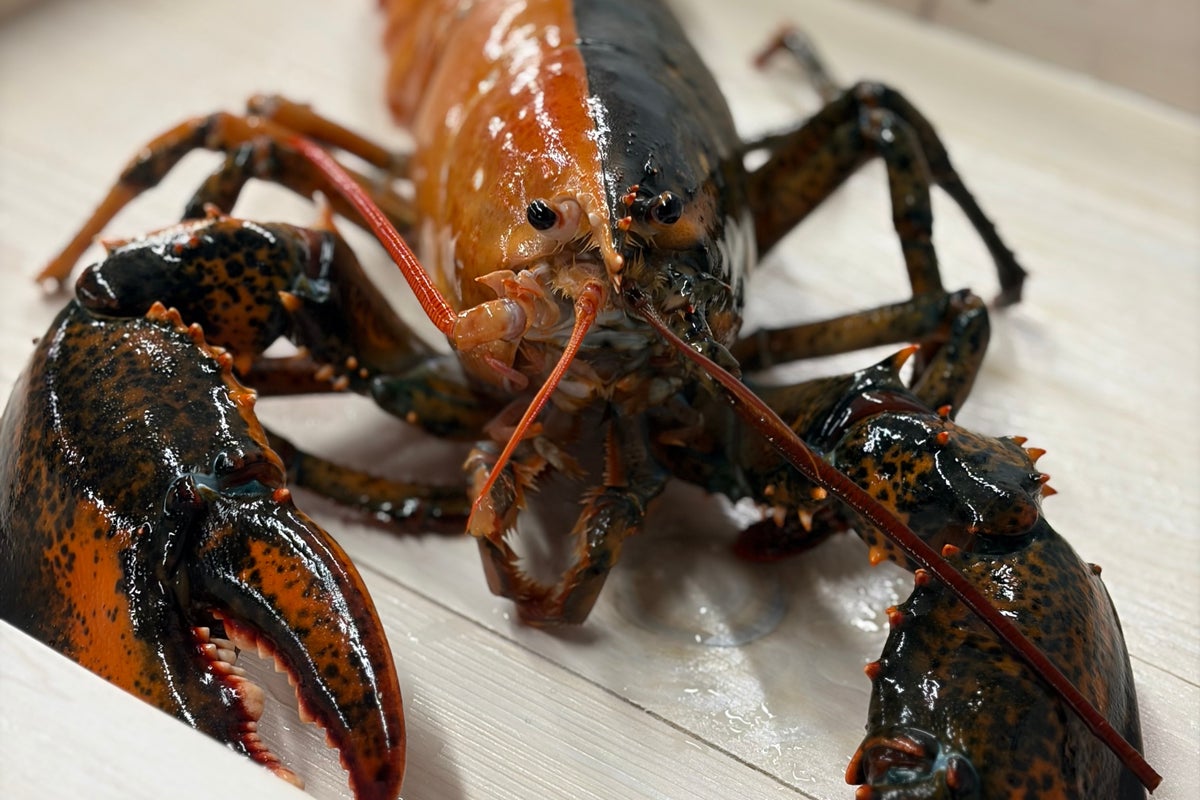
The local news cycle has a predictable, sugary heartbeat. A fisherman hauls up a "one-in-a-million" gynandromorph lobster—half-orange, half-black, split perfectly down the middle like a poorly rendered Batman villain. The headlines follow a script: the creature is "saved" from the boiling pot, dubbed a local celebrity, and relegated to a plexiglass tank where it will spend the rest of its days staring at tourists.
We call this a feel-good story. It isn't. It is an exercise in human vanity that actively ignores the brutal efficiency of marine biology. By "saving" these genetic outliers, we aren't protecting nature. We are turning a biological anomaly into a sideshow act while ignoring the actual mechanics of crustacean survival. Meanwhile, you can explore related developments here: Iraq's Prime Minister is Not a Puppet Between Two Fires He is the Match.
The Myth of the Lucky Lobster
The competitor narrative suggests that being "saved" from a dinner plate is the ultimate win for a lobster. This assumes that a life of captivity in a high-traffic aquarium is superior to the natural cycle of the Atlantic shelf. It’s a classic case of anthropomorphism. We project our fear of death onto a decapod that lacks a centralized brain, then congratulate ourselves for our "mercy."
In reality, these two-tone lobsters—often the result of a rare cellular division error early in embryonic development—are biological curiosities, not mascots. When we pull them out of the ecosystem to put them behind glass, we are removing a data point from the wild. To see the complete picture, check out the excellent analysis by The New York Times.
Genetics is Not a Beauty Pageant
The split-color phenomenon, or bilateral gynandromorphism, occurs roughly once in every 50 to 100 million lobsters. It’s a staggering statistical fluke. But here is the hard truth: nature usually culls these outliers.
Bright orange shells are a neon sign for predators. In the murky depths of the North Atlantic, being half-bright-orange is a death sentence. The "miracle" of finding a large two-tone lobster isn't just about the birth defect; it’s about the fact that it managed to survive long enough to crawl into a trap despite having a literal target painted on its back.
By placing these animals in tanks, we stop the clock on their evolutionary story. We treat their shells like art pieces rather than survival gear. If we actually cared about the species, we would be more interested in the stress levels and reproductive viability of these specimens in the wild, not how many Instagram tags they can generate for a coastal bistro.
The Aquarium Industrial Complex
Local attractions love these "saved" lobsters because they are cheap marketing. A blue lobster or a calico lobster is a localized "Mona Lisa" that eats herring and doesn't require a licensing fee.
I’ve seen dozens of these exhibits. They are almost always the same: a cramped tank, subpar filtration, and a plaque that simplifies complex genetics into a "cool fact." We tell children that the lobster is "special" because it looks different. We are teaching them that an animal's value is directly tied to its aesthetic novelty.
If a standard, mud-colored lobster is destined for the pot, but a "pretty" one gets a lifelong stay in an aquarium, what are we actually celebrating? We aren't celebrating life; we are celebrating a freak show.
The Math of Marine Survival
Let’s look at the numbers. The American lobster (Homarus americanus) is a powerhouse of the North Atlantic economy.
- Fertility: A single female can carry up to 100,000 eggs.
- Survival Rate: In the wild, only about $0.1%$ of those eggs survive past the larval stage.
- The Pot: Millions are harvested annually.
When a fisherman "spares" a split-colored lobster, he is making a choice based on optics. It is a drop of water in an ocean of industrial-scale harvesting. The sentimentality of saving one lobster while shipping ten thousand others to seafood wholesalers in the same afternoon is a cognitive dissonance we refuse to address.
The Evolutionary Dead End
Some argue that keeping these lobsters alive allows for scientific study. This is a half-truth at best. Most of these "saved" lobsters end up in touch-tanks or small local displays, not research facilities.
If we wanted to understand gynandromorphism, we would be tracking their movements, their diet, and their interactions with the standard population. Instead, we isolate them. We take a creature built for the crushing pressures and freezing temperatures of the ocean floor and put it in 60-degree filtered tap water so people can tap on the glass.
Stop Petting Your Dinner
The obsession with "saving" the colorful ones reveals a deep-seated discomfort with our role as apex predators. We want to enjoy our lobster rolls while feeling like we have a "connection" to the species because we spared the one that looked like a harlequin.
True conservation isn't about the individual; it's about the habitat. If you want to save lobsters, stop worrying about the one-in-a-million genetic fluke. Worry about ocean acidification. Worry about the warming of the Gulf of Maine. Worry about the ghost gear—abandoned traps—that continues to kill indiscriminately at the bottom of the sea.
Saving a two-tone lobster is a performative gesture. It’s the "thoughts and prayers" of the marine world. It costs nothing, changes nothing, and allows the public to feel a fleeting sense of moral superiority while the actual environment continues to degrade.
The Actionable Reality
Next time you see a headline about a "miracle" lobster being sent to an aquarium, recognize it for what it is: a marketing stunt wrapped in a shroud of false empathy.
If you find a rare lobster:
- Document it: Take the photos, record the GPS coordinates.
- Tag it: Give the scientists a chance to track its actual life.
- Release it: Let it face the ocean. If it gets eaten, it feeds the cycle. If it survives, it proves the strength of its own biology, not the "mercy" of a human with a net.
Nature doesn't need your protection from the dinner pot; it needs your respect for its cold, calculated indifference. Stop trying to turn the ocean into a Disney movie. The two-tone lobster isn't a star; it’s a mistake that the ocean was supposed to handle. Let it.
Don't buy the ticket to see the "miracle" lobster. Buy a ticket for a conservation group that actually protects the water the lobster lives in. Stop falling for the bait.


