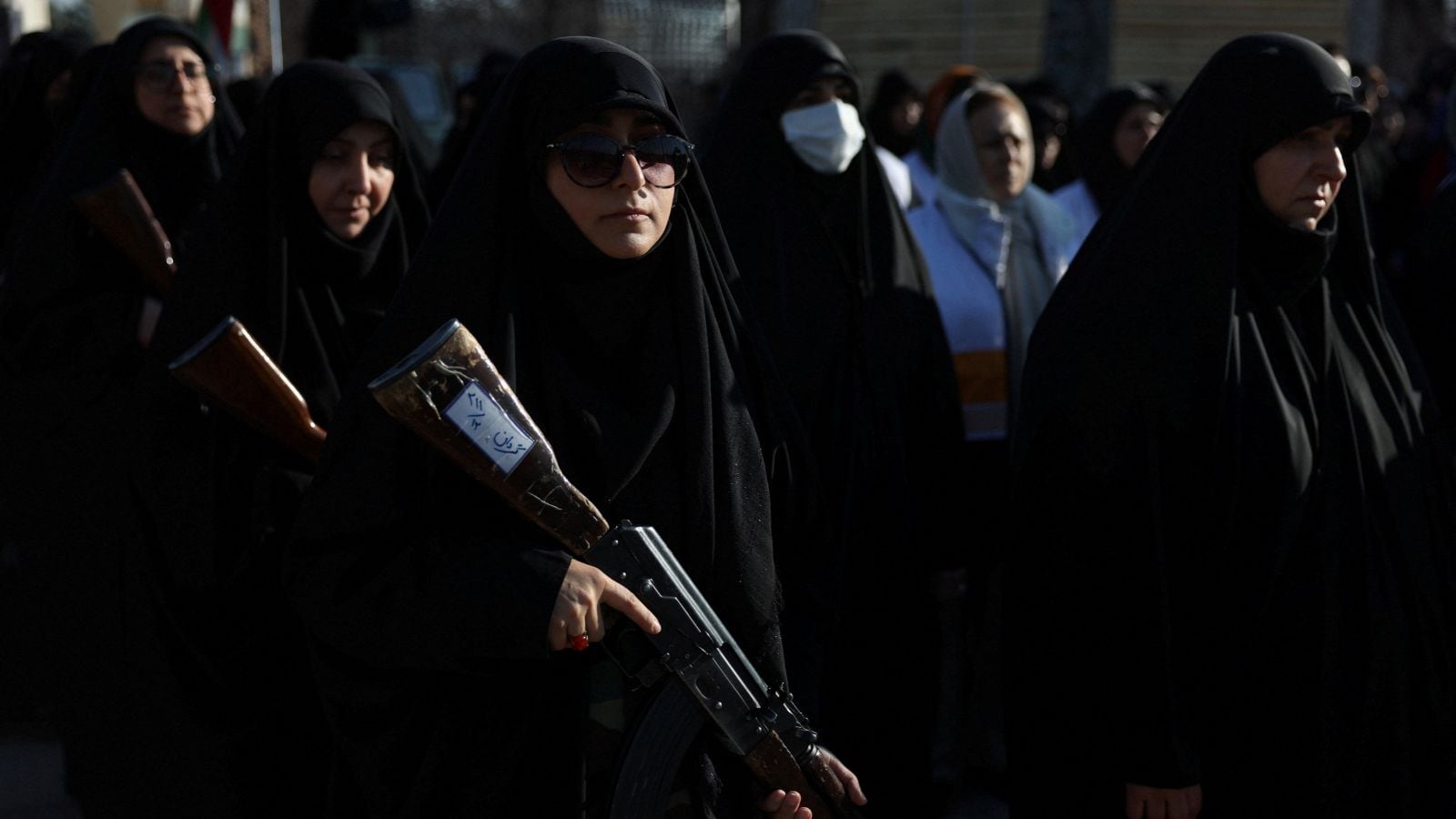
Every few months, wire services push out the exact same photo gallery. Women in full black chadors or tactical fatigues, rappelling down concrete walls in Tehran, aiming Dragunov sniper rifles, or sliding down ziplines with dramatic intensity. Western editors slap a headline on it—something about Iranian women training for combat—and watch the clicks roll in.
You are looking at a magic trick. And you are staring at the wrong hand. Don't miss our earlier coverage on this related article.
The lazy consensus in mainstream journalism treats these photo-ops as straightforward news: either a sign of desperate military mobilization ahead of a regional war, or an ironic twist on gender empowerment inside a rigid theocracy. Both interpretations miss the reality of how the Islamic Republic operates. These drills are not about building a combat-ready female infantry. They are meticulously choreographed information operations designed to manipulate domestic morale, project cheap deterrence abroad, and obscure the actual nature of state power in Iran.
If you want to understand what is actually happening on those training grounds outside Tehran, stop looking at the sniper rifles. Start looking at the cameras. If you want more about the context here, TIME provides an informative breakdown.
The Optics of Asymmetric Deterrence
I have spent over a decade analyzing state-sponsored media campaigns and irregular warfare doctrine across the Middle East. One rule holds true from Beirut to Tehran: when a military power invites international press photographers to a "tactical training exercise," the primary weapon being fired is the lens.
Real special operations units do not practice high-value maneuvers with wire service photographers standing ten feet away. Actual combat preparation is ugly, repetitive, and strictly classified. What happens at these Basij paramilitary showcases—often held at facilities like the Imam Ali garrison or during annual "Sacred Defense Week" commemorations—is theater.
Consider the tactical absurdity of the imagery itself:
- The Wardrobe: Conducting urban assault drills or ziplining in a loose, full-length black chador is a massive physical liability. In real close-quarters combat, fabric that snags on doorframes, obscures peripheral vision, and tangles in webbing gets operators killed. Yet the chador remains mandatory in these shoots because the ideological uniform matters more than tactical utility.
- The Equipment: You frequently see trainees handling legacy Soviet-era Dragunov SVDs or standard-issue Heckler & Koch G3 battle rifles—heavy, 7.62mm weapons that punish inexperienced shooters with brutal recoil. Handing a heavy designated marksman rifle to a part-time volunteer makes for a menacing silhouette, even if the shooter has fired fewer than fifty rounds all year.
- The Choreography: Ziplining and wall-rappelling look cinematic. They scream "elite commando" to a civilian audience scrolling through a news feed. In reality, basic rope descent is a foundational confidence-course exercise taught to teenagers at summer camps. It requires zero tactical acumen.
Iran’s military planners, particularly within the Islamic Revolutionary Guard Corps (IRGC), are not stupid. They know these maneuvers do not translate to battlefield lethality. They do not care. In modern hybrid warfare, the perception of total societal mobilization is a strategic asset. By broadcasting images of armed, militant women, Tehran sends a clear message to Washington, Tel Aviv, and Riyadh: Even our mothers and daughters are ready to bleed you dry in the streets.
It is deterrence on a budget. A ballistic missile costs millions of dollars to develop and test. A staged afternoon with fifty Basij volunteers, a few ziplines, and an Associated Press photographer costs practically nothing, yet generates global headlines within hours.
What the Mainstream Media Gets Wrong About the Basij
To understand why these photos exist, you have to understand the organization behind them. Most Western articles lazily refer to these women as "Iranian soldiers" or "female commandos." That is factually wrong.
The Iranian armed forces are split into two distinct pillars: the regular military (Artesh), responsible for conventional border defense, and the IRGC (Sepah), the ideological vanguard tasked with protecting the regime itself. Under the IRGC sits the Basij—the Organization for Mobilization of the Oppressed.
The Basij is not an elite fighting force. It is a massive, sprawling paramilitary network embedded into mosques, universities, factories, and neighborhoods across Iran. Membership runs into the millions on paper, though active, ideologically committed members represent a much smaller fraction.
For the majority of its female members—known as the Basij-e Khaharan (Sisters' Basij)—joining has very little to do with preparing to snipe invading paratroopers. It is a socioeconomic transaction.
In an economy strangled by decades of mismanagement, corruption, and international sanctions, Basij membership is a golden ticket. Active status unlocks concrete, life-altering perks:
- University Quotas: Reserved spots and lowered entrance exam thresholds for Iran’s fiercely competitive public universities.
- Employment Preferences: Priority hiring in state-owned enterprises, government ministries, and municipal bureaucracies.
- Financial Relief: Access to low-interest loans, subsidized housing schemes, and healthcare discounts.
- Legal Leverage: Protection and influence when dealing with local courts, police, or administrative red tape.
Imagine a scenario where a twenty-year-old woman from a working-class family in southern Tehran wants to study engineering, but her family cannot afford private tutoring to pass the national entrance exam. Joining the local Basij chapter, attending weekly ideological lectures, and occasionally putting on tactical gear for a weekend photo-op is a rational career move.
When Western outlets frame these women solely as fanatical warriors, they erase the mundane economic reality driving recruitment. Most of these trainees are not preparing for Stalingrad. They are trying to get a civil service job.
The Domestic Battlefield Nobody Mentions
There is a second, far more cynical reason Tehran pushes these photo essays out to the world, and it has nothing to do with foreign armies. The real target audience is inside Iran.
Over the past several years, the Islamic Republic has faced its most severe legitimacy crisis since 1979. The "Woman, Life, Freedom" movement shattered the regime's carefully curated image of unified public piety. Millions of Iranian women openly defied mandatory hijab laws, burned headscarves in the streets, and directly challenged the clerical establishment's authority over their bodies and lives.
The state’s response has been two-pronged: brutal street-level repression paired with aggressive narrative counter-programming.
When Tehran showcases women in chadors training with sniper rifles, it is executing a direct visual counter-strike against the protest movement. The state is attempting to redefine what "empowered Iranian womanhood" looks like. Instead of the rebellious university student tearing off her headscarf, the state offers the pious, armed defender of the revolution.
Even more critically, look at the actual operational role of the female Basij during moments of domestic crisis. When protests erupt in Tehran, Isfahan, or Mashhad, the regime faces a tactical dilemma: male riot police physically beating or arresting female demonstrators creates explosive, viral imagery that fuels further outrage.
Enter the female Basij.
Their primary operational value to the regime is not fighting foreign militaries on a distant border; it is policing other Iranian women on city streets. Female Basij units are deployed to enforce morality laws, surveil university campuses, infiltrate protest networks, and physically detain female dissidents without triggering the optics of male-on-female state violence.
Those zipline and sniper drills serve a psychological purpose for these domestic enforcers. They build in-group cohesion, foster a sense of elite martial identity, and convince low-level informants and morality enforcers that they are soldiers fighting an existential war—even when their actual job is harassing teenagers over loose headscarves in a shopping mall.
Dismantling the "Gender Equality in Combat" Myth
Whenever these photos circulate on social media, a predictable debate breaks out in the comments. One side mocks the absurdity of fighting in a chador; the other side argues—sometimes seriously—that Iran is surprisingly progressive for integrating women into combat roles long before some Western nations did.
Both takes fail basic historical and institutional literacy.
First, Iran does not deploy women in frontline conventional combat roles. Under the constitution and military regulations of the Islamic Republic, mandatory military conscription applies exclusively to men at age eighteen. Women are barred from serving as frontline infantry, armor crewmen, or fighter pilots in the regular Artesh or the IRGC’s ground, aerospace, and naval forces.
Second, the ideological framework of the Islamic Republic explicitly rejects Western concepts of gender equality in favor of "gender complementarity." As articulated by the regime’s founder, Ayatollah Ruhollah Khomeini, and continuously reinforced by Supreme Leader Ali Khamenei, women are viewed primarily as mothers and moral anchors of the Islamic family.
During the brutal eight-year Iran-Iraq War (1980–1988), tens of thousands of Iranian women mobilized to support the war effort. They worked as combat nurses, logistics coordinators, intelligence analysts, and ammunition factory workers. A small number took up arms in the chaotic early days of the Iraqi invasion during the defense of Khorramshahr. Yet once the frontlines stabilized, the clerical leadership systematically moved women out of direct combat roles and back into support, medical, and ideological functions.
Today, women in the IRGC and police forces (FARAJA) are strictly segregated into administrative, medical, intelligence, and female-policing units. Putting a Dragunov rifle in a woman's hands for a forty-five-minute press event does not change the rigid patriarchal structure of the Iranian military command. Not a single woman sits on the Supreme National Security Council, commands an IRGC provincial corps, or holds operational authority over regular combat brigades.
Treating a staged photo gallery as evidence of female martial empowerment is like mistaking a theme park stunt show for an actual military deployment.
The Nuance Critics Miss: Why You Shouldn't Dismiss Them Entirely
Now, here is where the armchair analysts get burned. Once people realize these drills are heavily staged propaganda, the pendulum swings too far in the other direction. Critics write off the female Basij as completely harmless clowns playing dress-up.
That is a dangerous mistake.
While these women are not storming fortified beaches, dismissing them entirely ignores how modern asymmetric regimes survive. Authoritarian states rarely fall because they lack elite commando units; they fall when their internal security apparatus fractures and refuses to suppress domestic unrest.
The female Basij are a critical pillar of the Islamic Republic’s survival architecture for three reasons:
- Social Penetration: Because they operate inside schools, clinics, charity organizations, and residential blocks, female Basij members provide the state with granular, neighborhood-level human intelligence that electronic surveillance cannot match.
- Ideological Reproduction: Through state-funded religious schools and youth camps, these cadres actively socialize the next generation of loyalists, ensuring the regime maintains a dedicated core constituency even as broader public support erodes.
- Logistical Depth: In the event of an actual large-scale military conflict—such as a direct war with the United States or Israel—Iran’s survival doctrine relies on protracted, decentralized resistance. The Basij network is designed to manage civil defense, medical triage, supply distribution, and rear-area security, freeing up regular IRGC units to fight.
So yes, the sniper rifles and ziplines are theater. The tactical skills on display in those wire photos are largely superficial. But the organizational machinery behind the cameras is very real, deeply entrenched, and ruthlessly effective at keeping the clerical establishment in power.
How to Actually Read State-Sponsored Military Media
The next time a major news outlet publishes a breathless photo essay showing militant women rappelling down buildings in Tehran, do not take the bait. You are not looking at breaking military intelligence. You are looking at an unedited press release disguised as photojournalism.
If you want to extract actual truth from state-curated military imagery—whether it comes from Iran, Russia, North Korea, or anywhere else—apply a basic intelligence filter before drawing conclusions:
- Check the Access: Ask who took the photos. In Iran, foreign photojournalists do not stumble across Basij training grounds. Every frame is cleared by the IRGC’s public relations apparatus and the Ministry of Culture and Islamic Guidance. If you are seeing it, Tehran wants you to see it.
- Look at the Weapons, Not the Faces: Propaganda shoots almost always feature visually dramatic, heavy, or outdated hardware (like sniper rifles, RPGs, or heavy machine guns) because they photograph well. Real force modernization shows up in boring things: encrypted radios, night-vision optics, modern body armor, and logistics trucks. Notice how rarely those appear in public Basij galleries.
- Track the Timing: State media blitzes never happen in a vacuum. Cross-reference the date of the photo shoot with domestic events in Iran. Did the rial just hit a record low? Was there a major labor strike in Khuzestan? Did the morality police just trigger another street protest? Staged martial strength is almost always an antidote to domestic vulnerability.
- Separate Capability from Intent: A photo of a woman holding a rifle proves intent to project strength. It proves zero capability to execute complex military operations. Never confuse a regime's desire to look terrifying with its actual ability to fight.
Mainstream news outlets love these stories because they require zero investigative effort. Wire services supply the high-resolution images, editors write a punchy caption about "female snipers in Tehran," and readers click out of curiosity or fear. Everyone wins—especially the Iranian propaganda ministry, which just got free global distribution for a domestic recruitment ad.
Stop mistaking a photo shoot for a battle plan. Look past the ziplines, ignore the staged sniper poses, and see the exercise for what it actually is: a regime desperately trying to convince the world—and itself—that it still commands the streets of Tehran.


