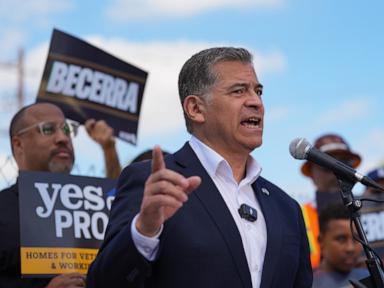
The political press wants you to believe that the sole televised debate between Democratic nominee Xavier Becerra and Republican nominee Steve Hilton was a high-stakes clash of civilizations. According to reporting from the Associated Press, the two contenders spent the night trading blows over Donald Trump, immigration, and California’s sprawling homelessness crisis just as mail-in ballots prepared to hit voters' mailboxes.
It is an easy story to write. Two men walk onto a stage, recite focus-grouped attack lines, and reporters dutifully transcribe the fireworks as if the exchange will meaningfully alter the trajectory of the fourth-largest economy in the world.
They missed the point entirely.
The real story of that debate—and the broader race to succeed outgoing Governor Gavin Newsom—isn't the friction between Becerra and Hilton. It is the quiet, bipartisan agreement to keep voters distracted with national culture-war proxies while avoiding the structural math breaking California’s governance. Both candidates played their assigned roles in a predictable script, leaving the actual mechanics of state failure completely untouched.
The Lazy Consensus of Campaign Coverage
Mainstream coverage frames a California gubernatorial debate around two predictable axes: how closely the Republican is tied to Donald Trump, and how aggressively the Democrat defends the state’s recent record. In their late September face-off, as documented by the Associated Press and The Guardian, Becerra repeatedly sought to tether Hilton to the president, declaring at one point, "You can hear Donald Trump" in his opponent's answers. Hilton, a former Fox News host, countered by attacking California’s billions in unreturned homelessness spending as an "absolute scandal" that shames the state, while accusing Democrats of treating the election outcome as a foregone conclusion.
Standard political journalism treats these exchanges as substantive policy collisions. They aren't. They are brand-management exercises.
For a Democrat running statewide in California—where a Republican has not won a statewide race since 2006—invoking Donald Trump is the ultimate political comfort food. It nationalizes a local race, flattens complex state-level grievances into a binary referendum on a polarizing national figure, and excuses the incumbent party from explaining why basic state infrastructure remains dysfunctional.
For a Republican, hammering the sheer dollar volume spent on homelessness is equally low-effort. Pointing at tent encampments and citing multi-billion-dollar budget figures requires zero policy architecture. It captures voter disgust without forcing the challenger to explain how a governor actually overrides local zoning boards, judicial injunctions, and municipal bureaucracies.
Why Both Candidates Dodged the Real Homelessness Math
Homelessness was billed as a centerpiece of the debate, yet both candidates treated it like a management problem rather than a legal and economic deadlock.
During the broadcast, Becerra promised that under his administration, "We will make sure the encampments are cleared". Hilton called the current state of affairs a disgrace and pitched a dramatic overhaul of state spending. Neither statement survives five minutes of contact with how California government actually operates.
The Governor Is Not a City Mayor
A California governor does not possess a magic wand to sweep sidewalks in Los Angeles, San Francisco, or Oakland. Encampment enforcement sits primarily with municipal police departments, county public health agencies, and local mayors—many of whom answer to progressive city councils that actively resist aggressive clearing operations.
When a gubernatorial candidate promises to "clear encampments," they are either proposing an unprecedented deployment of the California Highway Patrol across thousands of municipal blocks, or they are using rhetorical shorthand for conditioning state grant money on local compliance. The former is logistically impossible; the latter has already been tried by the Newsom administration with mixed, painfully slow results.
The Supply Bottleneck Nobody Wants to Own
Even if you arrest or cite every person sleeping on a sidewalk tomorrow, state and federal court rulings—alongside basic physical reality—require somewhere for those people to go. California's homelessness crisis is downstream of a decades-long housing deficit driven by:
- Municipal zoning monopolies that reserve the vast majority of residential land for single-family detached homes.
- Environmental litigation bottlenecks under the California Environmental Quality Act (CEQA), which allow local opponents to stall infill housing and shelter construction for years.
- Prevailing wage and regulatory mandates that routinely push the per-unit cost of subsidized supportive housing past $600,000 to $800,000 in coastal metros.
Becerra, a veteran of Washington and Sacramento institutions—having served as California Attorney General and U.S. Health and Human Services Secretary—pitched experience, arguing that "there aren't training wheels in the governor's office". Yet institutional fluency is precisely what binds a politician to the labor unions, environmental groups, and local political machines that defend those exact cost-drivers.
Hilton, meanwhile, ran on an outsider disruption pitch, criticizing high taxes and regulatory overreach. Yet dismantling California’s housing bottlenecks requires forcing high-density development into wealthy, suburban, often conservative-leaning neighborhoods that fiercely guard local control. Republicans in California have historically championed "local control" against Sacramento housing mandates—a stance that directly contradicts any serious plan to rapidly scale shelter and low-cost housing supply.
The Trump Distraction Is a Two-Way Crutch
Political analysts love counting how many times Donald Trump’s name comes up in a blue-state debate. In this matchup, Trump served as a convenient escape hatch for both men.
When pressed on immigration and the treatment of migrant children, Becerra pivoted straight to his federal record versus the Trump administration, stating, "Trump left a system for care of these immigrant kids that had been dismantled because he doesn't want them here. We changed all that. I am proud of the record". Hilton accused Becerra of hiding behind federal talking points while ignoring the fiscal strain on state services.
Notice what happened in that exchange. A debate meant to vet the next chief executive of California immediately morphed into a retrospective on federal border policy.
- For Becerra, keeping the spotlight on Trump nationalizes the ballot, reminding California’s overwhelming Democratic voter registration base why they dislike the national GOP.
- For Hilton, even distancing himself from Trump's claims about California election fraud—Hilton explicitly stated on stage, "I've got confidence in what we saw in the primary and in this process"—still meant spending precious airtime reacting to Washington narratives rather than defining a California-specific economic alternative.
I have watched political consultants burn tens of millions of dollars on this exact playbook across multiple election cycles. Campaigns default to nationalized anger because it is cheap to produce and polls well in focus groups. Voters nod along when their preferred candidate attacks the national villain. Then, six months after the inauguration, those same voters wonder why their electric bills are still climbing, why their insurance premiums just doubled, and why the encampment down the street hasn't budged.
What Voters Should Actually Ask Before Casting a Ballot
If you look at the standard "People Also Ask" questions surrounding the California governor's race, they almost all miss the lever of power that actually matters:
- "Who won the California governor debate?" Wrong question. In a state where party registration heavily favors one side, a single September debate rarely flips enough votes to alter the math. Ask instead which candidate committed to specific, measurable veto threats against the state legislature.
- "How will the next governor fix homelessness?" They won't "fix" it in a four-year term. The real question is whether the next governor is willing to strip state transportation and infrastructure funding from cities that refuse to permit emergency shelters and high-density housing.
- "Does a Republican have any chance in California?" Only when the Democratic coalition fractures over cost-of-living failures—and even then, institutional gravity is immense. The more consequential battle in California politics isn't Democrat versus Republican; it is the pragmatic, growth-oriented wing of the Democratic Party versus its regulatory, activist wing.
The Uncomfortable Truth About The Insider vs. Outsider Choice
To be fair to both candidates, governing California is an exercise in managing permanent structural friction. There is an undeniable downside to both philosophies presented on that debate stage.
If you buy Becerra’s argument—that deep governmental experience and steady institutional stewardship are required to navigate complex state budgets and federal conflicts—you accept incrementalism. You get a governor who knows where the levers are, who will vigorously litigate against a hostile federal administration, and who will protect core social safety nets. The cost is that the underlying regulatory apparatus, tax structure, and agency inertia remain largely intact.
If you buy Hilton’s outsider pitch—blowing up the Sacramento consensus, slashing regulations, and auditing every dollar of state spending—you get disruption. You force uncomfortable audits on agencies that have operated without accountability for decades. The cost is immediate institutional gridlock. A Republican governor without a cooperative legislature governs almost exclusively by veto pen, leading to years of budget standoffs and executive-branch warfare while urgent infrastructure projects stall.
Neither path is painless. Both carry severe trade-offs that neither candidate had any incentive to admit under studio lights.
How to Read the Race Without Getting Played
If you want to evaluate any California statewide candidate—whether in this cycle or the next—ignore the debate highlights entirely. Strip away the applause lines and apply three cold tests to their platform:
- Follow the Veto Power: California’s governor holds one of the strongest line-item budget vetoes in the country. If a candidate cannot name three specific state programs or spending allocations they will zero out on Day One, they are not serious about fiscal reform.
- Test Their Willingness to Alienate Allies: For a Democrat, ask which public-sector union demand or environmental restriction they will reject to lower housing and energy costs. For a Republican, ask which suburban zoning protection they will override to build housing. If they refuse to cross their own coalition, nothing changes.
- Separate State Jurisdiction from Federal Theater: Any candidate spending more than ten percent of their debate time talking about Washington politicians is auditioning for cable news, not applying to run Sacramento.
Debate coverage thrives on conflict because conflict sells clicks. Governance, however, happens in budget spreadsheets, regulatory agencies, and land-use statutes. Stop grading candidates on how well they land a punch on television, and start demanding to know which sacred cows they are actually willing to slaughter once the cameras turn off.