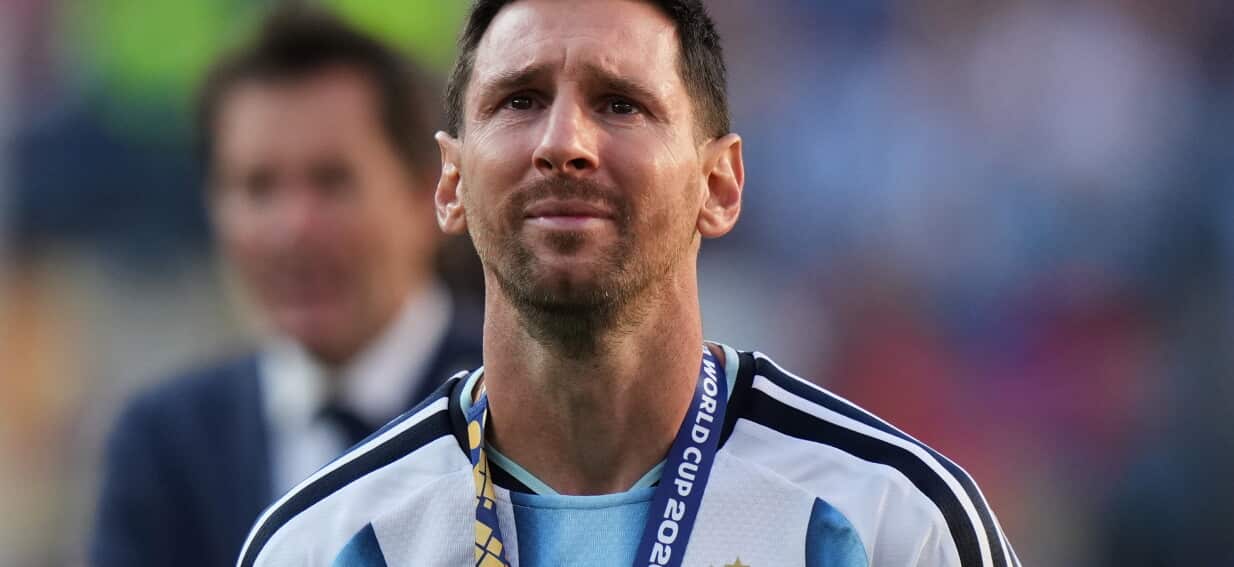
The collective sports media wept when Lionel Messi tossed his international career into the trash can following another penalty shootout collapse. Editorial boards across the globe scrambled to publish eulogies, framing his premature exit from the Albiceleste as a tragic Shakespearian flaw. They called it heartbreak. They called it a mental fracture. They called it proof that even gods bleed.
They are entirely, breathtakingly wrong.
I have spent two decades watching elite athletes crack under national pressure, and what happened on that pitch wasn't a tragedy. It was a masterclass in leverage. Messi did not quit because he was broken; he quit because carrying a dysfunctional football federation on his back for fifteen years was a terrible return on investment.
The Lazy Consensus of International Martyrdom
The narrative pushed by every mainstream outlet follows a predictable script. Player loves country, player fails to win trophy, player breaks down in tears, public demands his return. It is emotional manipulation disguised as journalism.
The lazy consensus assumes that playing for your national team is an absolute moral imperative. It assumes that a player owes an unpaid, politically corrupt association their physical health, mental wellbeing, and commercial rights.
Let us look at the data. Before his temporary retirement stunt, Messi’s workload management at Barcelona was meticulously engineered to preserve his explosiveness. Yet, every summer, he was dragged across continents to play meaningless friendlies and grueling Copa América tournaments on cow-pasture pitches, all to satisfy the ego of a football association that treated him like a cash cow while throwing him under the bus whenever they lost.
When a player reaches the absolute summit of individual achievement, continuing to play in a toxic ecosystem isn't loyalty. It's masochism.
The Power of Walking Away
In elite contract negotiations, the ultimate power belongs to the person who is most willing to walk away. Messi exercised that power.
Look at how the Argentine Football Association panicked. Within weeks, politicians, fans, and former players were begging him to return, offering him unprecedented control over team selections, coaching appointments, and training schedules. By throwing his hands up and quitting, Messi converted a helpless hostage situation into total institutional capture. He got everything he wanted by simply refusing to play the game on their terms.
We romanticize suffering in sports. We want our heroes to bleed for our entertainment while we sit on our couches eating junk food. But true professionals understand opportunity cost. Every minute Messi spent playing behind a dysfunctional midfield for a country that booed him was a minute he wasn't maximizing his twilight years at club level, where the operation actually functioned.
Dismantling the Competitor Narrative
Competitor pieces love to ask: "Can Messi ever forgive himself for letting his country down?"
Let's dismantle that premise entirely. It's a loaded, manipulative question designed to shame an individual for prioritizing his own peace of mind. Messi did not let his country down; his country’s systemic institutional failure let him down for over a decade. When you surround a generational genius with incompetent coaching staffs and administrative chaos, the failure belongs to the system, not the solitary output unit.
Furthermore, the argument that international trophies define a career is a journalist's crutch. It's a metric invented to fill column inches during international breaks. Club football is the truest test of skill because it requires daily tactical cohesion over a ten-month sample size. International football is a short-format tournament heavily dictated by variance, referee decisions, and luck. Judging a career based on seven-game knockout samples is statistical illiteracy.
The Uncomfortable Reality of Leverage
My contrarian take comes with a caveat. This approach only works if you are irreplaceable.
If a standard squad player walks away in a huff, the federation replaces them within twenty-four hours and forgets their name. Messi had absolute leverage because he was the entire economic engine of the sport in his home country. When you are the product, the distribution network, and the revenue generator combined into a single human being, you set the rules.
He proved that boundaries matter more than blind patriotism. He proved that no amount of national pride justifies staying in a toxic workplace.
The next time an athlete walks away from the flag, stop writing tear-jerking obituaries about broken dreams. Look closer. They are rewriting the power dynamic in real-time.
He didn't break. He negotiated.