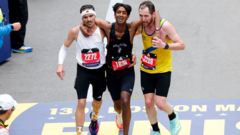
The feel-good story is a lie.
You’ve seen the footage. It’s a staple of every Boston Marathon highlight reel. A runner’s legs turn to jelly three hundred yards from the Boylston Street finish. Their eyes roll back. They collapse. Suddenly, two or three "Good Samaritans" scoop them up, hook their arms under the victim's armpits, and drag them across the timing mat. The crowd roars. The internet weeps. The headlines scream about the "triumph of the human spirit."
It isn't a triumph. It’s a medical emergency masked by a PR stunt.
By dragging a physically decimated runner across the line, these helpers aren't just violating the core ethos of endurance sports; they are actively endangering a human life and devaluing the very achievement they claim to honor. We need to stop applauding the spectacle and start calling it what it is: ego-driven interference that has no place in a serious race.
The Physiological Cost of a Stolen Finish
The marathon is a $42.195$ kilometer exercise in biological limits. When a runner collapses, it isn't "fatigue." It’s systemic failure.
When the body hits the floor, it’s usually due to Exercise-Associated Collapse (EAC). This happens because the "calf muscle pump," which helps return blood from the legs to the heart while running, suddenly stops. Blood pools in the lower extremities. Blood pressure plummets. The brain gets sidelined.
In more severe cases, you're looking at exertional heatstroke or hyponatremia. These aren't conditions cured by a hug and a 20-foot drag. By hoisting an unconscious or semi-conscious runner upright and forcing them to "finish," you are preventing them from getting the immediate, horizontal medical attention they need. You are literally keeping blood away from their brain so you can get a viral video of your "kindness."
Every second spent posing for the cameras while propping up a failing body is a second stolen from the medical tent. In a race like Boston, where the humidity and intensity can push internal temperatures north of $40^\circ\text{C}$, that delay can be the difference between a quick recovery and permanent organ damage.
The Rulebook Exists for a Reason
Let’s talk about Rule 144 of the World Athletics Competition Rules. It’s explicit: "Any athlete giving or receiving assistance from within the competition area during an event shall be disqualified."
The marathon is a test of individual grit. It is a closed-loop system of preparation, pacing, and execution. If your body fails before the mat, you didn't finish the race. That sounds harsh because it is. Sport is supposed to be harsh.
When we allow runners to be carried across the line, we turn the Boston Marathon into a participation-trophy parade. If the distance doesn't matter unless you cover it under your own power, then why are we celebrating people who are essentially luggage for the final quarter-mile?
Imagine a scenario where a powerlifter passes out under a 500-pound squat, and two spectators jump on the platform to help them lock it out. Would we call that "inspiring"? No. We’d call it a failed lift and a safety hazard. Running should be held to the same standard.
The Ego of the Helper
We need to address the "hero" in this equation.
The people who stop to help often claim they did it out of instinct. I’ve spent twenty years in the endurance world—coaching, racing, and watching the mechanics of the finish line—and I see a different pattern. The helper gets a dopamine hit. They get the "likes." They get the interview on the local news.
But what about the runner being dragged?
Most elite or even high-level amateur runners I know would be mortified to find out they didn't actually finish on their own. They didn't earn that medal; it was gifted to them by a stranger who decided their own narrative of "helpfulness" was more important than the integrity of the runner’s race.
If you truly care about the person on the ground, you don't pick them up. You wave down a medic. You clear a path. You stay with them until professional help arrives. You don't force them to perform a macabre dance toward a finish line their body has already rejected.
The Logic of "DNF"
There is no shame in a Did Not Finish.
A DNF is a data point. It tells you that your training was insufficient, your hydration was off, or your pacing was arrogant. It is the most honest result in sports. By papering over that reality with a forced finish, we rob the athlete of the lesson.
We’ve become so obsessed with the "experience" of the marathon that we’ve forgotten the "competition" of it. The "People Also Ask" sections of Google are filled with queries like, "Can I still get my medal if someone helps me?" The answer should be a resounding no.
If you can't cross the line under your own power, you have failed the test. That failure is necessary. It’s what makes the successful finishes mean something. When you treat the finish line as an entitlement rather than a milestone, the entire sport loses its teeth.
A Better Way to Help
If we want to actually support the running community, we have to change the culture around the finish line.
- Prioritize Triage Over Theater: If a runner goes down, the goal is stabilization, not transportation.
- Enforce Disqualification: Race directors need to be brave enough to DQ anyone who receives physical assistance. Yes, even the guy in the "inspiring" video.
- Celebrate the DNF: We should respect the runner who knows when they are beaten and chooses to live to fight another day, rather than the one who risks it all for a piece of cheap alloy.
The next time you see a runner buckling on the asphalt, don't reach for their arm. Reach for a radio. Stop turning medical emergencies into "human interest" stories. Let the race be the race. If they can’t make it, they can’t make it.
The finish line isn't a right. It’s a privilege earned by those who can actually get there.
Step aside and let the medics do their job. Stop being a hero and start being a rational adult. The integrity of the sport depends on our willingness to let people fail.