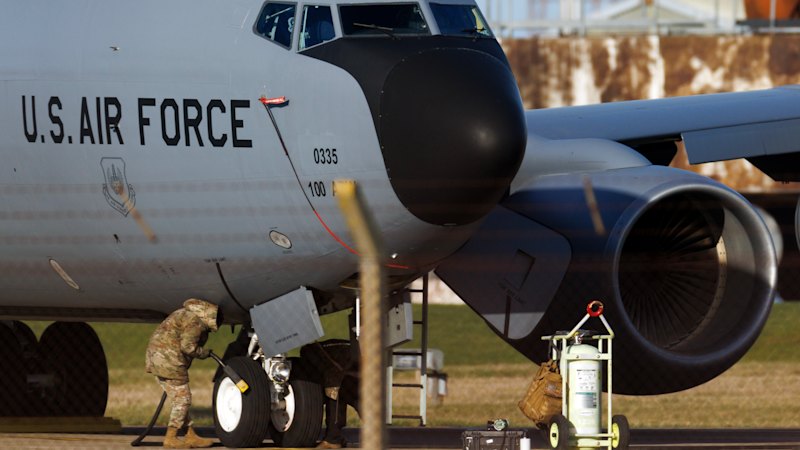
Mainstream defense reporters love panic porn. When American heavy bombers, tankers, or tactical fighters lift off from a British airbase during a spike in Middle Eastern tensions, the headlines write themselves. Journalists slap the word "evacuated" across the front page, pair it with a stock photo of a B-52 or an F-15, and frame the movement as a frantic retreat in the face of an unstoppable Iranian missile threat.
They are completely wrong.
Calling a routine, pre-planned force dispersal an "evacuation" is not just sloppy journalism. It betrays a fundamental ignorance of modern air combat doctrine, missile ranges, and how the United States Air Force actually fights a high-end war. The media wants you to believe the Pentagon is running scared from Tehran. In reality, the Pentagon is executing a cold, calculated chessboard maneuver designed to strip an adversary of its targeting data while putting American strike assets into launch positions.
If you want to understand what is actually happening when US aircraft clear out of Royal Air Force bases in the United Kingdom, you have to stop reading press releases through the lens of civilian panic and start looking at the math of modern warfare.
The Anatomy of a Media Mirage
Let us look at the lazy consensus dominating the news cycle. A report surfaces indicating that US Air Force assets—often KC-135 Stratotankers, RC-135 reconnaissance planes, or transient strike packages—have departed a British installation like RAF Mildenhall, RAF Lakenheath, or RAF Fairford. Within hours, pundits connect the dots to regional friction with Iran. The narrative solidifies: Iran threatened retaliation, and the US military fled its own bases to avoid getting blown up on the tarmac.
This narrative relies on a civilian misunderstanding of what an airbase is for. Civilians view a military base like an apartment building. You live there, you keep your stuff there, and you only leave in the middle of the night if the building is on fire.
Military planners view an airbase as a concrete gas station and munitions warehouse. An aircraft sitting on a ramp in Suffolk or Gloucestershire is a multi-million-dollar liability. It generates zero combat power while parked. Worse, commercial satellite imagery—available to anyone with a credit card from companies like Maxar or Planet Labs—tracks those parked aircraft in near real-time.
When open-source intelligence accounts on social media spot a dozen tankers departing a UK runway simultaneously, they scream "evacuation." Defense beat writers, starving for clicks, copy-paste the panic. They fail to check basic geography, they ignore ballistic missile physics, and they completely miss the operational doctrine governing the flight.
The Geography and Physics of the Threat
Let us test the competitor article's core premise against basic reality. Could Iran actually strike a British airbase?
Look at a map. The distance from western Iran to the United Kingdom is roughly 4,000 kilometers, or about 2,500 miles.
Iran possesses the largest and most diverse ballistic missile arsenal in the Middle East. Systems like the Shahab-3, Sejjil, and Khorramshahr are dangerous regional weapons. Their maximum operational ranges cap out around 2,000 to 2,500 kilometers. They can hit Israel. They can hit Saudi Arabia. They can hit US bases in Iraq, Qatar, and Bahrain. They can even reach parts of southeastern Europe, like Greece or Bulgaria.
They cannot reach England. Not even close.
To threaten a British airbase from Iranian soil, Tehran would need an operational Intercontinental Ballistic Missile (ICBM) or a heavy intermediate-range missile capable of clearing 4,000 kilometers with a conventional warhead accurate enough to hit a runway or a hardened aircraft shelter. Iran does not possess an operational ICBM. Even if you factor in space-launch vehicles like the Simorgh or Qased—which intelligence agencies like the US Defense Intelligence Agency monitor closely as potential testbeds—converting a liquid-fueled space rocket into a reliable, accurate, survivable weapon system capable of hitting a specific tarmac in Britain is a leap Iran has not made.
What about drones? The Shahed-136 has a range of roughly 2,000 kilometers. Launching a slow-moving, propeller-driven drone from Iran toward the UK means flying it across multiple sovereign nations, over NATO's integrated air defense network, across the entire European continent, and over the English Channel. It would be shot down hours before it ever saw the White Cliffs of Dover.
What about proxy attacks or covert sabotage? That is a real, persistent security concern. The UK's domestic intelligence service, MI5, has repeatedly warned about Iranian state-backed plots on British soil. Smuggling a quadcopter near a fence line or staging a sabotage cell is a genuine threat. However, you do not fly an entire wing of strategic tankers or bombers out of the country to stop a guy with a commercial drone at the perimeter fence. You deploy counter-UAS systems, tighten base security, and let local law enforcement sweep the surrounding woods.
If the physical threat to a British runway from an Iranian missile strike is near zero, why did the planes leave?
Agile Combat Employment Is Not Retreat
I have spent years watching defense contractors and military planners build budgets around fortress bases, only to realize that concentrated assets are dead assets. The Pentagon learned this lesson the hard way by watching how precision-guided munitions changed warfare in Ukraine and the Middle East.
The doctrine driving these movements is called Agile Combat Employment, or ACE.
The core principle of ACE is simple: predictability equals death. During the Cold War and the Global War on Terror, the US Air Force operated out of massive, centralized hubs. Think Al Udeid Air Base in Qatar, Bagram in Afghanistan, or RAF Mildenhall in the UK. You stacked dozens of aircraft wingtip-to-wingtip on massive concrete ramps, built sprawling logistics cities around them, and operated on predictable schedules.
That model is obsolete. Today, every major adversary has access to commercial satellite constellations, cyber espionage, and long-range precision weapons. If you leave high-value assets parked in one predictable location during a crisis, you give the enemy a static target list.
Under Agile Combat Employment, the Air Force intentionally breaks up large concentrations of aircraft and scatters them across a network of smaller, austere, or secondary airfields—often referred to as "spoke" locations—while maintaining command from a central "hub."
When aircraft depart a major British base during a geopolitical spike, they are executing a dispersal, not an evacuation. There is a massive difference between the two:
- An evacuation is reactive, chaotic, and defensive. You run away to save your equipment because you cannot defend your position, abandoning your mission in the process.
- A dispersal is proactive, scripted, and offensive. You move your assets to complicate the enemy's targeting calculus, shorten your own logistics tail, and position your aircraft closer to the actual theater of operations.
Think about the mechanics of aerial refueling. A KC-135 Stratotanker sitting in England is thousands of miles away from the Persian Gulf or the Eastern Mediterranean. If the US military anticipates a surge in strike operations, reconnaissance flights, or carrier air wing support in the Middle East, those tankers cannot stay in Britain. They have to forward-deploy to bases in Spain, Italy, Greece, Cyprus, or the Gulf states.
To a clueless observer watching flight-tracking websites like ADS-B Exchange, seeing ten tankers lift off from Mildenhall looks like a mass exodus. To an air operations planner, it looks like building an "air bridge" to fuel a combat deployment.
The Hidden Reality of Forward Positioning
Let us pull back the curtain on how the Air Force actually signals deterrence.
In military strategy, visibility is a weapon. Sometimes you hide your movements to achieve tactical surprise. Other times, you deliberately leave your transponders turned on so every amateur plane-spotter on the internet sees your aircraft leaving base.
Why would the Pentagon want the world to see US aircraft clearing out of a British base?
Because an empty ramp is a threat. When an adversary's intelligence analysts look at satellite photos of a US airbase and see the planes are gone, they suddenly have a massive intelligence problem. Where did they go? Are they already airborne? Did they stage forward to Souda Bay in Crete? Are they sitting on a dispersal strip in Jordan? Are bombers currently orbiting out of radar range waiting for a strike order?
By dispersing aircraft from rear-area staging bases in the UK, the US military forces Iranian military planners to burn intelligence resources trying to re-acquire the targets. It induces paralysis. If you do not know where the tankers and bombers are, you cannot predict when or from what direction an attack might come.
Furthermore, aircraft stationed in the UK are often there on rotational deployments—such as Bomber Task Force missions—precisely because Britain serves as a secure rear-area sanctuary. You fly B-1Bs or B-52s into RAF Fairford, integrate with NATO allies, check the maintenance logs, and then, when the balloon goes up, you push them forward or disperse them to secondary fields. Calling the departure of a rotational force an "evacuation" is like claiming a football team "evacuated" the locker room because they ran onto the field for kickoff.
Answering the Questions Nobody Bothered to Ask
When panic-inducing headlines hit the news feeds, readers inevitably search for basic answers. The problem is that the questions themselves are usually poisoned by the false premise of the reporting. Let us dismantle the most common misconceptions surrounding these movements.
Are US bases in the UK actually vulnerable to Iranian attacks?
No, not to conventional military strikes from Iran. As established by basic ballistic physics, Britain sits well outside the operational envelope of Iran's missile and drone inventory. The only credible threats to US installations in the UK are localized: espionage, cyberattacks targeting base infrastructure, or covert sabotage by state-sponsored proxies. Moving aircraft does nothing to stop a cyberattack or a local spy ring; those threats are handled by counterintelligence and network defense, not by flying jets away.
Why does the US keep so many aircraft in Britain if they just move them during a crisis?
Britain is an unsinkable aircraft carrier parked off the coast of Europe, sitting squarely on the great-circle air routes connecting North America to Europe, Africa, and the Middle East. It offers unmatched maintenance facilities, deep munitions storage, secure political stability, and seamless integration with the Royal Air Force. It is a staging and logistics hub, not a frontline bunker. Moving aircraft out of the UK during a crisis is the entire point of keeping them there in peacetime—it is a springboard, not a vault.
Does moving aircraft signal that a war with Iran is imminent?
Not necessarily. Military readiness operates on thresholds. When tensions rise, commanders execute "force posture adjustments" to buy decision space for political leaders. If the President decides to order a strike, the military cannot wait three days to fuel the tankers and load the munitions; those pieces have to be pre-positioned. Conversely, moving those pieces publicly often serves as a coercive deterrent designed to make Tehran back down without a single shot being fired.
The Honest Downsides of Constant Dispersal
To be completely transparent, the Pentagon's obsession with Agile Combat Employment and rapid dispersal is not without severe friction. Industry insiders know that while the doctrine looks brilliant on a briefing slide, executing it in the real world grinds down men and machines.
First, dispersal destroys maintenance efficiency. Modern fifth-generation fighters like the F-35 and aging heavy airframes like the KC-135 are maintenance hogs. At a main operating base in the UK, crews have climate-controlled hangars, heavy diagnostic equipment, and deep inventories of spare parts. When you scatter those jets to austere secondary airfields with a skeleton crew and a single pallet of parts, mission-capable rates plummet. Things break, and without a massive supply chain behind them, jets get stuck on the ground.
Second, it exhausts aircrews and maintainers. Constant short-notice movements create chronic operational fatigue. You cannot keep flight crews on hair-trigger dispersal alerts indefinitely without burning out your most experienced pilots and mechanics.
Third, it burns through massive amounts of money. Flying heavy aircraft across continents, standing up pop-up logistics hubs, and paying for emergency fuel contracts drains readiness budgets fast. Every dollar spent shuffling planes around Europe to posture against a regional threat is a dollar stripped away from long-term modernization or training for a peer conflict in the Indo-Pacific.
These are real, valid criticisms of US Air Force posture. Notice, however, that none of them involve cowardice or running away from Iranian missiles.
How to Read Military Movements Like an Insider
Next time a breathless headline claims American forces are "evacuating" a European base due to a Middle Eastern threat, ignore the adjective and look at the data.
- Check the airframe type. Are they moving non-combatants and administrative staff, or are they moving tankers, airborne command posts, and strike fighters? Moving families out of an embassy is an evacuation. Moving tankers and bombers out of a rear base is a combat deployment.
- Look at the direction of travel. An evacuation moves away from the danger zone toward deeper sanctuary. If aircraft leave Britain and fly south or east toward the Mediterranean, they are closing the distance to the threat, not running from it.
- Watch the logistics tail. Look for heavy cargo planes—C-17 Globemasters and C-5 Galaxies—moving alongside the fighters. If the cargo haulers are moving spare parts, munitions, and ground support equipment to secondary airfields, you are watching an offensive staging operation in real time.
Journalists will keep using the word "evacuation" because fear sells ads and nuance kills engagement. They want you to picture panicked pilots scrambling into cockpits to outrun incoming fire.
The truth is far colder. When US warplanes clear off a British tarmac during a crisis, they are not hiding from the fight. They are clearing the runway so the real war machine can go to work.