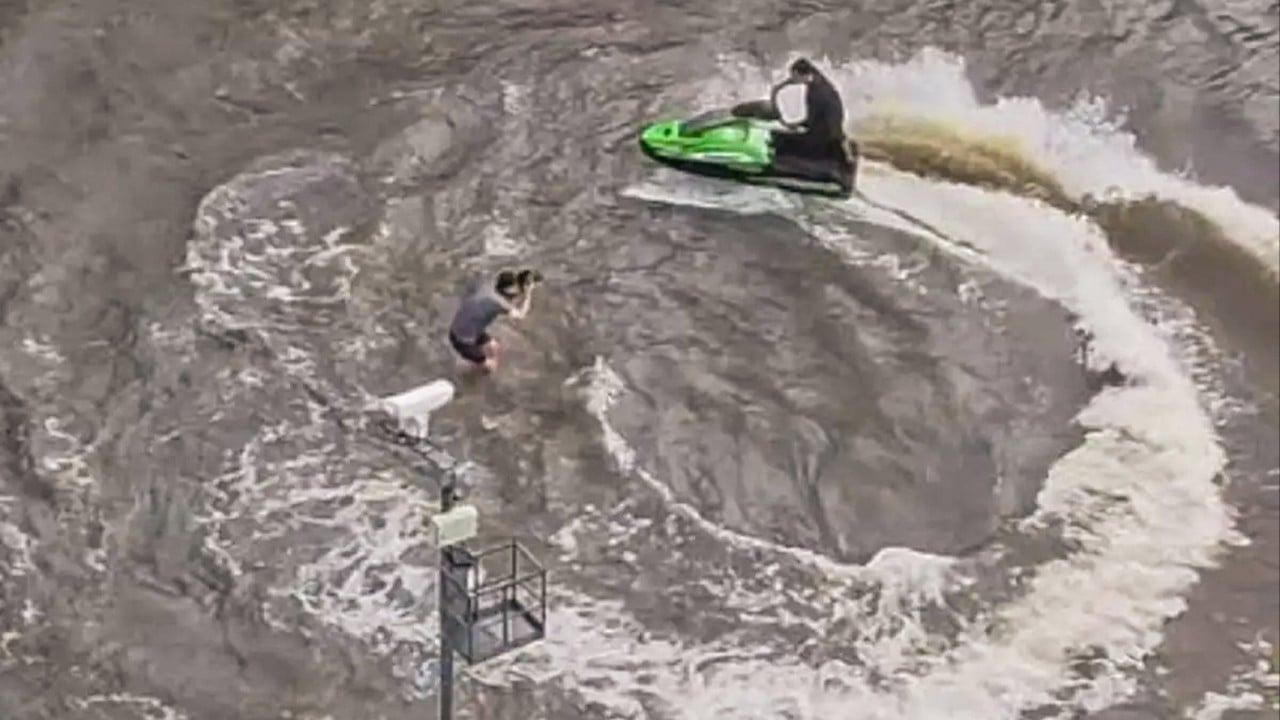
Another tropical downpour turns Bangkok thoroughfares into muddy canals, and the internet finds its favorite villain. Social media clips show a local riding a jet ski through high-water streets, and outrage follows instantly. The narrative writes itself. Headlines scream about inequality, tone-deaf privilege, and how the poor suffer while thrill-seekers treat municipal disaster as a personal water park. It is a neat, emotionally satisfying morality play. It is also entirely missing the point.
Focusing moral fury on a watercraft during an inundation ignores the structural engineering failures that created the crisis in the first place. When an entire metropolis sits on a sinking delta, built over natural floodplains with a drainage network choked by decades of unmitigated asphalt expansion, a jet ski rider is not the systemic threat. They are a symptom of a much larger, structural failure of governance.
I have spent years analyzing urban hydrology and municipal infrastructure across Southeast Asia, and I am tired of seeing systemic governmental incompetence masked as cultural outrage. Let us dismantle the lazy consensus.
The Geography of Neglect
Bangkok is sinking. That is not a metaphor or a dramatic exaggeration; it is a geological reality driven by excessive groundwater extraction and the sheer weight of high-rise construction on soft clay soils. When sea levels rise and monsoon rains dump months of precipitation in hours, water goes where gravity dictates.
Yet, public discourse routinely reduces a multi-billion-dollar hydrological catastrophe to a matter of personal etiquette. We debate whether a guy on a personal watercraft is being insensitive to street vendors whose stalls are underwater, while municipal leaders quietly ignore decades of delayed drainage upgrades and neglected pumping stations.
The inequality argument deployed by mainstream commentators is correct in its observation but entirely bankrupt in its target. The poor do indeed bear the brunt of urban flooding. But blaming a thrill-seeker for that disparity is like blaming a spectator for a stadium collapse. The water does not care about your social standing; it cares about topography, permeable surface area, and discharge capacity.
When you pave over every square inch of natural wetland to build concrete condominiums and shopping malls, you eliminate nature's sponge. Every square meter of concrete added without adequate subterranean retention basins is a policy choice that guarantees misery for low-lying neighborhoods. The jet ski rider is merely exploiting the physical manifestation of municipal failure.
The Myth of Egalitarian Weather
There is a comforting fiction that natural disasters are great equalizers. They are not. Wealth buys elevation, back-up generators, private drainage pumps, and the luxury of working from a high-rise condominium while the city below stagnates.
When a deluge strikes, low-income communities in districts situated in natural retention basins take the direct hit. Their homes lack raised foundations, their electrical systems are dangerously low to the ground, and their livelihoods depend on street-level commerce that grinds to a complete halt.
But redirecting our collective rage toward viral video protagonists lets the urban planners, real estate developers, and municipal authorities off the hook. Every time a viral clip of an urban water sports stunt dominates the news cycle, the real culprits behind Bangkok's water management crisis breathe a sigh of relief. The public is arguing about optics while the underlying infrastructure rots.
Consider the data on canal dredging and pumping efficiency. For years, engineers have pointed out that Bangkok's network of canals, known locally as khlongs, has been systematically narrowed and blocked by unauthorized construction and debris accumulation. The city's drainage capacity is a fraction of what it needs to be to handle modern rainfall volumes driven by shifting climate patterns.
When those canals overflow, the water backs up into the streets. No amount of social shaming of watercraft enthusiasts will clear a blocked drainage tunnel or force a corrupt municipal contractor to install high-capacity pumps that actually work.
Dismantling the Outrage Machine
We live in an era optimized for performative indignation. A viral video drops, commentators project their preferred sociopolitical grievances onto it, and millions share it without pausing to examine the underlying mechanics.
The outrage over the jet ski incident relies on a flawed premise: that public suffering during a flood is caused by individual callousness rather than systemic governmental neglect. If we accept this premise, the solution is simple, superficial, and entirely useless. We demand better manners from citizens, harsher penalties for stunt riders, and polite behavior during a crisis.
If we reject this premise, the real work begins. We have to look at zoning laws that allow rampant construction in known flood paths. We have to audit municipal spending on flood mitigation projects to find out why billions in budget allocations vanish into administrative black holes while neighborhoods submerge every rainy season. We have to confront the reality that urban planning in developing megacities is routinely sacrificed for short-term commercial gain.
A person riding a watercraft down a flooded street is annoying, sure. They might even be creating minor wakes that lap against flooded doorsteps. But treating them as the primary antagonist in an urban tragedy is an intellectual cop-out.
What Real Resilience Looks Like
If Bangkok and other vulnerable delta cities want to survive the coming decades of climate disruption, they have to abandon aesthetic fixes and face hard engineering truths.
First, stop treating floods as temporary anomalies. They are the new baseline. Urban design must incorporate aggressive water retention architecture, including underground storm retention tanks, mandatory permeable paving requirements for new developments, and the restoration of natural wetlands that act as buffers.
Second, decouple infrastructure funding from political cycles. Drainage projects take decades and require consistent maintenance, which makes them unattractive to politicians looking for ribbon-cutting ceremonies before the next election. Until long-term water security is treated as a non-negotiable security priority, cities will continue to sink, literally and figuratively.
Finally, stop falling for the outrage bait. The next time a dramatic video emerges of someone treating a flooded thoroughfare like a recreation area, recognize it for what it is: a sideshow designed to distract you from the institutional failures happening just off-camera.
The water is rising because the concrete is choking the earth, the pumps are failing, and the leadership looked the other way. Stop worrying about who is riding the waves, and start asking who engineered the disaster.