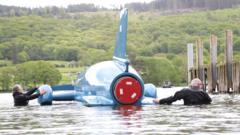
The Silence on the Lake
The water of Coniston is a gray slate Mirror. On mornings when the wind holds its breath, the lake looks so solid you feel as though you could walk across it. For decades, people came to this corner of the English Lake District to watch men try to fly across that mirror on cushions of air and internal combustion. They came for the roar.
Now, there is only the silence. And the creeping rot of frustration. You might also find this related story interesting: The Microeconomics of Extreme Altitude: Industrializing the Everest Ascent Mechanics.
To understand why a stalled engineering project in Cumbria matters, you have to understand the specific weight of history in this valley. This is not just about a boat. It is about Bluebird K7, the jet-powered hydroplane in which Donald Campbell chased the water speed record, and in which he died on a freezing January morning in 1967. For over half a century, the story of Campbell and Bluebird was a tragedy frozen in time. Then, a team of dedicated volunteers dug the shattered wreckage out of the lake bed, spent years rebuilding it to operational glory, and promised the world that the legend would run again.
Instead, the project has run aground on the dry, bureaucratic flats of human friction. As extensively documented in recent articles by Sky Sports, the effects are worth noting.
The machine sits silent. The public feels cheated. The volunteers are exhausted. What was supposed to be a triumphant return to the water has devolved into an abandonment that leaves everyone involved nursing a quiet, bitter resentment.
The Weight of the Artifact
Consider what it takes to bring a ghost back to life.
When the Bluebird Project, led by engineer Bill Smith, salvaged the remains of K7 from the bottom of Coniston Water in 2001, they did not just find twisted aluminum and a Bristol Siddeley Orpheus engine. They unearthed a secular shrine. Campbell’s death was a national moment of grief, an end of an era of British daredevils who risked everything for a few miles per hour more.
The restoration was a triumph of obsessive, unpaid human labor. For years, the team breathed life back into the metal. They sourced parts, rebuilt the structure, and eventually took the craft to the Isle of Bute in 2018, where Bluebird skimmed across Loch Fad at speeds exceeding 150 miles per hour. It worked. The dream was real.
The plan seemed simple: bring Bluebird home to Coniston, run her on the water where she belongs so the public can see and hear her, and then house her permanently in the Ruskin Museum.
But humans are complicated creatures. Ownership is a slippery concept when emotion is involved. A fracture developed between the restorers and the museum trustees. Who truly owned the soul of the boat? The family who gifted the wreckage? The museum built to hold it? Or the volunteers who spent two decades bleeding over its rivets?
The legal battle that followed was long and draining. Eventually, the physical vessel was delivered to the Ruskin Museum in March 2024. Thousands lined the streets to watch the blue hull pass by. There were tears. There was a profound sense of relief. The wandering artifact had returned.
Yet, the victory was hollow. The engine stayed behind.
The Engine Room and the Ego
A hydroplane without an engine is just a very expensive sculpture.
To see Bluebird sitting static in a museum wing is to see a caged predator. The true magic of the machine lies in its kinetic energy, the deafening scream of the jet engine echoing off the surrounding fells. The museum wants the boat to run. The public demands it. The local economy, built heavily on the pilgrimage of speed enthusiasts, desperately needs the influx of visitors that a live run provides.
The problem is that the expertise required to run a 1960s jet hydroplane safely does not exist in a standard museum handbook. It lives in the heads of the people who rebuilt it.
Imagine standing in a workshop, surrounded by specialized tools you designed yourself, looking at an empty space where a historic machine used to sit. The volunteers feel pushed out, replaced by institutional management. Conversely, the museum trustees face the immense pressure of safeguarding a priceless national treasure while answering to a public that wants to see it push the limits of physics on the water.
The result is a classic, agonizing stalemate. The relationship between the key players has broken down so completely that constructive dialogue has ceased. The museum has the hull; the restoration team holds the operational know-how and critical components.
Because two sides cannot find common ground, the entire enterprise has stalled. The runs have been abandoned. The project is parked.
The Cost of the Stagnation
This is where the abstract argument over ownership hits the reality of the local community.
For the shopkeepers, the B&B owners, and the publicans of Coniston, Bluebird is not just history. It is livelihood. A live running event on the lake brings thousands of people who buy pints, rent rooms, and keep the local economy alive. When the runs were called off, a collective sigh of disappointment went through the valley.
"Everybody is frustrated," says a local lodge owner who prefers not to be named, his voice carrying the weariness of someone who has watched this drama play out for years. "We were promised a living legend. We got a display piece. It feels like a betrayal of the effort that went into getting her back here."
The frustration is compounded by the ticking of the clock. Mechanical artifacts do not age well in static environments. Seals dry out. Metals corrode silently. The specialized knowledge required to operate the Orpheus engine is held by a dwindling number of people. Every month that passes in silence is a month where the collective memory of how to make Bluebird fly fades just a little bit more.
It is easy to blame bureaucracy. It is easy to point fingers at stubborn individuals. But the real tragedy is that both sides genuinely believe they are protecting Campbell’s legacy. One side believes protection means keeping the machine safe and accessible under a roof; the other believes legacy is dead unless the machine is doing what it was built to do.
They are both right. And that is why the deadlock is so hard to break.
The Human Horizon
Walk into the Ruskin Museum today, and you will see Bluebird K7 gleaming under the lights. She looks magnificent. The blue paint is flawless, reflecting the structural perfection of a bygone era of engineering.
But look closely at the visitors standing before the exhibit. They are quiet. They are not whispering about the triumphs of the past; they are talking about the tragedy of the present. They ask when the engine will return. They ask when the boat will taste the water again. The staff can only offer polite, practiced evasions.
The story of Bluebird was always a human story. It was about Donald Campbell’s restless ambition, his superstition, his courage, and his ultimate sacrifice. The modern chapter of the story should have been about redemption—about a community and a team of brilliant eccelsiastics coming together to honor that sacrifice by keeping the flame alive.
Instead, the narrative has been hijacked by the mundane realities of human stubbornness.
The lake remains calm. The fells look down on the water just as they did sixty years ago. Somewhere in a storage facility, an engine sits cold. In a museum, a hull sits empty. Until the people involved can remember that Bluebird belongs to history rather than to their own grievances, the silence on Coniston Water will remain unbroken. And that is the biggest frustration of all.