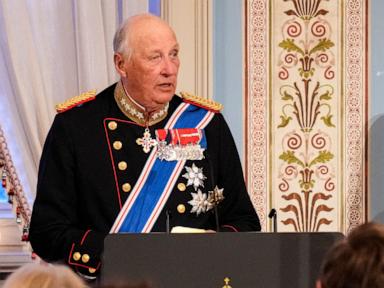
The death of an absolute or constitutional monarch triggers a complex institutional transition that extends far beyond ceremonial mourning. When King Harald V of Norway passed away at age eighty-nine after a thirty-five-year reign, the state machinery executed a pre-planned operational sequence designed to maintain constitutional continuity. Analyzing this event requires stripping away the media gloss of royalty and dignitaries to examine the underlying mechanics: the immediate transfer of executive authority, the logistics of state funerals, and the socio-political stabilization of a Nordic constitutional monarchy.
Constitutional continuity relies on instantaneous structural succession. The moment biological life ceases, executive transfer occurs without a fractional second of institutional vacancy. Under Norwegian state law, King Haakon VIII assumed the throne immediately upon his predecessor's death, formalizing his position through a sworn oath before the Storting, the national parliament. This mechanism prevents power vacuums that historically plague non-hereditary political offices. The operational speed of this transition serves a singular purpose: maintaining the stability of state functions while the nation enters an official mourning phase.
State funerals for constitutional heads of state operate as high-stakes diplomatic nodes. The centralization of international leaders, European royals, and global figures in Oslo for the service at Oslo Cathedral functions as an exercise in soft power. Security apparatuses coordinate multi-agency protection frameworks, managing foreign heads of state alongside public mourners who line the processional route from the Royal Palace to Akershus Fortress. The event acts as an international barometer of diplomatic relations, where geopolitical alignment is signaled through attendance rosters and bilateral interactions behind closed palace doors.
Public mourning logistics require the synchronization of municipal infrastructure and crowd management. The transition from private grief to public ritual follows a strict protocol: lying-in-state periods within the Royal Palace Chapel, timed processions along Karl Johans gate, a national minute of silence, and coordinated bell-tolling. These variables are optimized to absorb massive civilian throughput while mitigating security risks. Cities hosting state obsequies must balance public access with strict perimeter control, transforming urban centers into temporary stages for collective civic theater.
The economic and institutional cost function of a royal transition involves weighing public expenditure against long-term brand equity for the state. Constitutional monarchies derive their utility from perceived neutrality and historical continuity. King Harald V maintained high domestic approval ratings through an informal, egalitarian governance style—exemplified by his public accessibility and rejection of abdication. The succession of King Haakon VIII tests whether the institution can retain this relational capital under a new demographic and political baseline.
Future stability assessments for the Norwegian crown depend on the new monarch's ability to navigate changing societal expectations without modernizing the office into irrelevance. State planners must continuously calibrate public ceremonies to reflect contemporary democratic values while preserving ancient constitutional traditions. Monitor the initial legislative approval ratings and public engagement metrics of King Haakon VIII over the next twelve months to quantify the success of this institutional handoff.