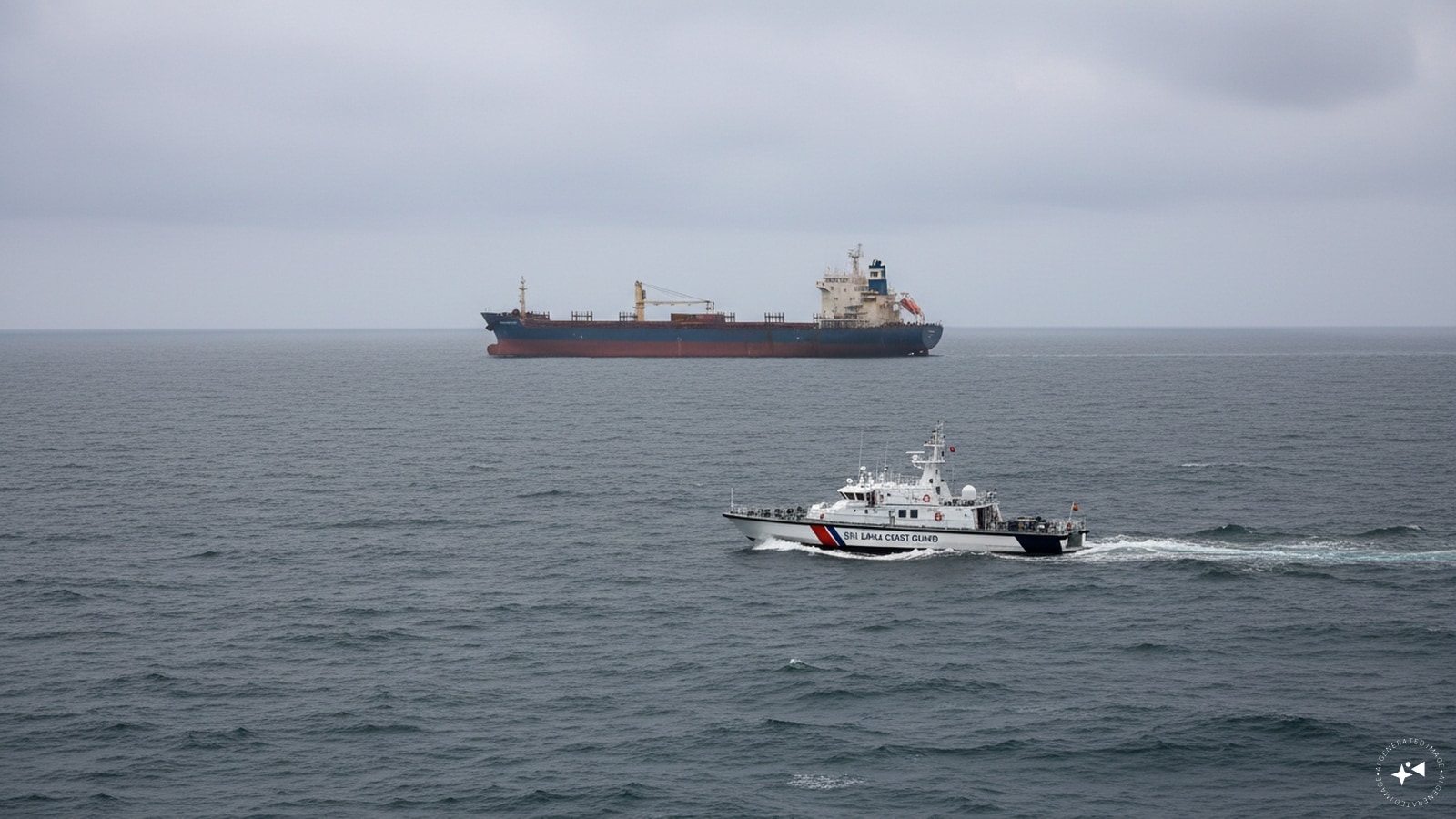
Colombo just took a beating in the court of international opinion. Headlines howled that Sri Lanka turned a cold shoulder to Iranian vessels drifting near its maritime boundaries, running on fumes and empty pantries. The humanitarian lobby lost its collective mind. Commentators shrieked about maritime law, moral duty, and the ancient code of the sea.
They are missing the entire point because they refuse to look past the velvet curtains of diplomatic theater.
Sri Lanka’s refusal to bail out stranded military or commercial assets isn't a heartless snub. It is a masterclass in sovereign self-preservation executed by an island nation that cannot afford to be caught in the crosshairs of a widening regional conflagration. When your own treasury is duct-taped together and your fuel queues are a recent national trauma, charity is not an option. It is a luxury good. And Colombo is fresh out of cash.
The Myth of Universal Maritime Hospitality
The lazy consensus in every major newsroom is simple: if a ship is out of food and fuel, you feed it. That rule stems from a romanticized era of wooden hulls, sextants, and isolated vessels battling the elements. It completely collapses in modern maritime geopolitics.
Today’s oceans are hyper-instrumented battlegrounds. A ship flying a flag under heavy sanctions, or operating within a disputed theater, is not just a floating village of hungry sailors. It is a moving geopolitical landmine.
When international sanctions dictate who can trade, fuel, and dock, maritime hospitality hits a hard legal wall. If Colombo provides fuel, provisions, or logistics support to ships tied to sanctioned state apparatuses, it does not earn diplomatic brownie points. It earns secondary sanctions from Western financial clearers. That means blocked SWIFT transfers, strangled supply chains, and immediate economic suffocation for 22 million citizens on the island.
Expecting a fragile economy to absorb that kind of blow for the sake of abstract maritime brotherhood is economic suicide disguised as empathy.
Sovereignty Means Saying No to Everyone
Let us address the core hypocrisy of the outcry. When powerful nations project force across international waters, smaller strategic hubs like Sri Lanka are treated like gas stations on the highway. You pull in, demand service, and expect the local proprietor to swallow the geopolitical risk while you drive off.
Sri Lanka’s strategic location in the Indian Ocean makes it a permanent target for courting, bullying, and entrapment by competing superpowers. India watches the northern approaches like a hawk. Western intelligence monitors every container movement through the Hambantota and Colombo ports. Beijing holds significant infrastructure stakes.
In that environment, neutrality is an active, aggressive stance. It requires the courage to slam doors in the faces of powerful actors.
When officials in Colombo look at drifting Iranian vessels, they do not see a routine rescue operation. They see a trap. If they assist, they alienate critical Western trade partners and alarm New Delhi. If they aggressively interdict, they invite asymmetric retaliation. By maintaining a strict, legally bounded distance—offering only standard, emergency maritime rescue if human life is actively perishing, while denying commercial or logistical resupply—Sri Lanka thread the needle.
They chose inaction. In international relations, inaction is often the only winning move.
The Economic Reality Check
Let us look at the numbers nobody wants to publish alongside the tear-jerking editorials.
Sri Lanka’s post-crisis recovery is a delicate house of cards. The International Monetary Fund program requires rigid fiscal discipline, transparent revenue collection, and absolute predictability in international trade compliance. A single misstep regarding sanctions enforcement can trigger compliance reviews that freeze disbursements.
Imagine a scenario where a port authority decides to play good Samaritan, loads up a few thousand tons of subsidized diesel and provisions onto barges, and services a stranded foreign asset. Within forty-eight hours, compliance officers in New York and London flag the transaction. Correspondent banking relationships freeze. Container vessels bypass Colombo entirely, heading straight for Singapore or Indian ports.
How many days of food security does that humanitarian gesture cost the domestic population? Exactly zero days of gain, and weeks of absolute misery.
Governments exist to protect their own populace first. Everything else is secondary PR. The armchair critics sitting in comfortable capitals thousands of miles away do not have to answer to local fishermen whose fuel prices double because of international banking restrictions.
The Uncomfortable Truth About Global Supply Lines
The incident exposes a brutal reality of the twenty-first-century maritime grid: the oceans are no longer a global commons governed by chivalry. They are privatized, policed, and heavily policed corridors where every calorie and every barrel of bunker oil carries a paper trail of liability.
When a ship gets caught between sanctions regimes and mechanical failure, it is experiencing the natural friction of a fractured global order. Expecting small nations to act as shock absorbers for great power friction is arrogant.
Colombo’s silence and bureaucratic foot-dragging are defensive armor. They signal to every major player in the Indian Ocean that the island is no longer an easy pit stop for proxy maneuvers.
Stop reading this situation through the lens of a maritime adventure novel. Look at it through the ledger of risk management. Sri Lanka protected its balance sheet, kept its compliance record clean, and avoided becoming a pawn in someone else's naval standoff.
That is not heartless. That is survival.