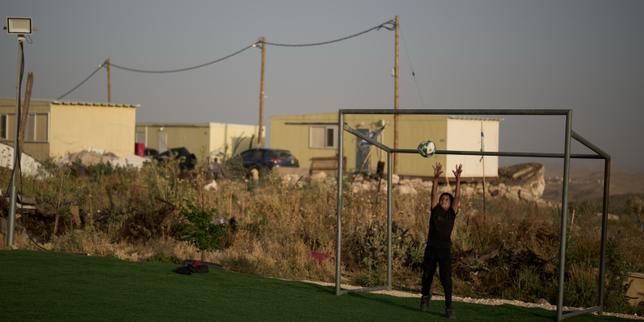
International journalism loves a beautifully tragic sports story. You have seen the template a thousand times. A camera crew films young athletes playing on a dusty, improvised pitch surrounded by concrete walls, checkpoints, and military infrastructure. The narrative is always the same: against all odds, football serves as a beacon of hope, a universal language, and a form of peaceful resistance.
It is a comforting, lazy consensus. It is also entirely wrong.
Western media outlets routinely filter the reality of West Bank football through a lens of romanticized sentimentality. They treat the sport as a therapeutic escape or a soft diplomacy tool. By doing so, they completely miss the structural mechanics of how football actually operates in a conflict zone. Football in the West Bank is not an escape from geopolitics. It is a highly bureaucratized, intensely politicized extension of the conflict itself.
Stop looking at the sport as a heartwarming metaphor for survival. If you want to understand what is actually happening on the ground, you need to look at the cold reality of institutional leverage, FIFA bylaws, and national identity infrastructure.
The Illusion of the Pitch as a Neutral Sanctuary
The foundational flaw of standard reporting on West Bank sports is the belief that the pitch exists outside of the surrounding political architecture. Journalists write about "football under the barbed wire" as if the game offers a temporary truce with reality.
It does not. Every single element of organizing a football match in the West Bank is governed by the same restrictive administrative regime that controls daily civilian life.
Consider the logistics of a standard fixture in the West Bank Premier League. A match between Shabab Al-Khalil (Hebron) and Markaz Balata (Nablus) is not just a sporting event; it is a complex logistical operation requiring permits, security clearances, and coordinated travel through a network of internal checkpoints.
- Player Mobility: Teams routinely face situations where key players cannot cross specific checkpoints due to sudden closures or delayed permit approvals.
- Infrastructure Arbitrage: Stadium development depends heavily on land zoning. Building a regulation pitch in Area C—which makes up about 60% of the West Bank—is virtually impossible due to strict administrative oversight.
- Foreign Interventions: International teams or scouts trying to enter the territory face strict border controls managed entirely by external authorities, not the Palestinian Football Association (PFA).
When a match is delayed or canceled because a defender is stuck at a transit point, the game has not transcended the conflict. The conflict has dictated the lineup. To frame this as a story of "triumph of the human spirit" is to ignore the actual mechanics of administrative control. It treats a structural systemic barrier as a mere dramatic hurdle for a feel-good sports documentary.
FIFA Article 72 and the Corporate Battlefield
While casual observers focus on the emotional storylines of local players, the real battle is fought in air-conditioned boardrooms in Zurich. The PFA, led by Jibril Rajoub, has spent over a decade weaponizing FIFA's own rulebook against the Israeli Football Association (IFA). This is not a story of grassroots resilience; it is a calculated game of international sports law.
The core of the institutional conflict centers on FIFA Article 72.2, which states that member associations and their clubs cannot play matches on the territory of another member association without permission.
The PFA has repeatedly argued that the IFA violates this rule by incorporating clubs based in West Bank settlements—such as Ma'ale Adumim and Ariel—into the lower tiers of the Israeli domestic league system.
Look at how this breaks down mechanically:
| Institutional Actor | Core Legal Position | Strategic Objective |
|---|---|---|
| Palestinian Football Association (PFA) | Settlement clubs violate territorial integrity under FIFA Article 72.2. | Force FIFA to sanction the IFA or expel settlement teams. |
| Israeli Football Association (IFA) | Sports should not be mixed with shifting political borders. | Maintain status quo and protect domestic league integration. |
| FIFA Executive Committee | Avoid taking a definitive political stance that sets a precedent. | Kick the issue down the road via committees and fact-finding missions. |
I have watched international sports federations navigate these waters for years. They do not want to touch territorial disputes with a ten-foot pole. When the PFA brought this issue to the FIFA Congress, the response was a masterclass in bureaucratic stalling. FIFA created a monitoring committee, commissioned reports, and eventually altered its voting rules to ensure the executive executive body could defer a hard decision indefinitely.
This is the nuance the romantic profiles miss. The local football league is not just a collection of passionate amateurs playing for pride. It is the visible tip of a sharp, institutional spear designed to achieve recognition and leverage through international sports bodies where statehood recognition is contested.
The High Cost of the Romantic Narrative
Why does it matter if Western media gets this story wrong? Because the lazy narrative of "sport as hope" actively harms the development of the game and misallocates resources.
When international NGOs and donors buy into the idea that football is a magical tool for psychological healing, they pour money into short-term, feel-good initiatives. They fund weekend tournaments, distribute branded gear, and organize friendly matches with foreign delegations.
These initiatives achieve absolutely nothing of long-term value. They do not build heated training facilities. They do not establish sustainable youth academies. They do not build sports medicine infrastructure.
If you speak to serious technical directors working in difficult environments, they will tell you the same thing: sentimentality is a garbage currency. It does not produce elite athletes. The West Bank national team (Palestine) has made impressive strides, qualifying for multiple AFC Asian Cups and advancing to the knockout stages in 2024. But that success did not happen because of romantic resilience. It happened because the federation aggressively scouted the global diaspora—finding eligible players in Chile, Sweden, and Egypt—and integrated them into a professional tactical framework.
The domestic league, meanwhile, suffers from severe financial instability. Clubs are heavily dependent on political patronage, municipal funding, and volatile corporate sponsorships. When a club cannot pay its players' salaries for three consecutive months, telling them that they are "symbols of hope" is an insult. They need a functioning sports economy, clear contract enforcement, and reliable revenue streams from broadcasting and ticketing.
Dismantling the "People Also Ask" Assumptions
To truly fix the perspective on this topic, we have to challenge the deeply flawed premises of the questions people ask online.
Can sports bridge the political divide in the West Bank?
No. Stop asking this. The idea that putting two opposing groups on a football pitch will magically dissolve decades of deep structural, territorial, and political dispute is a naive fantasy. "Peace matches" organized by well-meaning international organizations are public relations exercises that look great in annual reports but have zero impact on the ground. Football reflects societal realities; it does not rewrite them.
Why doesn't FIFA just ban teams that violate territorial rules?
Because FIFA is a multibillion-dollar corporate entity, not a global court of human rights. FIFA operates on a logic of self-preservation and commercial continuity. Taking a definitive, legally binding stance on the borders of the West Bank would instantly alienate major corporate sponsors, broadcasters, and powerful member associations. FIFA will always choose a muddy compromise over a clean, principles-based decision.
Is football in the West Bank purely amateur?
No. The West Bank Premier League is professional, but it is an incredibly fragile professionalism. Players sign contracts, clubs trade talent, and matches are broadcast. However, the economic ecosystem is constantly on the verge of collapse due to the macroeconomic realities of the region. It is an industry operating under permanent crisis management.
The Brutal Operational Reality
Let us strip away the romanticism completely and look at what it actually takes to run a club under these conditions.
Imagine a scenario where a club president has a budget of $300,000 for the season. In a normal environment, that money goes toward player wages, youth development, scouting, and facility maintenance. In the West Bank, a significant chunk of operational energy and capital is burned just managing uncertainty.
You have to account for the financial risk of matches being abandoned due to sudden curfews or security incidents. You have to maintain an oversized squad because you never know when three players will be denied travel permits for an away game. You have to deal with the fact that equipment shipments—balls, cones, GPS tracking vests—can be held up at ports of entry for months for security inspections.
This is a hyper-transactional, high-stress business environment. The people running these clubs are not wide-eyed idealists trying to spread joy through sport. They are tough, cynical operators navigating an administrative minefield every single day just to ensure eleven men can kick a ball on a Saturday afternoon.
The Western obsession with turning this struggle into a heartwarming story of perseverance is a form of intellectual laziness. It allows audiences to consume a complex geopolitical reality as a digestible, feel-good sports drama. It centers the emotions of the observer rather than the structural realities of the participants.
Football in the West Bank is not an escape from the wall. It is simply another arena where the wall dictates the rules of the game. Stop looking for a silver lining in the mud of the pitch. Acknowledge the machinery of the system, or stop talking about the sport entirely.