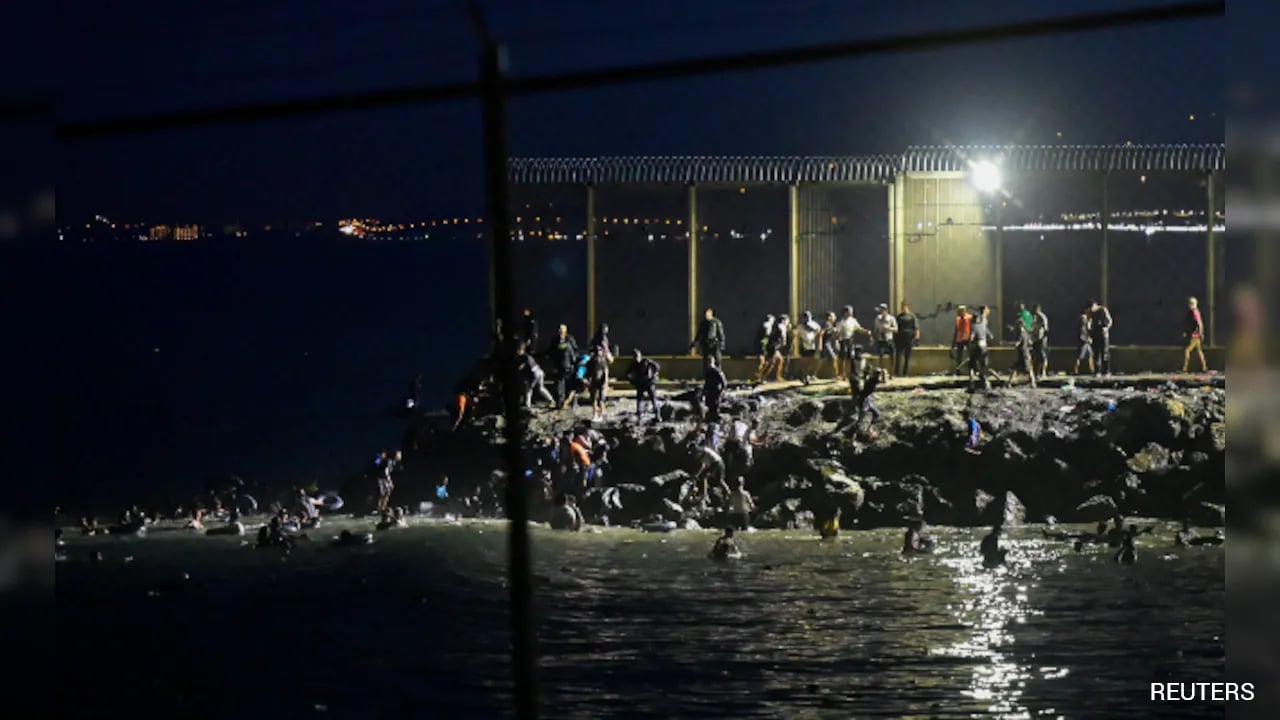
A staggering 49,000 migrants poured into the tiny Spanish enclave of Ceuta from Morocco in just 24 hours. This sudden rush turned a tense geopolitical fault line into an absolute humanitarian disaster. At least 18 people lost their lives, mostly drowning or getting crushed in terrifying stampedes along the Tarajal beach breakwater.
If you are trying to understand how a European Union border can completely collapse overnight, you have to look past the political finger-pointing. This crisis is about desperate economic realities, legal loopholes, and criminal networks exploiting human misery.
What Actually Triggered the Mass Crossing
You might wonder how tens of thousands of people manage to coordinate an invasion-style border breach so quickly. It didn't happen by accident.
Videos from the scene showed crowds swimming around breakwaters, floating on cheap inner tubes, and sprinting onto Spanish soil. While the Spanish government initially pointed the finger at criminal trafficking networks, investigators quickly uncovered a messy web of domestic and international pressures.
A recent Spanish Supreme Court ruling shifted the entire dynamic. The court ruled that migrants intercepted at sea could no longer be immediately pushed back across the border to Morocco without specific due process. Trafficking rings caught wind of this legal adjustment immediately. They weaponized the ruling, convincing thousands of people that the doors to Europe were suddenly wide open.
At the same time, severe local unemployment in northern Moroccan towns like Fnideq created a massive pool of individuals with nothing left to lose. When hope runs dry, people listen to smugglers who promise safe passage—even when that passage is a deadly swim through freezing Mediterranean waters.
Inside the Humanitarian Nightmare in Ceuta
Ceuta is tiny. It spans just about 7.5 square miles and normally houses around 84,000 residents. Dumping 49,000 extra people into that space in a single day breaks basic infrastructure instantly.
Local officials described the ground reality as pure chaos. Reception centers overflowed within hours. Thousands of people, including unaccompanied minors, found themselves sleeping on sidewalks, parks, and public plazas because there simply wasn't a roof available.
Juan Jesús Vivas, the president of Ceuta's regional government, pleaded with Madrid to declare a national emergency. The local police force was completely outnumbered. Spain responded by deploying military reinforcements to support the Civil Guard, but soldiers arrived to find a humanitarian emergency rather than a traditional security threat. Their initial tasks shifted from guarding fences to pulling bodies from the water and administering first aid to the injured.
Meanwhile, violence spilled over into Melilla, Spain's other North African enclave. Authorities shuttered the Beni Enzar border crossing after hundreds attempted a parallel breach, leaving burnt cars and smashed infrastructure in the wake of running street clashes with security forces.
The European Diplomatic Fallout
Borders in Europe are rarely just local issues. Because Ceuta and Melilla form the EU's only land borders with Africa, a breach here sends shockwaves straight through Brussels, Rome, and Paris.
Tensions flared immediately between Madrid and its European neighbors. Italian Deputy Prime Minister Antonio Tajani openly criticized Spain's migration policies. Tajani went as far as suggesting that Spain's recent domestic decision to regularize roughly 500,000 undocumented migrants acted as a magnet for illegal crossings, publicly calling for Spain to face scrutiny or suspension from the Schengen open-border area.
Madrid hit back hard against what it called partisan demagoguery, summoning the Italian ambassador while French authorities rapidly tightened border checks along the Spanish frontier to prevent the surge from moving further north. Prime Minister Pedro Sánchez flew to Ceuta to project control, but the diplomatic damage was already done. Europe's shared border strategy remains deeply fractured, and every surge exposes how fragile the bloc's migration agreements truly are.
The immediate rush has slowed down as Moroccan authorities deployed water cannons and reinforced their side of the fence alongside Spanish troops. Yet, the underlying pressures haven't vanished. Thousands of migrants remain stranded near the border, caught between economic despair at home and heavily fortified European walls just feet away.


