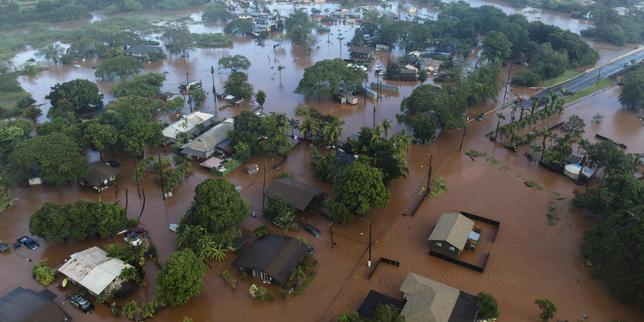
The rain in Hawaii usually feels like a blessing. It is the lifeblood of the islands, the "wai" that turns the volcanic dust into a lush, emerald cathedral. But when the sky over Oahu turned a bruised, heavy purple and refused to clear, that blessing began to feel like a siege. In the town of Wahiawa, located in the high central plateau of the island, the sound of the rain wasn't rhythmic or soothing. It was a relentless weight. It was the sound of a reservoir filling past its limit.
Water is heavy. We forget that until it moves. A single cubic meter of water weighs a metric ton. When you have a reservoir like the Wahiawa (Lake Wilson), you aren't just looking at a scenic body of water; you are looking at millions of tons of kinetic energy held back by a wall of earth and concrete built more than a century ago.
The Kaukonahua Stream was never meant to carry the volume that the storm of March 2021 demanded. As the spillway began to groan under the pressure, the abstract concept of "infrastructure" suddenly became a matter of life and death for 5,500 people.
The Weight of an Inch
Imagine standing in your kitchen in the North Shore or the lower reaches of Waialua. You’ve lived here for years. You know the smell of the damp earth after a light shower. But this is different. The sirens start. They aren't the midday tests you've grown used to. These are the long, low wails that mean the earth is failing.
Civil defense officials didn't use flowery language when the order came down. They spoke in cold, hard metrics. The water level was rising at a rate that threatened to overtop the dam. If a dam overtops, the water doesn't just spill over like a glass of milk. It erodes the back of the structure. It eats the very foundation holding the lake in place. Once that process starts, there is no stopping it. The wall becomes a sieve, then a memory, and then a wall of debris moving at thirty miles per hour toward the sea.
For the residents of the evacuation zone, the "human element" wasn't a statistic. It was the frantic effort to find the cat, the struggle to remember where the social security cards were kept, and the sight of neighbors—people who usually wave from across the street—tossing suitcases into truck beds with trembling hands.
The logistical nightmare of moving 5,500 people during a torrential downpour is a feat of panicked coordination. You aren't just moving bodies; you are moving histories. You are moving the elderly who remember the last great floods and the children who don't understand why they can't take all their toys.
A Century of Pressure
The Wahiawa Dam is an aging sentinel. Constructed in the early 1900s to support the burgeoning pineapple and sugar cane industries, it was a marvel of its era. But the era has changed. The climate has changed. The "hundred-year flood" now seems to arrive every decade, catching up to the iron and stone of a bygone industrial age.
We often treat our dams and bridges like permanent features of the landscape, as static as the mountains themselves. They aren't. They are living, aging things that require constant vigilance. When the state issued the evacuation order, it was an admission that we had reached the edge of what the past could protect.
The engineering reality is stark. When a dam like Wahiawa reaches its "critical level," the pressure on the gates is immense. Engineers at the site weren't just looking at gauges; they were listening to the structure. They were watching for "boils"—places where water starts to seep through the earth, indicating that the internal integrity of the dam is being compromised. It is a game of high-stakes poker played against gravity and physics.
The Ghost of 2006
In Hawaii, the fear of a dam failure isn't theoretical. It is a scar.
Everyone in the emergency management office that night was thinking about Kaloko. In 2006, on the island of Kauai, the Kaloko Dam breached after weeks of heavy rain. It didn't give a long warning. It just went. Seven people were swept away in the middle of the night, their homes obliterated by a wall of water that moved with the force of a freight train.
That memory is why the 2021 evacuation was so swift and so broad. You do not gamble with a dam. You do not "wait and see" if the rain will let up. You assume the worst because the worst is unthinkable.
While the media reported the number—5,500 people—the reality was 5,500 individual dramas. It was the teacher wondering if her classroom would be underwater by morning. It was the farmer looking at his livestock and realizing there was no way to get them all to higher ground in time. It was the sheer, exhausting uncertainty of being told that your home, your safe harbor, might become a casualty of the very landscape that makes Hawaii beautiful.
The Fragile Silence
Then, the rain stopped.
Not all at once, but the sky shifted from that terrifying purple back to a dull, exhausted grey. The inflow into Lake Wilson slowed. The spillway held. The frantic radio chatter at the command centers turned from "evacuation" to "assessment."
The people allowed back into their homes hours later didn't return to a celebration. They returned to a quiet, damp reality. They walked through their front doors, dropped their bags, and listened to the drip of the eaves. The crisis had passed, but the tension remained.
This is the hidden cost of living in the shadow of aging infrastructure. It isn't just the damage caused by a breach; it's the psychological tax of knowing that your safety is tied to a wall built by men who have been dead for fifty years. Every time the clouds gather and the wind picks up, that 2021 siren echoes in the back of the mind.
We live in an age where we are constantly told that technology has mastered nature. We have satellites that track every drop of rain and sensors that measure every millimeter of movement in a concrete wall. But when the water rises, those sensors only tell us how fast we need to run. They don't stop the flood.
The evacuation of Wahiawa wasn't just a news story about a dam. It was a story about the fragility of our tether to the land. It was a reminder that we are guests here, and that the "wai"—the water that gives life—retains the power to take it back whenever the earth grows too heavy to hold.
The lake is still there, shimmering under the Oahu sun. The dam still stands. But for those 5,500 people, the water will never look quite the same again. It is no longer just a view. It is a sleeping giant, and they have heard it stir.