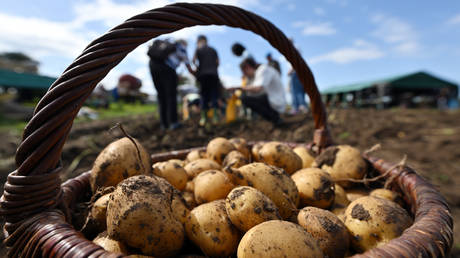
The ground does not merely dry; it hardens into iron.
If you walk across the fields of Flanders in the grip of a relentless July heatwave, the earth beneath your boots sounds hollow. There is no give. There is no moisture. There is only a pale, powdery crust concealing a tragedy happening quietly, invisibly, centimeters below the surface.
Meet Henri. He is a hypothetical composite of the thousands of growers whose livelihoods depend on a single, unassuming tuber across Western Europe. Henri is fifty-four years old. His grandfather farmed this exact patch of clay-loam; his father expanded the operation during the stable decades of the late twentieth century. Henri knows the temperament of his soil the way a musician knows the frets of an instrument. He knows when it breathes, when it drinks, and when it is content.
Or, at least, he used to.
Last summer broke the rules. It did not arrive with the dramatic fanfare of a hurricane or the sudden fury of a flash flood. It crept in as a persistent, shimmering dome of high pressure. Weeks bled into months without a drop of meaningful rain. Thermometers pushed past forty degrees Celsius, turning the agricultural heartlands of France, Belgium, Germany, and the Netherlands into convection ovens.
And inside those ovens, the potatoes were baking alive.
To understand the crisis unfolding across the European continent, one must first abandon the misconception that the potato is a hardy survivor. It is, in truth, remarkably delicate. Unlike wheat or corn, which can hunker down and ride out dry spells by going dormant, the potato plant is an ambitious water junkie. More than eighty percent of its mass is liquid. During the crucial bulking phase—that vital window in mid-summer when the plant pumps nutrients down into the swelling tubers underground—it requires a steady, rhythmic intake of moisture and cool nights.
When the night air stays locked at thirty degrees, the plant panics. It stops growing. It breathes too heavily, burning through the sugars it should be storing.
And when the soil moisture drops below critical thresholds, the tubers simply refuse to expand. They deform. They crack. They turn glassy and hollow inside, rendering them useless for the French fries that line the menus of London and Paris, useless for the crisp bags lining supermarket aisles from Madrid to Berlin.
Henri spent mornings last August walking his fields with a spade, turning over dry clods that resembled baked pottery. He would pull up a stem, hoping against hope to find a cluster of plump, clean-skinned potatoes. Instead, he found marbles. Small, shriveled, stunted things no bigger than a walnut.
Multiply Henri by ten thousand. Multiply his heartbreak across the vast agricultural belts that feed millions. The numbers quickly transcend agronomy and enter the realm of systemic shock.
The European potato harvest did not merely drop; it plummeted. Regions that traditionally export surplus yields suddenly found themselves scrambling to secure enough stock to meet domestic contracts. Prices on the futures markets spiked with a volatility usually reserved for precious metals or crude oil. Processing plants in Belgium—the undisputed capital of the frozen fry industry—faced an agonizing choice: shut down lines early or pay exorbitant prices to import scarce tubers from unexpected corners of the globe, absorbing margins that threatened to bankrupt generational businesses.
This is the invisible stakes of climate volatility.
We live in a culture accustomed to infinite abundance. We walk into a brightly lit supermarket aisle, pick up a neatly printed bag of crisps for pocket change, and give zero thought to the complex web of weather, soil, hydrology, and human grit that brought it there. We treat food as a background detail of modern life, an endless stream that flows reliably from shelf to basket.
Until the tap runs dry.
The shortage of European potatoes is not merely an economic statistic. It is a symptom of a shifting baseline. For generations, European agriculture was calibrated for a predictable climate rhythm—gentle spring rains, warm summers, predictable autumn harvests. That rhythm is gone. In its place is a jagged, unpredictable volatility where extremes are the new average.
Consider what happens next in the supply chain. When the raw material halves in volume, the economic pressure cascades downward and upward simultaneously.
For the processor, the cost of production triples. For the restaurant owner in downtown Amsterdam or Lyon, the price of a wholesale crate of chipping potatoes doubles overnight. They absorb the blow for as long as humanly possible, trying not to alienate patrons already squeezed by the rising cost of rent and energy. Eventually, the price on the menu creeps upward. A plate of fries becomes a luxury item.
And for Henri? For Henri, the math is stark. Insurance payouts rarely cover the full replacement cost of a failed crop. Irrigation rights, where they exist, become heavily restricted as municipal authorities prioritize drinking water over agriculture. Wells sink deeper into aquifers that are not recharging fast enough. Every morning brings a tense calculation: do I pump more expensive groundwater onto fields that might bake anyway, or do I accept the loss and watch the earth turn to dust?
Doubt. It is a heavy thing to carry into the fields at dawn.
Yet, agriculture has always been an exercise in stubborn optimism. Farmers are, by necessity, eternal optimists. Every spring, despite the disasters of the previous year, they drop seed into the dark earth and look up at the sky, hoping for rain.
The scorching summers are not going away. The atmospheric pressures locking over the continent are part of a broader, deeper planetary realignment. Adapting to this new reality requires more than just hoping for a milder July. It demands a fundamental rethinking of how we farm, what varieties we plant, how we store and manage water, and how we value the fundamental staples of human sustenance.
Agronomists are already racing to breed heat-tolerant potato varieties—strains that can endure spikes in temperature without halting their growth, roots that can dive deeper into the subsoil in search of hidden moisture. Farmers are investing in precision irrigation systems, drip lines buried inches beneath the surface to minimize evaporation, shifting from overhead sprinklers that lose half their water to the dry afternoon air.
These are not quick fixes. They require capital, time, and experimentation. They require a willingness to abandon centuries-old traditions in favor of radical adaptation.
Back in the fields of Flanders, the sun is setting. The fierce glare of the afternoon softens into a bruised palette of orange and deep purple.
Henri stands at the edge of his fallow field, hands buried deep in the pockets of his jacket. The soil is quiet now, cooling rapidly under the clear night sky. Tomorrow, the work begins again. Not because the crisis has passed, but because there is no other option. We eat what the earth yields. And until we learn to listen closer to the warnings written in the dust, the earth will continue to speak in a language we are only just beginning to understand.