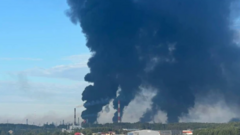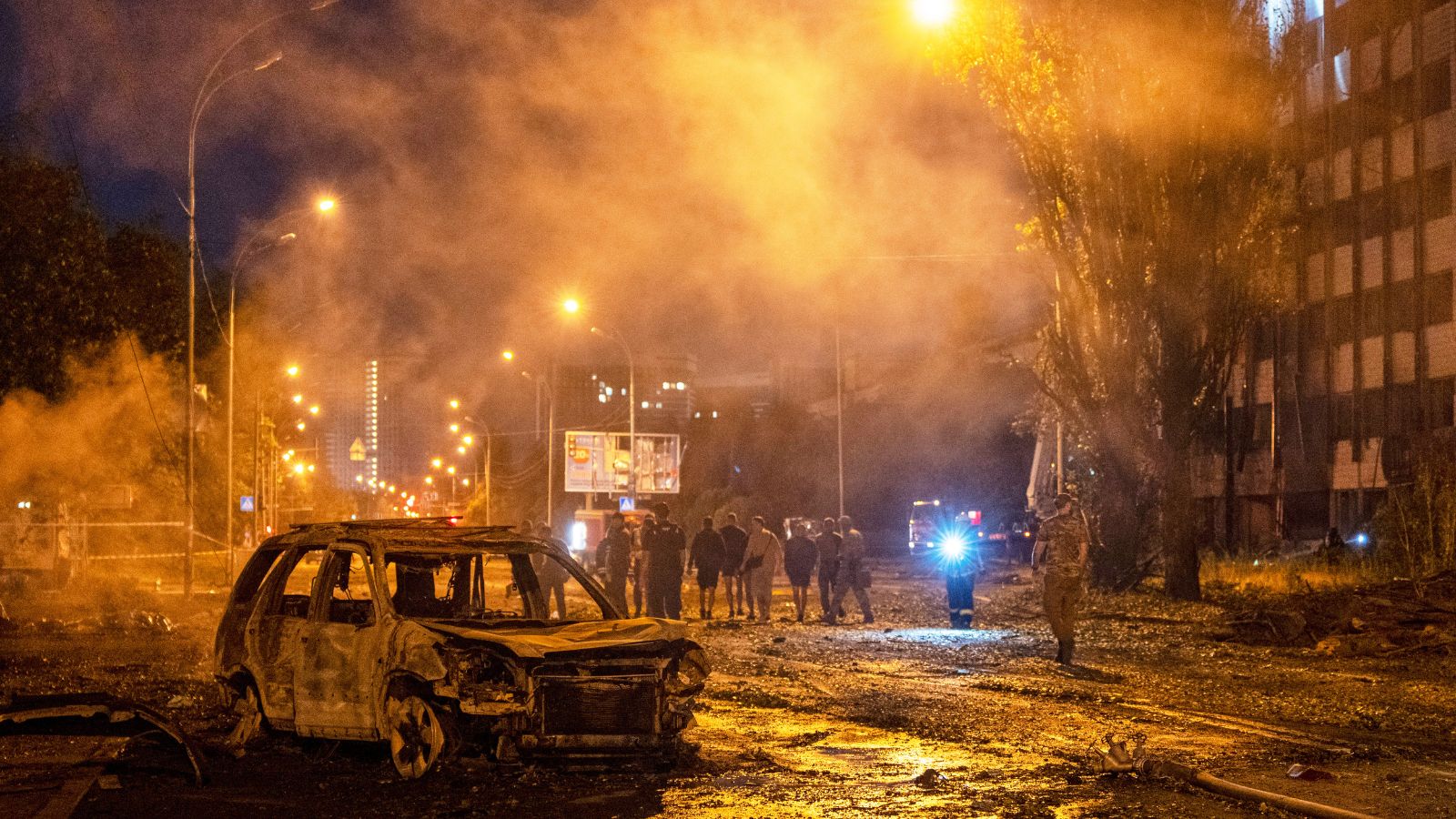
The air smells different when a refinery burns. It is not the clean, crisp bite of winter frost or the sharp scent of pine after a heavy rain. It is thick, oily, and heavy enough to sit on the back of your tongue for hours. It smells like money turning to carbon, and for the people watching the orange glow pulse against the night sky hundreds of miles from the front lines, it smells like a fundamental shift in gravity.
For months, the strategy had a predictable rhythm. Sirens would wail in Kyiv, interceptors would climb into the pale dawn, and the map would slowly bleed across muddy fields in the east. We watched the trenches. We counted the artillery shells. We measured the conflict in meters of shattered concrete and ruined orchards. We treated the war as a localized weather pattern, violent and destructive, but contained within a specific geographical theater.
Then came the predawn hum of low-flying engines over the Russian heartland.
President Volodymyr Zelenskyy confirmed what the satellite thermal signatures had already whispered to anyone paying attention. Ukraine has pushed its reach far beyond the contested borders, striking oil facilities deep inside Russian territory. These are not frontline depots or improvised supply trucks. These are massive industrial processing hubs, complex mazes of cracking towers, storage tanks, and pipelines that pump the financial lifeblood of a superpower.
To understand why this matters, you have to look past the military communiques and stand inside a control room. Imagine staring at a digital console where every blinking light represents millions of dollars in revenue flowing directly into state coffers. Now imagine that light turning red.
For years, the architecture of modern statecraft rested on an unspoken asymmetry. One side could strike with impunity across borders, turning cities into rubble, secure in the psychological armor of territorial depth. The home front was supposed to be a sanctuary. Factories hummed, television screens broadcast entertainment, and citizens could pretend that the distant thunder was happening on another planet.
That illusion is burning.
When long-range drones strike an oil facility in a region like Ryazan or Tatarstan, they do not just destroy steel and fuel. They puncture the psychological insulation of a population. They turn abstract geopolitical tension into a personal inconvenience, and eventually, into a profound, creeping anxiety. Suddenly, the cost of the conflict is measured not just in casualty reports from nameless villages, but in fuel shortages, disrupted supply chains, and the terrifying realization that distance is no longer a shield.
Consider the logistics. Russia is a petrostate. Its economy is a colossal engine fueled by oil and gas extraction. When you target the refineries, you are not merely engaging in tactical sabotage; you are introducing systemic friction into a massive, bureaucratic machine. Refined products like diesel and gasoline are the absolute currency of modern logistics. They move the trucks, power the tractors, and keep the military supply chains breathing.
When those facilities catch fire, the ripple effects travel outward in concentric circles. First, local authorities scramble to contain the blazes, releasing statements that downplay the damage while black smoke blots out the sun. Then, regional fuel prices twitch upward. Distribution networks stutter. Plant managers who thought themselves safe behind hundreds of miles of air defense suddenly find themselves looking at the sky every time a pigeon flies past.
War has a way of shrinking space. Technology has erased the buffer zones that once allowed nations to wage industrial conflicts at a comfortable remove. A handful of fiberglass and carbon-fiber components, guided by commercial GPS chips and amateur ingenuity, can cross international boundaries and rewrite the strategic calculus of a continent.
There is a stark, haunting vulnerability to modern civilization. We have built hyper-efficient, highly centralized systems of energy and commerce. A single well-placed spark can cascade through an entire network, causing failures that no amount of frontline armor can prevent. It is a lesson that military planners have known since the dawn of the industrial age, but one that civilian populations rarely internalize until the heat reaches their own doorsteps.
As the smoke clears over these distant industrial sites, the diplomatic shockwaves are just beginning to register. Capitals from Washington to Brussels are recalibrating their assessments. The calculus of endurance—the belief that time is purely on the side of the larger nation with the deeper reserves—is being violently interrogated. If the home front can be touched, the psychological timeline of the conflict accelerates.
We are left watching a horizon punctuated by distant fires, waiting to see what burns next. The map has changed, and there is no eraser left that can put the lines back where they were.