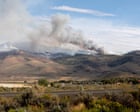
Ash does not fall like snow. Snow has a gentle architecture, a quiet drifting rhythm that settles on coat sleeves and window sills with a soft, forgiving weight. Ash is different. Ash is the ghost of a pine tree, the skeleton of a living room, the memory of a summer that ended too abruptly. It is gritty, gray, and greasy between your fingers. It smells of ruin.
When the sky turned the color of a bruised plum over the foothills, I knew the air had changed from something we breathe into something we fight.
Roughly ninety thousand people received the alert on their phones at the exact same moment. That number is a statistic. It is a neat, tidy digit you read on a screen while drinking coffee three states away. But ninety thousand is not a statistic. It is a Friday afternoon panic. It is bumper-to-bumper tailights bleeding red down McCarran Boulevard. It is a grandmother leaving her wedding album on the dining room table because there was only room in the back seat for the dog and a single duffel bag.
Fast-moving.
That was the phrase the meteorologists kept repeating, their voices tight with a professional panic they couldn't quite mask. A fast-moving wildfire does not wait for you to pack your winter coats. It does not care that you spent twenty years planting the lilac bushes by the front porch. It runs through dry brush and drought-starved timber at the speed of a galloping horse, driven by erratic winds that scoff at containment lines.
I remember standing in the driveway, watching the amber glow pulse behind the ridge like a second, angry sunset.
The mechanics of evacuation are deceptively mundane until you are living them. You check your gas gauge. You secure the cat carrier. You wonder, with a cold knot in your stomach, if the kitchen window is locked. Human beings are remarkably ordinary creatures, even when the world is ending. We cling to routine because the alternative—the sheer, unadulterated terror of losing everything—is too massive to hold in your head all at once.
(Note: While the specific family dynamics described here are a hypothetical reconstruction built to anchor the human scale of the disaster, the evacuation figures, wind speeds, and regional geography reflect the verified realities of the emergency responses in the area.)
Consider what happens next. The highway becomes a parking lot of collective breath-holding.
Every headrest is pushed forward. Every radio station plays the same frantic loop of emergency broadcast coordinates, evacuation shelters filling up by the minute at convention centers and fairgrounds, and warnings about visibility dropping to zero. You look at the driver in the next lane over. They are gripping the steering wheel so hard their knuckles are white. Nobody honks. Nobody yells. There is an eerie, cooperative silence among strangers who share a single, terrifying trajectory.
We have engineered our lives around the assumption of permanence. We build houses out of timber and drywall, sign thirty-year mortgages, and plant roots deep into the high desert soil of Nevada, trusting the geography to stay put. But the climate has rewritten the contract. The dry years stack on top of each other like dry kindling, waiting for a stray spark, a downed power line, a moment of human carelessness, to turn decades of ordinary Tuesday afternoons into smoke.
By midnight, the air miles away tasted like an old campfire left to smolder in the rain.
Shelters hummed with the low-frequency drone of anxiety. Cots clicked open like mechanical ribs. Children slept fitfully on army blankets, their small chests rising and falling to the rhythm of displaced lives, while parents stared at glowing cell phone screens, refreshing local news feeds for updates on neighborhood perimeters. Is our street still there? Did the wind shift?
Those are the questions that keep you awake on an institutional gym floor. Not grand philosophical queries, but small, agonizing inventories of loss.
When the sun finally clawed its way back over the horizon the next morning, it cast a sickly, jaundiced light across the valley. The fire was still out there, a beast breathing heavily behind the mountains, but the immediate choke-hold on the city had loosened just enough for emergency crews to begin the grim, necessary work of assessment.
We talk endlessly about disaster management in terms of acreage burned, containment percentages, and resource allocation. We treat these events as logistical puzzles to be solved by men and women in yellow jackets with fire hoses and bulldozers. And they are heroes, navigating walls of flame that defy imagination.
Yet the true geography of a wildfire is emotional. It is mapped in the sudden clarity of what we actually own versus what we merely borrow. It lives in the scratch in the back of your throat days after the smoke has cleared, a physical reminder that the border between safety and catastrophe is terrifyingly thin.
Drive down those same streets a week later, past the scorched guardrails and the blackened tree trunks standing like charred exclamation points against the hillside. The traffic lights are working again. The coffee shops are open. People are walking their dogs. But the air feels different now. Lighter, perhaps, but sharper. We know the secret the mountains keep. We know how fast the wind can change.