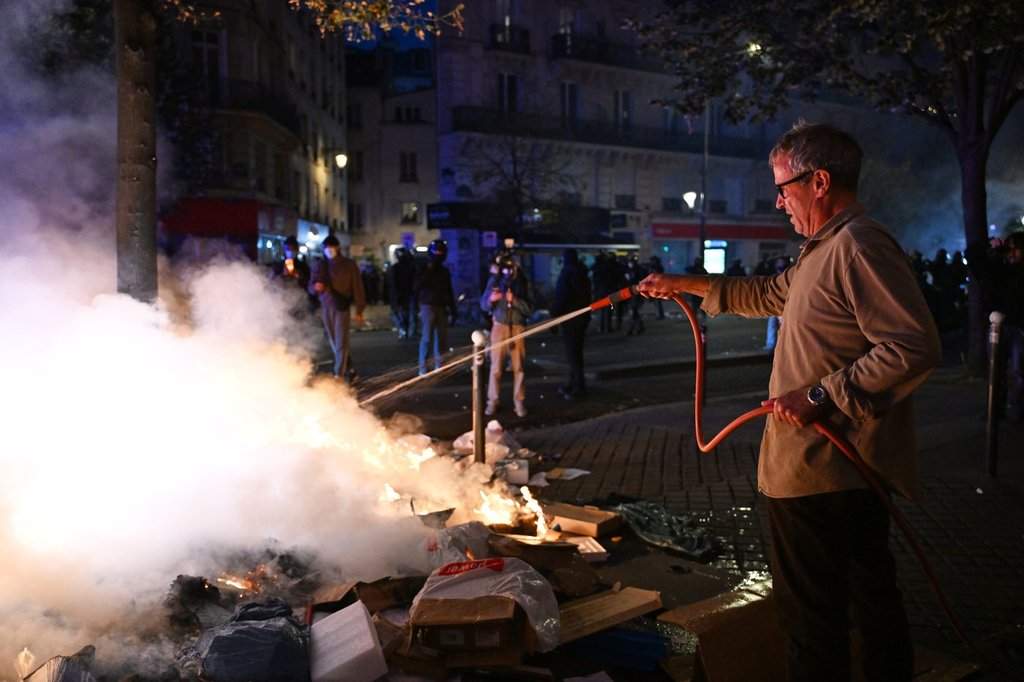
Sirens. Always the sirens first.
Before the television anchors even find their somber cadence, before a presidential press secretary clears a throat behind a lectern in the Élysée Palace, the sound of a city tearing itself apart arrives in low, metallic wails that vibrate right through the soles of your shoes.
I have stood on enough wet cobblestones at two in the morning to know the difference between anger and opportunism. Anger has a rhythm. It chants, it marches, it holds up cardboard signs whose ink runs in the drizzle. Opportunism moves sideways. It slips down side alleys when the tear gas drifts left, pries open rolled steel shutters with crowbars, and vanishes carrying boxes of sneakers or electronics while exhaustion settles over everyone else.
When a president steps before the cameras to condemn violence after riots spill into looting and mass arrests, the headline writes itself in neat, clinical blocks. Macron condemns violence after riots lead to looting and mass arrests. Five seconds to read. Zero weight carried home.
Yet what happens on the street does not fit inside a single sentence. It lives in the cracked pane of a neighborhood bakery. It lives in the back of a police van where a nineteen-year-old whose only plan that evening was to film a crowd on a phone suddenly realizes he is being booked for an offense that carries a prison record. It lives in the quiet, hollow hours at dawn when the smoke thins and ordinary people try to figure out whether their city still belongs to them.
What a Presidential Condemnation Actually Weighs
Listen closely to the language whenever a French head of state addresses street unrest. Every word is chosen like a sandbag stacked against a rising river. Condemn the violence. Back the security forces. Protect public buildings and small merchants. Remind citizens that the republic rests on law, dialogue, and order rather than arson and plunder.
To critics watching from afar—or from living rooms three hundred miles from the smoke—a presidential rebuke can sound hollow. He says that every time, people mutter. Words don't replace a shattered window.
That skepticism is fair. A speech does not sweep up glass. It does not refund an uninsured cash register or un-break a collarbone.
Still, dismissing state condemnation as mere theater misses the narrow ledge a leader stands on during civil disorder. If a government speaks too softly when shops are being gutted and officers are pelted with paving stones, it signals abdication; the state looks frightened of its own streets. If it speaks with unguarded fury or promises sweeping crackdowns without restraint, it pours gasoline onto grievances that already feel ignored. A president is trying to hold two opposing truths in the same pair of hands: firmness against lawlessness and legitimacy for a democratic system that many citizens feel is failing them.
Honesty requires admitting something uncomfortable here. Even seasoned observers of French politics—people who have watched protests flare from the gilets jaunes demonstrations to urban clashes over policing and economic strain—cannot always predict which spark will catch. Sometimes a single tragic encounter or an unpopular policy triggers a localized flashpoint. Other times, social media turns a small scuffle in one district into a coordinated wave of street chaos and looting across several cities before midnight. Nobody holding a microphone has a crystal ball that can freeze that momentum mid-air.
Think of a public square during a riot like dry timber stacked beside a campfire. A single stray ember can roll harmlessly onto damp grass nine times out of ten. The tenth time, a gust catches it, and suddenly three blocks are ablaze. Presidential words are not the fire department; they are an attempt to change the wind.
Inside the Chaos: A Hypothetical Night on Rue des Martyrs
To see how abstract news items—riots, looting, mass arrests—attach themselves to real lives, consider a hypothetical scenario set during a tense weekend evening in a busy commercial corridor. None of the people in this scene are real individuals, though every detail reflects patterns documented across repeated nights of French urban unrest.
Hypothetical character one: Nadia, thirty-four, runs a small independent bookshop and stationery store she spent seven years building with family savings and a bank loan. At seven o'clock, she watches a stream of young people and hooded figures surge past her front window. Some are shouting slogans; a smaller pack peels off toward a nearby chain store, yanking at a security grille. Nadia lowers her metal curtain early, locks the deadbolt, and sits in the dim back office listening to helicopters thrum overhead. Her stomach twists every time a bottle shatters outside. She is not a billionaire corporation with a corporate risk department. One fire, one smashed display, one week of forced closure can erase a year of thin margins.
Hypothetical character two: Karim, twenty, works part-time in logistics and lives in an outer housing estate where buses run thin after midnight. He came toward the center of town out of curiosity and solidarity after seeing clips online, wearing a hoodie because the night air had a sharp bite. When tear gas canisters pop and crowd-control units advance in formation, panic turns a dense crowd into a stampede. Karim runs down a narrow street just as a cluster of looters bolts out of a ransacked shop. Police cordon off the block. Within minutes, handcuffs click shut on wrists belonging to both people who broke glass and bystanders caught in the dragnet.
Hypothetical character three: Officer Laurent, forty-one, a veteran of public-order deployments, stands behind a polycarbonate shield with aching calves and ringing ears. To his family at home, he is a badge number in a news report about mass arrests. Inside his helmet, he sees projectiles flying out of the dark, feels the sting of acrid smoke seeping past a worn seal, and knows that one mistake—one overreaction caught on a dozen phone cameras—will define the next month of headlines and investigations.
None of these three people wanted a textbook news story. Yet each of them becomes a statistic inside one. Nadia becomes a figure in a chamber-of-commerce damage tally. Karim becomes a number in a ministry press release announcing hundreds of arrests. Laurent becomes an instrument of state authority praised by hardliners and condemned by civil-liberties advocates.
Why Looting Changes the Temperature of a Protest
There is a crucial divide that gets blurred whenever riots, looting, and mass arrests are lumped into a single breath.
Protest is a claim on the public square. Even when protests turn destructive or clash with police, many participants believe they are pushing back against injustice, economic pressure, or institutional neglect. Looting is different. Looting is predation disguised by confusion.
When storefronts are broken open and merchandise is hauled away in broad daylight or under streetlights, the moral gravity of the event shifts beneath everyone's feet. Neighbors who might have sympathized with demonstrators suddenly see their own livelihoods treated as fair game. Local politicians who might have urged restraint feel pressured to demand harsher policing. The original grievance—whatever sparked the march in the first place—gets buried under piles of stolen goods and charred debris.
History in France shows how predictable that arc can be. Unrest often begins around a sharp grievance or flashpoint, draws in crowds with mixed motives, and then attracts smaller groups skilled at exploiting chaos. Once looting spreads, the state's response almost always hardens: more riot squads deployed, tougher judicial fast-tracks for offenders, curfews or perimeter closures in vulnerable neighborhoods, and sweeping arrest totals touted as proof that control is being restored.
Order matters. Without basic safety on the streets, there is no freedom to walk to work, open a shop, or assemble peacefully without fear.
At the same time, mass arrests carry their own quiet peril. Sweeping up large numbers of people in chaotic conditions can sweep in teenagers who made a foolish choice to linger, residents heading home from a late shift, or people caught in a kettle maneuver. When courts process hundreds of cases rapidly, the line between ringleaders who planned vandalism and scared young people who panicked can blur. Resentment deepens in the exact neighborhoods where trust in institutions is already thin.
The Invisible Stakes Behind the Headlines
Most readers scan a story about riots and mass arrests, feel a brief jolt of alarm or frustration, and move on to the next tab. That is human nature; we cannot carry every crisis in the world at full volume every morning.
Still, when you strip away the diplomatic phrasing and the arrest tallies, three quiet stakes sit right beneath the surface.
First is the survival of the middle ground—the baker, the pharmacist, the corner grocer, the local delivery driver. Large chains can absorb a broken window or temporary closure across a national balance sheet. Small businesses operate on razor-thin buffers. When streets turn volatile night after night, foot traffic dries up even on blocks that never suffer physical damage. People stay home. Evening routines shrink. A lively neighborhood starts feeling like a war zone even after the barricades are cleared.
Second is the widening fracture of trust. Every cycle of violent confrontation, harsh crackdown, and bitter argument leaves scars that do not show up on a municipal repair bill. Young people who feel watched rather than heard grow harder to reach. Police officers who feel targeted and second-guessed grow more defensive. Leaders whose warnings go unheeded see their authority erode with every repeat performance.
Third is the cost of binary thinking. Online outrage loves simple villains and simple heroes. One side treats every protester or arrested youth as a criminal menace; the other treats every police action or presidential warning as pure oppression. Reality is messier and harder to hold. A society can insist firmly that looting and violence against people or property are unacceptable and still ask why so many young citizens feel alienated enough to burn their own neighborhoods.
Picking Up the Pieces When the Cameras Leave
Two days after a major flare-up, the television crews pack their cables. The dramatic live shots from burning intersections give way to quieter scenes: municipal sweepers clearing broken glass along the curb, plywood nailed across shattered shopfronts, families waiting outside precinct doors or courthouses to learn what happens next.
Rebuilding physical damage is the easy part. Wood, glass, asphalt, and paint can be ordered and installed. Rebuilding civic trust takes years of unglamorous work—fair policing, real economic opportunity, schools and neighborhoods that offer a future worth protecting, and leaders whose actions match their speeches long after the cameras turn off.
Dawn breaks pale and cold over a quiet avenue, where a shopkeeper sweeps the last slivers of glass from a threshold while a lone police van idles at the corner, waiting to see whether tonight will be peaceful.