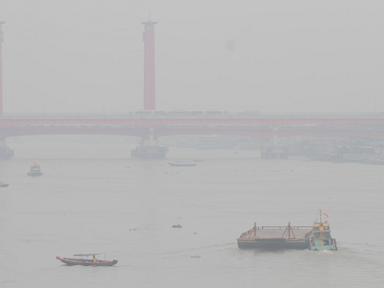
The air tasted like coins and wet ash.
It was seven in the morning, yet the sun hung suspended behind a bruised shroud of yellow-gray, a dull, sullen eye refusing to wake up. Across several regions in Indonesia, children woke up not to the sharp, clear light of dawn, but to a suffocating stillness. Outside their windows, the world had been erased, swallowed whole by an invisible wall of smoke creeping inland from the forest floor.
Smoke does not merely arrive; it occupies. It crawls beneath doorframes, clings to bedsheets, and sits heavy on the tongue.
For twelve-year-old Nia, living in a province where the horizon has vanished for weeks, the morning routine changed entirely. There was no racing out the front door with a backpack slung over one shoulder, no calling out to friends down the dusty lane. Instead, there was the heavy ritual of the cloth mask, damp at the edges, and the quiet click of a television broadcasting a familiar, dreaded message.
School was closed again.
When the Forest Burns, the Classrooms Empty
The official reports call it seasonal haze. They measure it in particulate matter, in air quality index numbers that climb past hazardous thresholds into numbers that sound like abstract math problems. But numbers do not capture the weight of a quiet classroom.
Consider what happens when the schools lock their doors. Millions of children are pulled indoors, confined to cramped rooms where windows remain bolted shut to keep the acrid fog at bay. Education, already fragile in regions vulnerable to climate disruptions, stutters and halts. For working parents, the closure forces an impossible choice: leave young children unattended in a toxic environment or stay home and forfeit the day's wages.
The fires driving these closures are rarely accidental sparks of nature. They are often born of deliberate clearing, peatlands drained and set ablaze to make way for agriculture. Beneath the surface, ancient carbon repositories smolder for months, locked in underground chambers of peat that laugh at ordinary rainstorms. When the wind shifts, that ancient smoke travels hundreds of miles, crossing districts and borders, turning vibrant communities into ghost towns under a perpetual twilight.
The Cost Measured in Breaths
To understand the crisis, one must look down at the ground. Or rather, look at the people trying to breathe it.
Medical clinics in affected districts fill with the unmistakable rattle of wheezing chests. Toddlers with newly minted asthma diagnoses sit on plastic chairs, nebulizers humming a mechanical tune against the backdrop of coughs. The elderly, whose lungs have weathered decades of changing seasons, find themselves gasping for air inside their own living rooms.
Doctors speak of acute respiratory infections surging by astronomical percentages during these months. They hand out masks like currency, knowing full well that paper and fabric offer only a desperate defense against microscopic intruders.
(Note: The following scenario is a hypothetical composite based on recorded medical admissions in Sumatra and Kalimantan during peak fire seasons.)
Imagine a clinic waiting room at noon. The ceiling fans churn the thick indoor air, offering no relief, only moving the dust from one corner to another. A mother holds a sleeping four-year-old whose chest heaves too fast, too shallow. She has spent three days wiping soot from her windowsills, only to find it back an hour later, fine as talcum powder. She is not thinking about carbon metrics or regional governance policies. She is thinking about whether tomorrow will bring a blue sky or another wall of gray.
The Silence of the Classrooms
Education is a rhythm. Break the rhythm, and the consequences ripple outward for generations.
When schools close due to toxic air, learning loss follows swiftly. Not every family has a smartphone, let alone reliable internet or laptops to pivot to remote learning. For many rural Indonesian students, the classroom is the primary anchor of stability, nutrition, and social growth. Without it, days blur into weeks of indoor confinement.
The irony is sharp. The very generation whose future is threatened by global environmental degradation is also the one sitting in dark houses, barred from learning about the forces shaping their world.
Yet, resilience takes many forms. In some neighborhoods, teachers organize makeshift study circles in homes with air purifiers, or distribute paper packets of homework through doorways like contraband. They refuse to let the smoke steal the children's minds, even when it steals their sky.
The Fire Beneath Our Feet
The haze is a messenger. It carries the burnt remnants of ecosystems thousands of miles away, reminding every city dweller, shopkeeper, and student that boundaries on a map mean nothing to the wind.
As long as peatlands are left vulnerable and seasonal burning remains unchecked, the cycle will repeat. Next year, the schools will likely close again. The masks will come out of the drawers. The air quality indices will spike, and another generation of children will learn to measure time not by the calendar, but by the color of the smoke outside their window.
The sun tries to break through around noon, a pale, bleeding orange disk fighting a losing battle against the gray. Nia presses her forehead against the cool glass of her window, staring out at a street where no one is walking. Somewhere out there, beneath the ash, the green world waits for rain.