The morning routine is a shield against chaos. You boil the water. You check the weather. You watch the steam rise from a ceramic mug, thinking about the emails you need to answer or the laundry waiting in the basket. In Sumy, a city tucked into the northeastern pocket of Ukraine, just miles from the Russian border, these mundane rituals are not guaranteed. They are borrowed time.
When the sky tore open on a recent afternoon, there was no time to put down the coffee. There was only the roar.
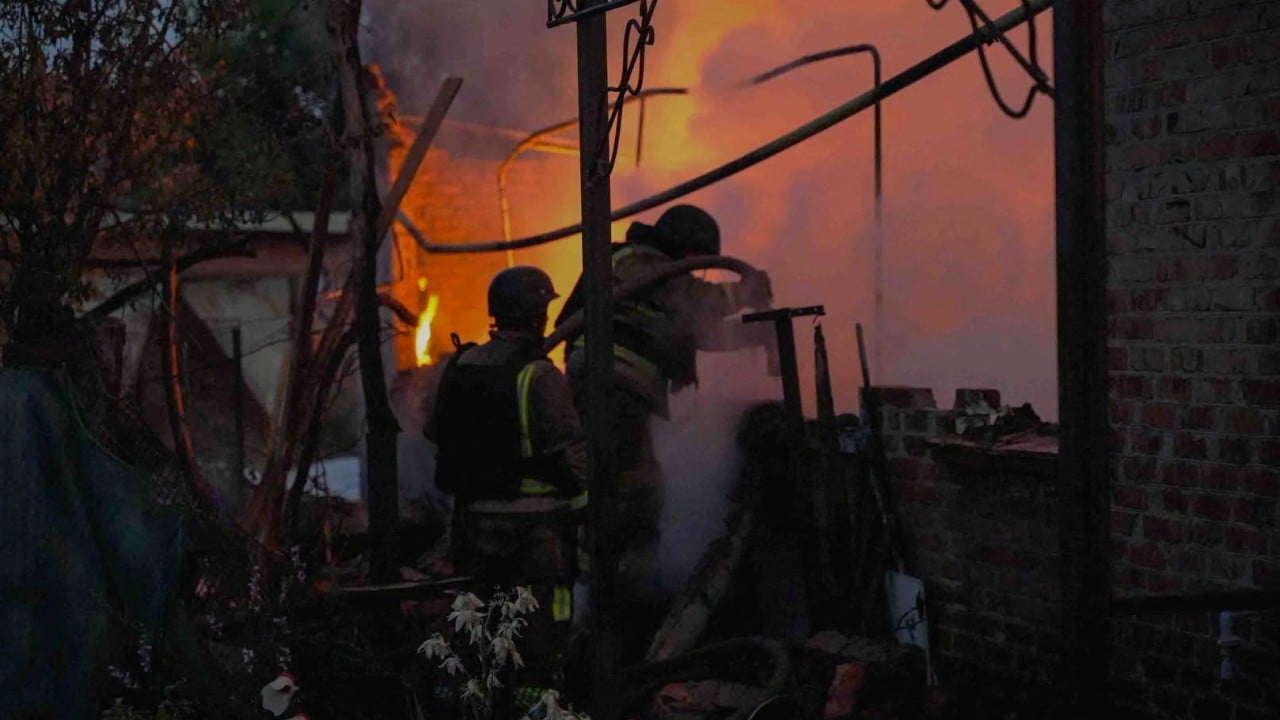
A massive Russian bomb attack struck the city, slicing through the fragile veneer of daily life. At least four people woke up that morning, breathed in the crisp air, and expected to see the sunset. They never did. Dozens of others were left pulling glass out of their hair, staring at the ruins of what, minutes earlier, had been their living rooms. This is not a dispatch about geopolitical chess pieces or abstract military strategies. This is about the weight of concrete when it falls on a human life.
The Chemistry of Terror
To understand what happened in Sumy, you have to understand the specific cruelty of the weapon used. These are not standard artillery shells. The skies over Ukraine are increasingly haunted by guided aerial bombs—massive, Soviet-era munitions retrofitted with cheap satellite guidance wings. They carry hundreds of kilograms of high explosives. They are silent until they arrive.
Think of a standard missile as a sniper’s bullet; it is precise, expensive, and targeted. A guided aerial bomb is a sledgehammer swung by a blind giant. It demolishes entire apartment blocks by sheer displacement of air and mass.
When one of these detonations occurs, the pressure wave hits first. It moves faster than the speed of sound. It empties the lungs of anyone nearby, shatters eardrums, and turns ordinary windows into clouds of supersonic shrapnel. Then comes the heat, followed by the collapse.
Let us consider a hypothetical resident—we can call her Olena, though she represents a thousand real women in Sumy right now. Olena was likely standing near her kitchen window when the alert sounded. In Sumy, the proximity to the border means the interval between the air raid siren and the impact is often measured in seconds. Sometimes, the bomb arrives first. The siren is merely an entry in an official logbook. Olena doesn't have a reinforced bunker. She has the "two-wall rule"—the hope that putting an interior hallway between herself and the street will stop the flying shards of her own life.
But the two-wall rule is useless against five hundred kilograms of falling iron.
The Geography of Vulnerability
Sumy has a distinct misfortune. It sits too close to the edge. Its proximity to the Russian frontier makes it an easy target for tactical aircraft that can release these guided bombs from the safety of their own airspace. The planes do not even need to cross the border to kill.
This geographical reality creates a chronic, low-grade psychological torture. In the capital of Kyiv, air defense systems offer a dome of relative safety, a chance to hear the sirens and walk calmly to a subway station. In Sumy, life is lived in the throat of the cannon.
The physical destruction is massive, but the invisible erosion of the human spirit is the true objective of these strikes. When a residential neighborhood is targeted, the message isn't military. It is an eviction notice served to an entire population. It says: You cannot sleep. You cannot build. You cannot raise children here.
The rescue workers who arrive at these scenes do not look like heroes in movies. They look tired. They wear heavy Kevlar vests over their regular uniforms because of the tactic known as the "double tap"—where a second bomb is dropped on the exact same coordinate twenty minutes later, specifically targeting the paramedics, firefighters, and neighbors digging through the rubble with their bare hands.
Imagine kneeling in the dust, listening for the sound of a muffled cough or a scratching fingernail beneath three stories of collapsed brick, knowing that the next roar is already in the air.
The Arithmetic of Grief
The official reports will list the casualties as numbers. Four dead. Thirty-four wounded. Three missing.
Numbers are clean. They fit into a news ticker. They can be analyzed by experts sitting in well-lit studios thousands of miles away. But a number cannot capture the specific shade of blue of a child’s backpack pulled from a crater. It cannot describe the sound of a dog barking frantically next to a covered body on the pavement, refusing to leave the side of the only person it ever knew.
Every unit in that casualty count is an entire universe obliterated. One was a teacher who had spent forty years explaining the nuances of Ukrainian literature to teenagers. Another was a mechanic who could fix any tractor in the district with a piece of wire and a wrench. These are the threads that hold a community together. When you pull them out with high explosives, the entire fabric unravels.
The survivors are left with the silence that follows the blast. It is a thick, choking silence filled with the smell of pulverized plaster, burnt rubber, and the metallic tang of ruptured heating pipes.
The Cost of Looking Away
There is a temptation, as this war drags into its successive years, to treat these dispatches as background noise. The human brain is wired to normalize horror to protect itself. The first time an apartment building is bombed, the world stops. The hundredth time, it is merely a headline.
But the people of Sumy do not have the luxury of fatigue. They cannot switch the channel or close the tab. For them, the threat is as tangible as the gravity that keeps their feet on the ground. They must sweep up the glass, bury their neighbors, and decide whether to sleep in their clothes tonight in case they need to run into the freezing dark.
We often talk about the financial cost of conflict, the billions of dollars in aid, the shipments of air defense ammunition, the political debates in distant capitals. But the real currency being spent in Sumy is time. The stolen years of children who study in underground basements. The shortened lives of the elderly whose hearts give out from the sheer stress of the sirens.
The true stakes are found in the determination to remain human when everything around you is being reduced to ash.
The dust in Sumy will eventually settle, as it always does. The cranes will move the largest pieces of concrete. The blood will be washed from the asphalt. A makeshift memorial of plastic flowers and stuffed animals will appear near the crater, a small, stubborn defiance against the oblivion raining from the sky. And tomorrow morning, someone else will stand in a kitchen, boil the water, and look up at the ceiling, wondering if the air will stay quiet.