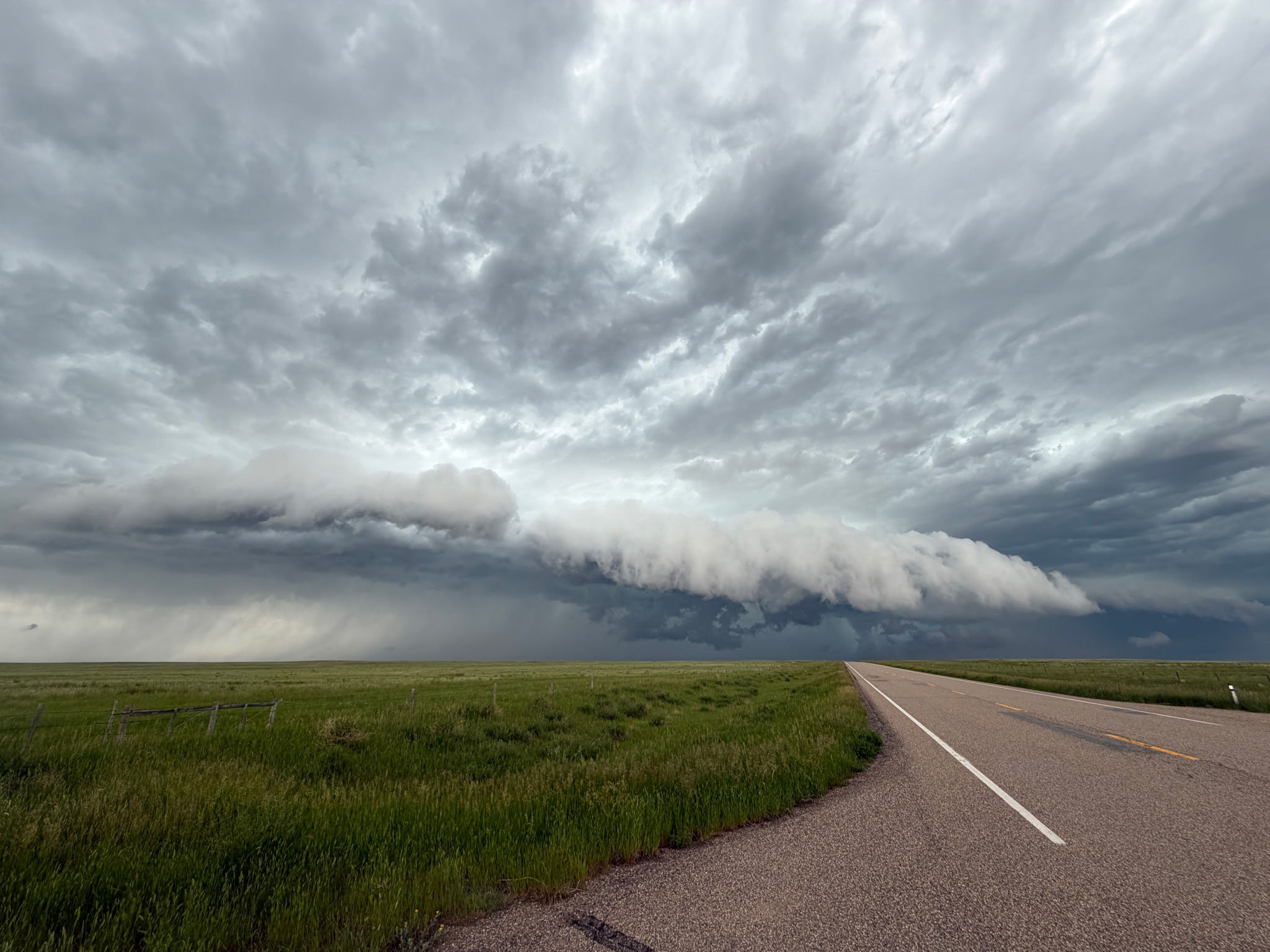
The air in southern Manitoba before a supercell breaks does not merely grow hot; it grows heavy, thick with a damp, suffocating weight that presses against the back of your neck. It smells faintly of ozone and bruised grass. If you look closely at the horizon on a July afternoon, the clouds do not resemble soft cotton. They are bruised iron, towering upward into towering anvil shapes that swallow the sun whole.
When the sirens begin their low, mechanical wail across towns like Winnipegosis and Fork River, the world shrinks. Everything outside of a basement stairwell or an interior bathroom suddenly loses its meaning.
For hours on a recent Saturday, Environment and Climate Change Canada draped a heavy red ink over regions like the Mossey River Municipality, Waterhen, Meadow Portage, and Skownan. A tornado warning is not a polite suggestion. It is an active crisis. It means rotation has been spotted on radar or seen by human eyes. It means a funnel is reaching toward the dirt, hunting for something to take.
But then, the alert clears. The red map goes gray. The text message on your phone reads: The warning has ended.
A collective sigh ripples through thousands of kitchens, living rooms, and storm shelters. The danger has passed. But what happens to the human psyche when the sky finally decides to hold its breath again, leaving us to step out into the sunlight and assess the quiet spaces left behind?
The Anatomy of the Near-Miss
To live on the Canadian Prairies is to understand a volatile contract with the horizon. A meteorologist will tell you that a massive upper ridge has been parking itself over the region, pumping suffocatingly hot, moist air into the atmosphere, sending humidex levels soaring into the mid-40s. They will talk about wind shear, thermal instability, and atmospheric triggers.
But a farmer standing on a porch in western Manitoba understands this reality in a fundamentally different way.
Consider a hypothetical family—let us call them the Friesens—living just outside the boundary of Riding Mountain National Park. When a warning hits, the physical logistics of survival take over. You gather the kids. You find the flashlights. You lock the front door, knowing deep down that a piece of brass and wood means nothing to wind blowing at 190 kilometers per hour.
You sit in the dark of the cellar, listening. Every crack of thunder sounds like a localized execution of the landscape.
The Northern Tornadoes Project recently used satellite imagery to confirm that what we originally thought was a single storm in late June was actually a brutal triplet. Three distinct tornadoes spun out of the same supercell storm. One left a scar through the ancient forest of Riding Mountain National Park with maximum wind speeds of 145 kilometers per hour. Minutes later, a second monster spun up near Roynick Lake, roaring at 190 kilometers per hour, snapping mature trees like dry toothpicks.
By the time July rolled around, Manitoba had already logged 10 confirmed tornadoes for the year. That eclipses the historical 30-year average of 8.5 per year, and summer is barely halfway through. The Prairies are experiencing a violent atmospheric awakening, seeing the highest frequency of twisters since the 1980s.
When the warning ends, you walk up the basement stairs. The door creaks open. The light is a strange, watery yellow. You look across your property, looking for what was lost. This time, it was nothing. This time, the storm took a path through uninhabited timber or dissolved over an empty slough.
The relief is dizzying. Yet, it is accompanied by a quiet, unshakeable guilt. Because you know the storm did not simply vanish into thin air; the energy merely shifted, leaving someone else to stare at a shattered roofline.
The Invisible Toll of the Alert
The human body is not designed to process a red alert with calm indifference. When the phone flashes with an emergency broadcast, a flood of cortisol and adrenaline hits the bloodstream. Your heart rate spikes. Your pupils dilate. Your mind races through a checklist of vulnerabilities: Where is the dog? Did I park the truck under the old elm tree? Is the barn latched?
When these warnings occur repeatedly over a single weekend—stretching into an eight-hour marathon of active alerts across Saskatchewan and Manitoba—the nervous system begins to fray.
The immediate danger ends when the weather agency lifts the warning, but the psychological echo lingers for days. Every dark cloud on the horizon becomes a threat. Every sudden drop in barometric pressure brings back that knot in the stomach. We tend to measure the severity of a storm season solely by its casualties and its dollar figures—by the trailers flipped over at campgrounds or the roofs peeled back in Winnipeg neighborhoods.
We rarely measure the invisible cost of the sleepless nights, the anxious glances at weather apps, and the profound vulnerability that comes from knowing your entire life can be upended by a passing cloud.
Consider what happens next: the weather system moves east, bleeding its remaining fury into northwestern Ontario, threatening communities near Kenora with the same red-coded dread. The danger does not disappear; it just changes addresses.
Surviving the Season of Open Skies
If you find yourself caught beneath a sky that has turned hostile before the warnings can even be updated, the old, ancestral wisdom of the plains remains our only true shield.
Step one is a ruthless abandonment of pride. Leave the mobile homes. Leave the tents, the trailers, and the temporary shelters that feel safe during a gentle summer rain but turn into projectiles when the wind shears. Find a permanent, heavy structure. If the earth is all you have left, find its lowest point. Lie flat in a ditch. Cover your head. Become as small as possible, letting the fury of the atmosphere pass over you.
If you are out on the vast, beautiful lakes that dot our province when the horizon begins to curdle, turn back immediately. Do not try to wait it out. If the shore is too far, put on your life jacket, stay low in the boat, and prepare for the world to turn upside down.
The weather office will continue to issue its technical bulletins, track the radar anomalies, and send its emergency pings to our pockets. They provide the data that keeps us alive, mapping the chaotic dance of a warming planet.
But the true resilience of Manitoba does not live in a radar dish. It lives in the quiet moments after the sirens stop. It is found in the neighbor who drives down the gravel road with a chainsaw in the back of his truck, checking on the folks down the line before the dust has even settled. It is found in the stubborn, quiet determination to rebuild, to replant, and to look at a vast, terrifying sky the very next morning with a sense of hope.