The air didn't just smell like smoke. It tasted like old copper and burnt plastic, a metallic grit that settled against the roof of the mouth and refused to wash away with water.
Outside, the Mediterranean sun was no longer a golden disc. It was a dull, bruised orange eye peering through a ceiling of charcoal.
Athens was holding its breath.
Just a few miles north of the ancient city, the pine forests of Mount Parnitha and the surrounding foothills were roaring. When people talk about wildfires in the abstract, they speak in terms of acreage and containment lines. They talk about humidity percentages and wind vectors. But on the ground, a wildfire is not a statistic. It is an entity with a heartbeat. It breathes in oxygen and exhales terror. It moves with a terrifying, calculated hunger, leaping across highways and swallowing decades of human memory in a matter of seconds.
Consider what happens when the wind shifts.
Maria stood on her rooftop in Varybobi, a suburb where the scent of pine used to mean peace. She held a damp washcloth to her face, her eyes stinging not just from the drifting ash, but from the realization that her life was packed into the trunk of a ten-year-old sedan idling in the driveway.
"We have ten minutes," a voice had shouted through a megaphone down the narrow street. Local authorities, stretched thin across multiple fronts, were moving door-to-door.
Ten minutes.
How do you distill forty years of existence into ten minutes? Do you grab the photo albums, heavy with the faces of grandparents who survived other wars, other tragedies? Do you grab the deeds to a house that is currently turning into tinder? Or do you grab nothing at all, paralyzed by the sheer impossibility of choice?
Maria grabbed a small wooden box containing her mother's baptismal cross and three changes of clothes. Then she ran.
Behind her, the horizon glowed with a sickening, incandescent fury.
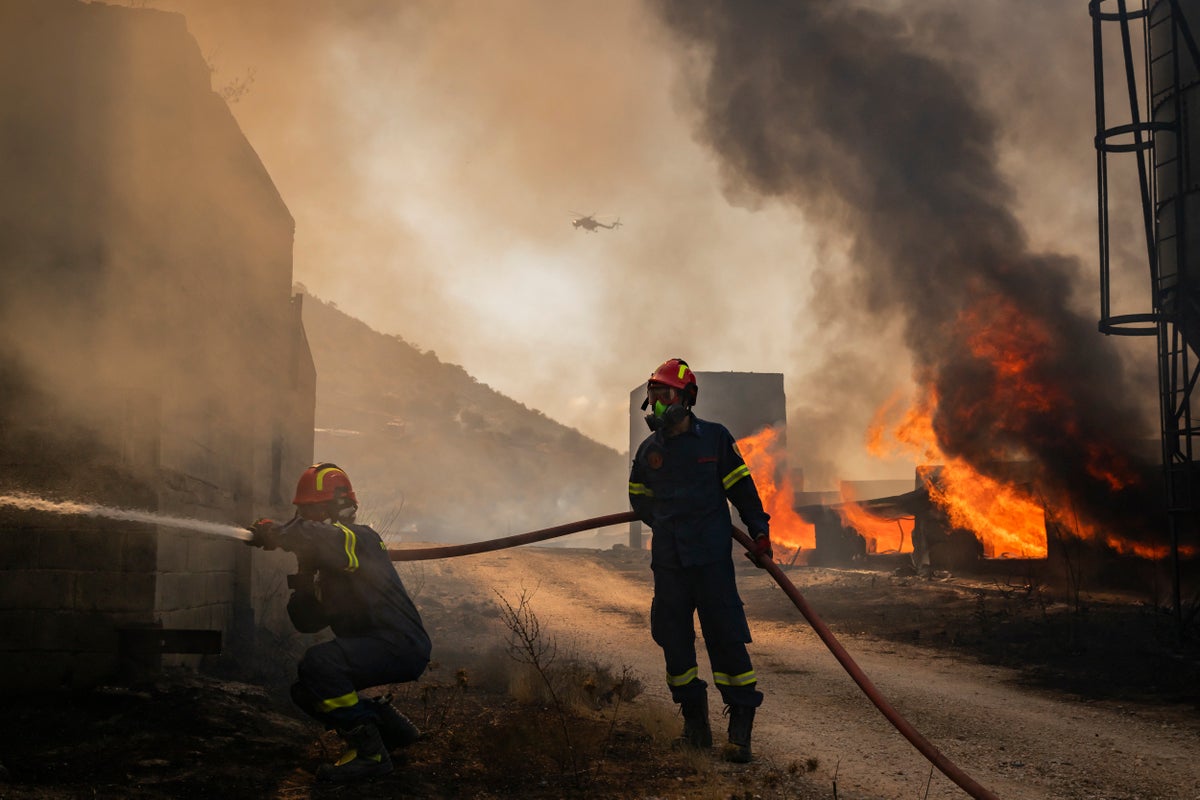
Hundreds of firefighters were already swallowed by that glow. They were men and women from Greece, reinforced by specialized teams arriving from across Europe under the EU Civil Protection Mechanism. They didn't look like heroes in promotional posters. They looked like ghosts moving through a fog of soot, faces smeared black, eyes bloodshot, hoses gripped in blistered hands.
Firefighting at this scale is an exercise in heartbreaking geometry. The wind is a variable that refuses to be solved. When gusts hit speeds of over forty miles per hour, dropping water from airplanes becomes a high-stakes gamble against physics. The water often evaporates before it even kisses the flames, turned to steam by the sheer, brutal thermal radiation rising from the canopy.
Yet they held the line.
They stood between a wall of fire and the northern suburbs of a city that has stood for millennia. They anchored their trucks on narrow dirt roads, wetting down roofs, cutting firebreaks with chainsaws while embers rained down like malevolent fireflies.
This is the hidden cost of our changing climate. We treat these disasters as seasonal inconveniences, sudden storms that arrive and depart, leaving behind neatly quantified property damage reports. But the trauma lingers long after the smoke clears. It lives in the lungs of the elderly who couldn't evacuate in time. It lives in the vacant lots where olive trees stood for generations, trees that watched empires rise and fall, only to be reduced to ash in an afternoon.
The science behind this is unforgiving. Decades of rising temperatures, prolonged droughts, and unmanaged underbrush have turned the Mediterranean basin into a loaded gun. All it takes is a spark—a discarded cigarette, a downed power line, a deliberate act of malice—to pull the trigger.
And once it fires, human infrastructure scrambles to catch up.
Back in the city center, miles from the front lines, the Acropolis stood pale and spectral against the smoggy haze. Tourists walked the Plaka with surgical masks on, looking up at the Parthenon with a strange, disconnected reverence, as if ancient stone could somehow protect them from modern catastrophe. The ash drifted down onto the ancient stones like black snow. History and disaster, locked in a strange, uneasy embrace.
By morning, the wind finally died down.
The sky turned a bruised, sickly yellow-gray. In the burn zones, the silence was absolute. The birds were gone. The cicadas, usually the constant soundtrack of a Greek summer, were silent.
Maria returned home. Or rather, she returned to the place where her home used to be.
The concrete skeleton of the house remained, but everything soft—the books, the curtains, the furniture, the quiet afternoons spent reading on the veranda—had been erased. The pine trees behind the fence were jagged black matchsticks, still smoking lazily into the damp morning air.
She walked through the front door frame, her boots crunching on broken glass and ash.
On the kitchen counter, miraculously shielded by a heavy cast-iron skillet that had fallen from a burning shelf, sat a ceramic coffee mug her daughter had painted for her years ago. The handle was cracked, but it was intact.
She picked it up. It was still warm.
Somewhere in the distance, a siren wailed, a sharp, piercing reminder that the fire season was far from over. But here, amidst the ruins, the smoke began to thin, revealing a pale, stubborn sliver of blue sky.


