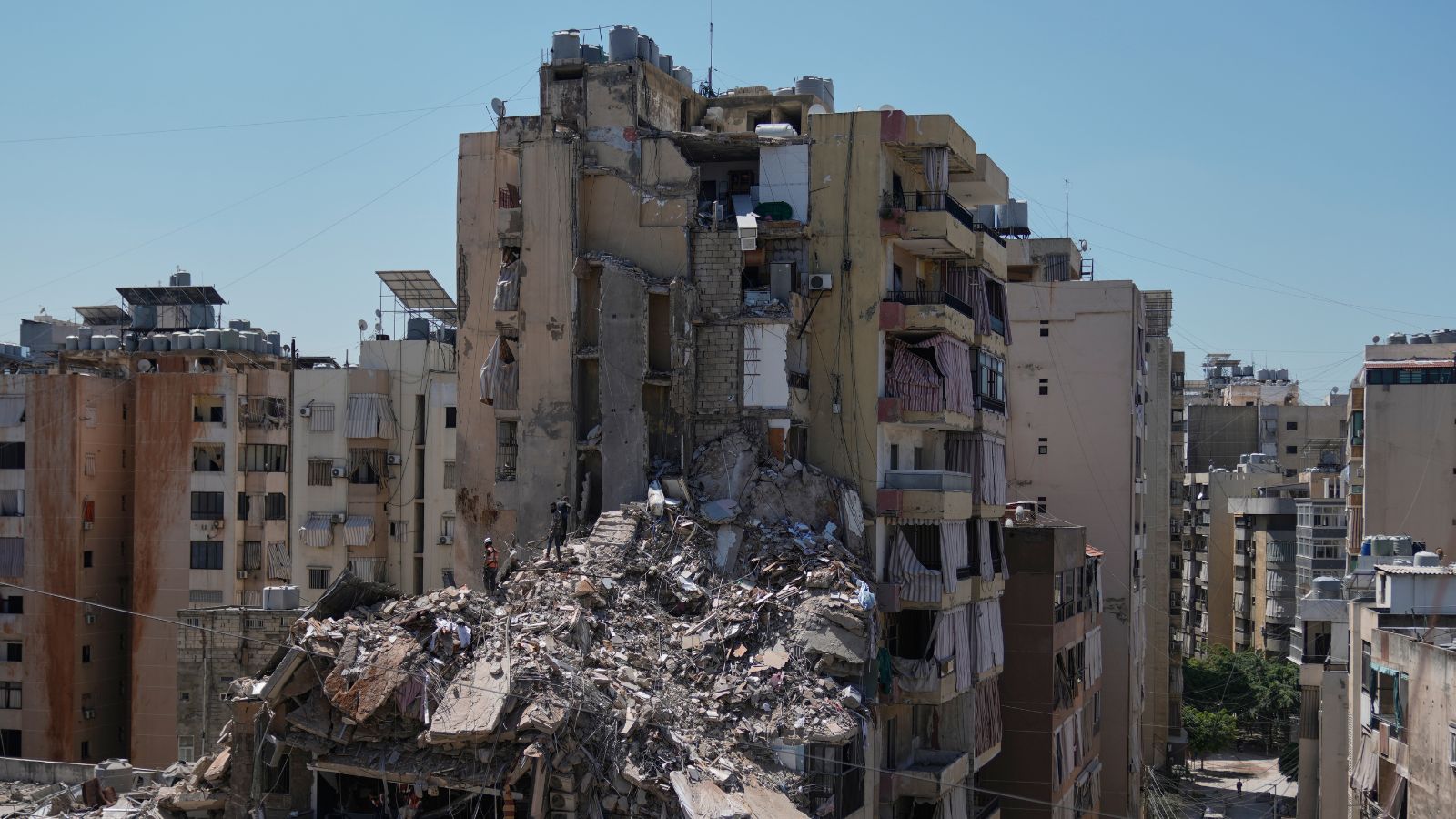
The windows in the Dahiyeh district don’t just break. They disintegrate.
When the munitions struck a high-rise in the southern suburbs of Beirut, the sound didn't travel; it arrived everywhere at once. It was a physical weight, a pressure wave that sucked the breath out of the lungs of shopkeepers three streets over. In the aftermath, the air tasted of pulverized concrete and something metallic—the scorched scent of high explosives meeting the domestic mundanity of kitchen appliances and office furniture.
This wasn't a random spasm of violence. It was a surgical erasure.
At the center of the dust cloud lay the remains of a man whose name was whispered in the corridors of power and shouted in the recruitment halls of the Bekaa Valley: the commander of Hezbollah’s elite Radwan Force. His death is a data point in a geopolitical ledger, a "successful strike" in a press release. But for the people living in the shadow of the Mediterranean, it is another chapter in a book that refuses to end.
The Ghost of the Radwan Force
To understand why a single man’s death matters more than the rubble he leaves behind, you have to understand the Radwan Force. Named after Imad Mughniyeh—whose nom de guerre was "Hajj Radwan"—this unit is not composed of part-time insurgents or ideologues with rifles. They are the scalpel of Hezbollah.
They are trained for one specific, terrifying purpose: the invasion of Galilee.
http://googleusercontent.com/image_content/180
For years, the Radwan Force has been the silent specter perched on Israel’s northern shoulder. They studied the topography of the panhandle. They mapped the kibbutzim. They built a subterranean world of tunnels and bunkers that rivals the complexity of any modern subway system. When an Israeli F-15 or a drone loiters over Beirut to find a Radwan commander, they aren't just hunting a soldier. They are trying to decapitate a strategy.
Consider a hypothetical resident of Beirut—let’s call her Maya. Maya is a pharmacist. She knows the political leanings of her neighborhood, but she also knows the price of bread is tripling and the electricity only stays on for four hours a day. When the building shook, she didn’t think about the "deterrence architecture" of the Middle East. She thought about whether the glass shards would find her daughter’s bed.
For Maya, the death of a commander is a paradox. It is a moment of perceived justice for some, a martyrdom for others, and for her, it is simply a signal that the ceasefire everyone keeps talking about is a ghost.
The Diplomacy of the Screaming Jet
The timing of the strike was as precise as the targeting. It arrived while diplomats in Washington, Paris, and Doha were still refining the language of a "sustainable calm." There is a grim irony in how we conduct modern warfare: we talk about peace in air-conditioned rooms while the sky above the Levant is filled with the roar of afterburners.
The logic of the strike is simple, if brutal. Israel’s military establishment believes that diplomacy only works when the opponent is bleeding. By removing the architects of the Radwan Force, they are forcing Hezbollah into a corner. They are saying, "Your elite cannot protect themselves, let alone your borders."
But history is a stubborn teacher.
We have seen this cycle before. A leader is killed. A "pivotal" victory is declared. Then, a younger, more radical successor steps out of the funeral procession. The invisible stakes here aren't just about who holds the rank of commander. It’s about the institutional memory of a group that has built its entire identity around the concept of "Muqawama"—resistance.
When you kill a commander in a crowded urban center, you aren't just destroying a military asset. You are fertilizing the soil for the next generation of grievances. The debris from that high-rise didn't just fall on the street; it fell on the hearts of people who were already weary of being pawns in a regional chess match between Tel Aviv, Tehran, and Washington.
The Calculus of Human Cost
Let’s look at the numbers, though numbers feel cold when applied to human life. Since the escalations began, tens of thousands of Lebanese civilians have been displaced from the south. Across the border, tens of thousands of Israelis have been living in hotels and temporary shelters, their northern towns turned into eerie, silent dioramas of their former lives.
The strike in Beirut was meant to bring those Israelis home. That is the stated goal. By crippling the Radwan Force, the IDF hopes to remove the threat of a cross-border raid, making the north safe again.
But the reality on the ground is messier. War is not a series of discrete events; it is a fluid, chaotic organism. Every time a missile finds its mark in Beirut, a rocket launch is authorized in the hills of Southern Lebanon. The "ceasefire tensions" mentioned in the news aren't just political disagreements. They are the literal vibrations of a region on the edge of a total, uncontained conflagration.
The commanders know this. They live in the shadows because they know their lives are the currency of this conflict. They trade their safety for the ability to project power. When that trade fails, the explosion is just the final audit.
The Silence After the Blast
There is a specific kind of silence that follows a structural collapse. It’s the sound of dust settling on broken porcelain. It’s the sound of a city holding its breath, waiting for the second strike, the "double tap" that has become a hallmark of modern urban warfare.
In that silence, the political analysts will tell you that Hezbollah is weakened. They will point to the loss of tactical expertise and the psychological blow of having a senior leader assassinated in his own stronghold. They aren't wrong. The Radwan Force is hurting. Its communications are frayed. Its leadership is looking over their shoulders, wondering which of their electronics is a tracking beacon.
But then there is the other side of the truth.
The people of Beirut—the ones who don't carry rifles, the ones who just want to keep their pharmacies open and their children safe—are learning to live with the impossible. They are developing a psychic callus. And a population that no longer fears the worst is a population that can never be truly controlled by "deterrence."
We often treat these events like a movie where the credits roll once the villain or the hero is eliminated. But in Lebanon, there are no credits. There is only the next morning. There is the clearing of the rubble. There is the funeral, where the slogans are louder than the day before.
The Invisible Borders
The border between Israel and Lebanon is officially called the Blue Line, but it is less a line and more a wound. It is a place where the past and the future collide every single hour. The commander who died in Beirut was a man of that border. He spent his life dreaming of ways to erase it.
Meanwhile, the diplomats continue to shuffle papers. They speak of "1701," the UN resolution that was supposed to keep the south clear of weapons. It is a document that exists in a different universe than the one where the Radwan Force operates. To the men in the tunnels, 1701 is a suggestion. To the pilots in the cockpits, it is a secondary concern to the mission at hand.
The real tragedy of the Beirut strike isn't just the death of a man or the destruction of a building. It is the realization that we are trapped in a loop. We are using 20th-century tactics to solve 21st-century ideological rifts, and the only thing being "unleashed" is more of the same.
The invisible stakes are the souls of the children growing up in these shadow wars. What do they see when they look at the sky? They don't see the beauty of a sunset over the Mediterranean. They look for the silver glint of a drone. They listen for the whistle.
The Weight of the Rubble
As the sun sets over the Mediterranean, the smoke from the Dahiyeh strike begins to thin, blending into the hazy smog of a city that has seen too much. The rescue crews work by the light of portable generators, their shovels scraping against the bones of a building that used to be someone’s home.
The commander is gone. His name will be printed on posters and plastered on walls. He will become an icon, a symbol, a memory.
But for Maya, the pharmacist, the commander’s death hasn't changed the fundamental equation of her life. The sky is still dangerous. The future is still a flickering light. She will go home, if her home is still standing, and she will try to explain to her daughter why the world shook today.
She will tell her that it was just the wind, or a thunderstorm, or a heavy truck. She will lie because the truth—that men are killing each other for the right to control the ruins—is too heavy for a child to carry.
The geopolitical experts will spend the next week debating whether this strike brings us closer to a ceasefire or a full-scale war. They will use maps and pointers. They will talk about "strategic depth" and "tactical advantages." They will miss the point entirely.
The real story isn't the man who died. It’'s the million people who have to live in the space he left behind. It’s the way a single explosion can ripple outward, crossing borders and oceans, until it reaches the heart of anyone who still believes that peace is something you can build with bombs.
In Beirut, the night is coming. The sirens are fading. The city is preparing for whatever tomorrow decides to bring. And in the dark, the Radwan Force is already choosing a new name to put on the office door, while the rest of the world waits for the next sound of breaking glass.


