:strip_icc()/pic7213199.jpg)
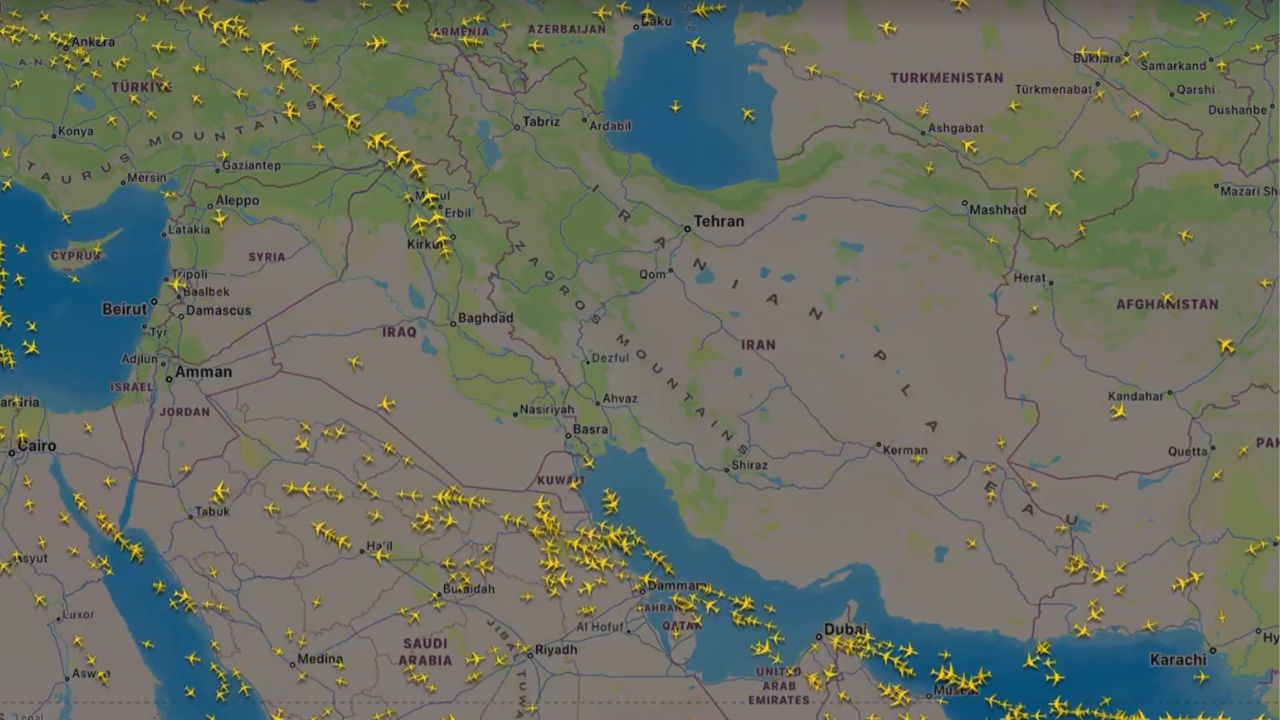
The global aviation industry is currently rewriting its playbook in real-time as a direct result of the escalating military exchanges between the United States, Israel, and Iran. This is no longer a temporary disruption involving a few diverted flight paths. It is a fundamental collapse of the geographic "bridge" that connects Europe to Asia. When the first reports of missile strikes hit the wires, airlines didn't just delay flights; they effectively surrendered some of the most lucrative air corridors on the planet.
Major carriers including Lufthansa, Air France-KLM, and United Airlines have slashed their schedules to Tehran, Tel Aviv, and Beirut, citing an unacceptable risk to civilian life. But the reality goes deeper than immediate physical danger. We are seeing the death of the "overflight" economy in the region. For decades, airlines paid hefty fees to traverse Iranian and Iraqi airspace because it was the most fuel-efficient route between London and Mumbai or Singapore and New York. Now, those routes are being scrubbed. The fuel costs of circumnavigating the entire Persian Gulf are adding millions to weekly operating budgets, and those costs are already trickling down to passenger ticket prices.
The Geometry of a No-Fly Zone
Aviation safety isn't just about avoiding a direct hit from a missile. It is about the "cone of uncertainty" that exists during active electronic warfare. When state actors engage in high-intensity strikes, GPS jamming and "spoofing" become standard tactical maneuvers. For a commercial pilot, losing reliable GPS navigation over a mountainous region or a dense urban center is a nightmare scenario.
Industry analysts are looking at the current map and seeing a tightening noose. To the north, Russian airspace remains closed to most Western carriers due to the war in Ukraine. To the south, the Red Sea corridor is under threat from Houthi militants. Now, with the central corridor through the Middle East compromised by US and Israeli strikes on Iranian interests, the "Great Circle" routes that make long-haul flight profitable are essentially gone.
The detour is brutal. A flight from London to New Delhi that used to take nine hours can now take eleven or twelve. That extra time requires more fuel, more crew hours, and more wear on the airframe. Most importantly, it limits the amount of cargo a plane can carry, as weight must be sacrificed for the extra fuel load. This is a supply chain crisis masquerading as a travel inconvenience.
Insurance Markets Are the Real Commanders
While the public watches the military maneuvers, the most significant decisions are being made in the boardrooms of London and Zurich. Insurance underwriters have the final say on where a plane flies. The moment the US and Israel signaled a shift toward direct kinetic action against Iranian targets, the "war risk" premiums for the region skyrocketed.
For many airlines, it isn't a matter of can we fly to Tehran, but should we pay the $50,000 extra per flight just for the insurance coverage. In many cases, the answer is a flat no.
Why the Current Stoppage is Different
In previous decades, Middle Eastern tensions were often localized. A conflict in Gaza or a skirmish on the Lebanese border might cause a few days of rerouting. This current escalation is systemic.
- Target Diversity: The strikes are hitting logistics hubs, drone manufacturing sites, and command centers scattered across vast geographic areas.
- Predictability: There is none. Unlike the traditional "tit-for-tat" exchanges of the past, the current posture of the US and Israel suggests a willingness to strike without the usual back-channel warnings that allowed airlines to move their assets out of harm's way.
- The Ukraine Lesson: The industry is still haunted by the downing of MH17. No CEO wants to be the one who gambled on a "de-escalation" that never came.
The Regional Carrier Trap
While global giants like Emirates, Qatar Airways, and Etihad are masters of the "pivot," smaller regional players are facing an existential threat. These airlines rely on the stability of their home hubs. If the airspace over Amman, Beirut, or Baghdad becomes a permanent "amber zone," these carriers lose their primary competitive advantage: location.
We are observing a shift where the "Super-Connectors" of the Gulf are forced to fly increasingly convoluted patterns to avoid Iranian-aligned territory. This adds minutes to every flight, but those minutes compound. If a hub-and-spoke model relies on 45-minute transfer windows, a 15-minute delay due to rerouting breaks the entire system. Missed connections lead to grounded passengers, which leads to massive compensation claims under international aviation law.
The Hidden Cost of "Precautionary" Cancellations
When an airline cancels a flight "out of an abundance of caution," it isn't just the passengers on that plane who suffer.
- Cargo Perishables: High-value electronics and medical supplies often travel in the bellies of passenger planes.
- Crew Positioning: If a flight to Tel Aviv is canceled, the crew that was supposed to fly the return leg is now stuck in the wrong city, causing a "domino effect" of cancellations across the rest of the network.
- Diplomatic Friction: Airlines often act as the unofficial flag-bearers for their nations. A total withdrawal of Western flights from a country is a powerful signal of diplomatic isolation, one that often precedes even harsher economic sanctions.
The Technology Gap in Modern Cockpits
Modern commercial jets are marvels of engineering, but they are surprisingly vulnerable to the types of electronic interference currently being deployed in the Middle East. If an Israeli strike involves high-end electronic jamming to blind Iranian air defenses, any civilian aircraft in a 200-mile radius could lose its primary navigation data.
We have already seen reports of "phantom" signals appearing on cockpit displays in the region. These signals can trick a plane's computer into thinking it is miles away from its actual position. While pilots are trained for this, it increases the cognitive load significantly. In a high-stress environment where air traffic controllers may also be struggling with equipment interference, the margin for error shrinks to near zero.
This Is Not a Temporary Glitch
The assumption that things will "return to normal" by next season is a dangerous one for the travel industry. The geopolitical architecture of the Middle East is shifting toward a more permanent state of friction. Just as the closure of Soviet airspace during the Cold War defined a generation of travel, the "closing" of the Middle Eastern corridor could become a semi-permanent feature of 21st-century aviation.
Airlines are already looking at "polar routes" and long-range aircraft like the Airbus A350-1000 to bypass the region entirely. This requires a massive capital investment that most carriers weren't planning to make for another decade. The cost of this transition will be borne by the traveler. Expect a future where a flight to Asia is a rare luxury rather than a routine business trip.
The reality is that the US and Israel have signaled a new doctrine of proactive engagement. This means the threat level won't drop back to "green" just because a specific strike has ended. As long as the threat of a regional firestorm remains, the "Notice to Airmen" (NOTAM) warnings will stay active, and the gates to the East will remain heavy and difficult to swing open.
Watch the fuel surcharges on your next booking. They are the most honest indicator of how dangerous the world has become.
Stop looking for a return to the status quo and start adjusting to a world where the map has been permanently redrawn by a few nights of tactical strikes.