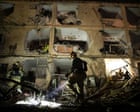
The desert does not keep secrets; it only buries them under layers of shifting heat. In the Negev, where the sand turns a pale, chalky yellow, the wind carries a specific kind of stillness. It is the silence of a place that knows it is being watched from three hundred miles above by lenses that can count the buttons on a soldier’s tunic.
At the center of this stillness lies Dimona. Officially, it is a research center. Unofficially, it is the geographic heart of Israel’s ultimate insurance policy. When the sirens finally tore through that silence, they didn't just warn of incoming metal. They signaled the end of a decades-old shadow play. Learn more on a connected subject: this related article.
For years, the conflict between Iran and Israel operated like a whispered conversation in a crowded room. A cyber-attack here, a pinpointed assassination there, a "mysterious explosion" at a centrifuge facility in Natanz. It was a war of ghosts. But ghosts don't leave craters.
The Weight of the Sky
Imagine being a resident of a small desert town, perhaps a mechanic or a schoolteacher, someone who has grown accustomed to the distant silhouette of the Shimon Peres Negev Nuclear Research Center. You know it’s there. You know what people say about it. But mostly, it’s just a part of the horizon, as permanent and inert as the mountains of Jordan in the distance. More journalism by NPR explores related perspectives on this issue.
Then, the sky changes color.
The retaliation for the strike on Natanz wasn't a diplomatic cable or a sanctioned protest. It was a kinetic statement. When Iran launched a missile that landed within reach of Dimona, they weren't just aiming for a building. They were aiming for the psychological ceiling of a nation.
Ballistic physics is a cold, unforgiving math. To move an object from a silo in the Iranian highlands to a specific coordinate in the Negev requires a mastery of propulsion, guidance, and the sheer audacity to cross multiple sovereign borders. When that object streaks through the atmosphere, it creates a sonic boom that feels less like a sound and more like a physical blow to the chest.
The Ghost in the Machine at Natanz
To understand why the sand shook in Dimona, we have to look back at the shattered glass in Natanz.
Natanz is a subterranean labyrinth. It is a forest of steel—thousands of tall, slender tubes spinning at speeds that defy intuition. These are the centrifuges. Their job is to separate isotopes, a process so delicate that a vibration the size of a heartbeat can cause the whole system to disintegrate.
When a "power failure" or a "deliberate explosion" hits a place like Natanz, it isn't just a maintenance headache. It is a surgical strike on a nation's scientific pride. Imagine the years of engineering, the billions of rials, and the clandestine procurement of parts, all reduced to a pile of scrap metal because of a breach in the perimeter or a line of malicious code.
For Tehran, the strike on Natanz was a humiliation that required a symmetrical response. In the grim arithmetic of Middle Eastern geopolitics, silence is often interpreted as weakness. If your heart is struck, you reach for the throat of your adversary.
The Anatomy of a Near Miss
The missile that fell near Dimona was reported by some as an "errant" anti-aircraft missile, a stray S-200 that simply forgot to stop flying. That is the polite version of the story. The reality is more unsettling.
Whether by design or by a stroke of terrifying luck, the projectile bypassed one of the most sophisticated air defense umbrellas on the planet. This is the Iron Dome, the David’s Sling, the Arrow system—a multi-layered shield designed to make the Israeli sky impenetrable.
But no shield is perfect.
Consider the sheer complexity of the interception. An incoming missile is traveling at several times the speed of sound. The defense system must detect it, track it, calculate its trajectory, and launch an interceptor to collide with it—all in the span of a few heartbeats. It is like trying to hit a speeding bullet with another bullet while standing on a moving train.
When that "bullet" lands near a nuclear facility, the math stops being academic. It becomes existential. Even if the reactor itself is encased in meters of reinforced concrete designed to withstand a direct hit, the message is delivered: We can touch you.
The Human Cost of Strategic Ambiguity
We often talk about these events in terms of "strategic assets" and "deterrence capabilities." We forget the people living in the shadow of the cooling towers.
There is a specific kind of exhaustion that comes from living in a target zone. It is a low-grade hum of anxiety that settles into the marrow. In Israel, the "red alert" is a part of childhood. In Iran, the threat of a sudden strike on infrastructure looms over every political shift.
The engineers at Natanz and the technicians at Dimona are, in many ways, mirrors of each other. They are highly educated, deeply patriotic, and fully aware that they are the primary targets in a war that hasn't been officially declared. They work in environments where a single mistake—or a single successful infiltration—means the end of their life’s work, or their life itself.
This isn't a game of chess. Chess has rules. This is a game of poker played in a dark room with a loaded gun on the table.
The Invisible Stakes
The real danger of the strike near Dimona isn't the physical damage to the desert floor. It is the erosion of the "unspoken."
For decades, both sides knew where the lines were drawn. You don't hit certain targets. You don't use certain weapons. You keep the conflict in the shadows. By bringing the fire to the doorstep of a nuclear facility, the rules have been set ablaze.
When the threshold of "unthinkable" is crossed, it becomes the new baseline. Yesterday, a missile landed in the vicinity. Tomorrow, the target might be the cooling system. The day after, the power grid of an entire city.
The technology of destruction is evolving faster than the diplomacy of restraint. We now possess the ability to reach across the globe and delete a facility with a keystroke or a drone, but we haven't yet mastered the ability to talk our way out of the inevitable retaliation.
A Sky Full of Iron and Fire
As night falls over the Negev, the technicians go home. The soldiers in the radar arrays keep their eyes on the screens, watching for the tiny blips that represent a threat.
The desert is quiet again, but it is a fragile silence.
The craters will be filled. The centrifuges will be replaced. The political leaders will give speeches about "unprecedented responses" and "unshakable resolve." But for the people on the ground, the world has shifted. They have seen the sky turn to fire, and they know that the distance between a "near miss" and a catastrophe is only a few degrees of a guidance fin.
We live in an age where the most advanced technology is used to safeguard the most primitive of human impulses: the desire to strike back. As long as the cycle of retaliation dictates the rhythm of the region, the silence of the desert will remain a lie. It is only the breath taken before the next scream.
The sirens are quiet for now. But in the air over Dimona, the ghost of the next missile is already flying, waiting for the moment when the shadows are no longer enough to hide the rage.


