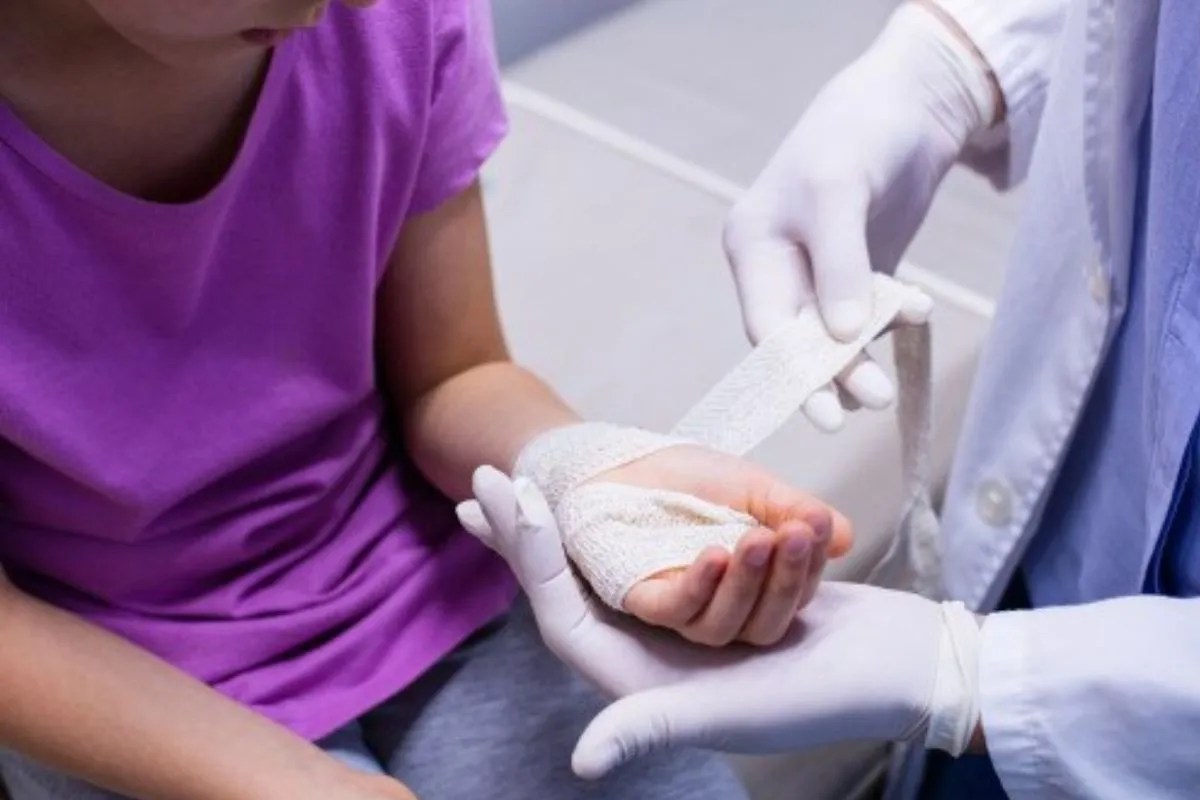
The room smells of sterile gauze and low-grade panic. If you have ever sat by a hospital bed, watching a loved one sleep while a plastic pump hums in the background, you know the specific terror of the unseen. You look at the white cotton taped to their skin. Underneath that fabric, a microscopic war is raging.
Is the wound healing? Is it festering?
Right now, the only way to find out is to rip the tape off.
The Agony of the Peel
Every doctor and nurse faces the same agonizing dilemma multiple times a day. To check for an infection, you must expose the wound. But tearing away a dressing disrupts the fragile, newly forming layers of skin. It introduces airborne bacteria. It hurts. It is a primitive, brutal guessing game masquerading as modern medicine.
Let us ground this in a scenario that plays out in thousands of clinics every morning. Consider a patient named Ramesh. He is sixty-two, diabetic, and recovering from a routine surgical procedure on his foot. For Ramesh, a localized infection is not just an inconvenience. It is a straight path toward tissue death, severe sepsis, or amputation.
Every two days, Ramesh visits the clinic. The nurse peels back the bandage. Ramesh winces. The nurse sniffs the wound, looks for redness, and pokes the edges.
"It looks a little angry," the nurse says.
That phrase—a little angry—is the pinnacle of our current diagnostic precision for early-stage wound complications. It is a vibe check. If the nurse panics, Ramesh gets a heavy dose of broad-spectrum antibiotics. If the nurse is too optimistic, the bacteria gain a foothold, multiplying quietly beneath the surface until the infection spills into the bloodstream.
We are fighting a modern war with medieval binoculars.
The Invisible Threat of the Blanket Prescription
When in doubt, we medicate. It is the golden rule of defensive medicine. Because we cannot see through the cotton, we flood the human body with antibiotics at the slightest hint of trouble.
This brings us to a terrifying global crisis that feels abstract until it knocks on your door: antimicrobial resistance. Bacteria are smart. When we bombard them with antibiotics unnecessarily, the weak ones die, and the strong ones learn how to survive. We are rapidly running out of medicines that actually work.
The real tragedy is that over half of the antibiotics prescribed for chronic wounds are entirely unnecessary. They are given "just in case." We sacrifice our long-term global immunity because we lack the vision to see through a piece of woven fabric.
But what if the bandage could talk?
The Fabric That Thinks
Scientists have quietly engineered a profound shift in how we treat trauma. They have created a smart dressing. This is not a standard piece of gauze coated in antiseptic; it is a highly integrated, responsive system that bridges the gap between textile engineering and biochemistry.
The science relies on a fundamental biological truth: bacteria change their environment. When a colony of pathogens takes over a wound, the chemistry of the localized fluid shifts. The pH levels fluctuate. Temperature rises. Specific enzymes are secreted.
The smart bandage utilizes embedded micro-sensors that constantly taste and feel the wound fluid.
Imagine a mesh woven with biocompatible polymers that change color or transmit a low-energy wireless signal the exact moment the pH transitions from healthy to infected. The fabric detects the invasion days before a human eye would notice redness, and long before Ramesh would feel a fever.
Autonomous Rescue
Detecting the enemy is only half the battle. The true genius of this technology lies in its ability to fight back without human intervention.
Within the fibers of the smart dressing sit microscopic capsules of targeted antimicrobial agents. These capsules are sealed with a heat-sensitive or chemical-sensitive membrane. Under normal healing conditions, the medicine remains locked away, completely inert.
But when the bacteria begin their assault, the chemical shift acts as a key. The membranes dissolve. The bandage autonomously releases the precise dose of antibiotics required to neutralize the threat right at the site of infection.
The implications are staggering.
- Zero Waste: The medicine goes exactly where it is needed, avoiding the liver and stomach entirely.
- Instant Action: There is no waiting for a lab culture to come back from the hospital pharmacy.
- No Pain: The dressing remains undisturbed, allowing the skin cells to knit back together in peace.
Consider what happens next for someone like Ramesh. He wears the smart dressing. He goes home. He watches television. Underneath the clean white cloth on his foot, a small cluster of harmful bacteria attempts to colonize a suture. The bandage feels the chemical signature of the bacteria. It opens its micro-reservoirs. It releases a targeted dose of medicine. The bacteria are wiped out within an hour.
Ramesh never feels a thing. The nurse never has to peel back the tape. The global supply of antibiotics remains unthreatened by another unnecessary prescription.
The Friction of New Frontiers
It sounds like science fiction, and like all things that sound too good to be true, it faces a steep, rocky path to widespread adoption.
As someone who watches the intersection of technology and human health, I admit to a healthy dose of skepticism regarding the rollout. Who pays for this? A standard roll of gauze costs pennies. A smart dressing laced with polymers and biochemical triggers will initially cost significantly more. Hospital boards look at budgets through a cold, analytical lens.
Then there is the question of reliability. What happens if a bandage misreads a harmless sweat gland fluctuation as a massive bacterial infection and dumps its entire payload of medicine into a healthy wound? The human body is incredibly messy, chaotic, and unique. Coding a piece of fabric to understand the nuance of human flesh is an immense challenge.
Yet, the alternative is to keep doing what we have done since the American Civil War: wrap the injury in cloth, wait for the patient to cry out in pain, and pray that the infection hasn't reached the bone.
Beyond the Hospital Bed
We must look at the broader canvas to truly appreciate what is happening here. The smart bandage is a harbinger of a shift toward passive, autonomous healthcare. We are moving away from reactive medicine—where you get sick, visit a doctor, and get a pill—toward a world where your clothing, your bedsheets, and your bandages act as an external immune system.
It reframes our relationship with our bodies. It removes the burden of vigilance from the patient and the caregiver.
The true value of this technology isn't found in the sophistication of its polymers or the elegance of its micro-circuits. Its value is found in the quiet stillness of a hospital room where a family member can sit, hold their loved one's hand, and look at a clean, white bandage with absolute peace of mind, knowing that the fabric is watching over them.