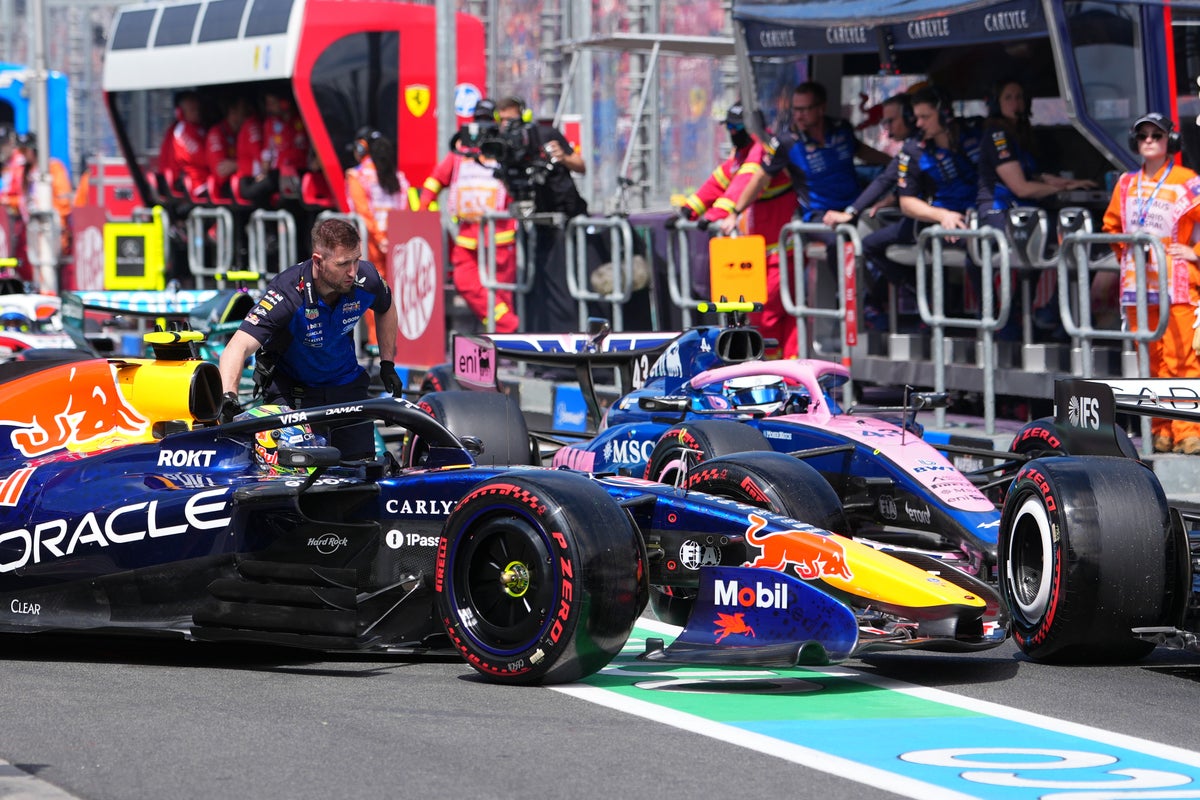
The air in the garage usually smells of high-octane fuel and expensive rubber. It is a scent that represents the pinnacle of human engineering, a frantic, mechanical heartbeat that pulses at eighteen thousand revolutions per minute. But lately, in the hushed boardrooms where the global map of Formula 1 is drawn, the air smells of something else entirely. It smells of ozone and uncertainty.
Stefano Domenicali is not merely a CEO. He is a tightrope walker. On one side of his rope lies the commercial juggernaut of the Middle Eastern expansion—billions of dollars in hosting fees, shimmering night circuits in the desert, and a fan base growing faster than a DRS-enabled overtake. On the other side lies the brutal, uncompromising reality of a region on the brink of a massive shift.
The decision to delay the official confirmation of races in the Middle East isn't just a scheduling conflict. It is a mirror held up to the sport’s greatest contradiction: the desire to be a global, borderless entertainment entity while being physically tethered to the ground in some of the world's most volatile geography.
Imagine a mechanic in a fireproof suit, his hands trembling slightly as he checks the tire pressures for a race that might never happen. He isn't thinking about the championship standings. He is looking at the news alerts on his phone. He is wondering if the charter flight home will be routed through a combat zone. This is the invisible weight that data points and press releases never capture.
The Geography of Risk
Formula 1 operates on a logistics chain so complex it rivals military operations. To move ten teams, their cars, spare parts, hospitality units, and thousands of personnel across continents requires a precision that leaves no room for error. When Iran enters a state of kinetic conflict, the ripples don't just affect local shipping. They rewrite the entire manual for international transit.
The Strait of Hormuz is a narrow neck of water, but for the world of motorsport, it is a choke point for the imagination. If the airspace is closed, the "circus" stops.
During the 2024 season, we saw the first cracks. A missile strike near a track in Jeddah a few years back was a warning shot that the sport tried to muffle with corporate platitudes. Now, the stakes have evolved from localized incidents to regional instability involving major powers. The delay in finalizing dates for races in Bahrain, Qatar, or Abu Dhabi isn't about the readiness of the tarmac. The tarmac is perfect. The grandstands are gold-plated. The problem is the sky above them.
Insurance premiums for a single Grand Prix weekend are already astronomical. When a "force majeure" event becomes a statistical probability rather than a fringe theory, the math changes. Lloyd’s of London underwriters are suddenly more influential in the paddock than the aerodynamicists at Red Bull or Mercedes. If the insurers won't back the event, the engines don't start.
The Human Cost of the Spectacle
We often talk about "The Show" as if it were an autonomous machine. It isn't. It is made of people.
Consider the junior engineer who has spent six months away from their family. For them, a race cancellation isn't a loss of revenue; it’s a terrifying question mark. They are the ones sitting in hotel lobbies in Manama or Lusail, watching the local news and trying to decipher the tone of a government spokesperson. They are the ones who have to explain to a spouse back in Oxfordshire why they are staying in a city that might become a target.
The sport prides itself on being "one family." But families have breaking points.
The drivers, too, are caught in a pincer movement between their contracts and their consciences. They are paid to be the fastest humans on earth, to ignore fear, and to push the limits of physics. But how do you focus on a late-braking maneuver into Turn 1 when you know that a few hundred miles away, the geopolitical equivalent of a multi-car pileup is occurring?
In the past, the sport could hide behind the "sports and politics don't mix" mantra. That shield has shattered. You cannot host a race in a country that is either a participant in or a primary target of a regional war and claim that the event exists in a vacuum. The roar of the engines cannot drown out the sound of the headlines.
The Financial Gravity
Formula 1 is a business of momentum. The current Concorde Agreement demands a certain number of races to satisfy broadcasting contracts worth hundreds of millions. If the Middle Eastern leg of the season—which often provides the bookends of the calendar—is compromised, the financial impact isn't a ripple. It’s a tsunami.
- Hosting Fees: Each Middle Eastern race brings in an estimated $40 million to $55 million in direct payments to Formula One Group.
- Sponsorship: Massive state-owned entities like Aramco are the lifeblood of the sport's current commercial model.
- Tourism: Local economies rely on the "F1 Bump," where hotels and services see a 300% increase in revenue during race week.
When these numbers are threatened, the delay in the decision-making process becomes a desperate attempt to buy time. Formula 1 is waiting for a ceasefire that may not come, or a de-escalation that feels increasingly like a fantasy.
Every day that passes without a firm calendar is a day where the logistics teams cannot book the 747 freighters. It is a day where fans lose money on non-refundable flights. It is a day where the credibility of the sport’s "global" vision is tested against the reality of a fractured world.
The Ghost in the Machine
There is a specific kind of silence that falls over a racetrack when the cars aren't running. It is heavy. It feels like a void.
That silence is currently haunting the offices in London and the garages in Italy. The delay is the sound of the sport holding its breath. We have seen this before, during the early days of 2020 when the Australian Grand Prix was canceled hours before the engines were meant to fire. The chaos of that morning—fans pressed against the gates while the teams packed their crates in secret—remains a scar on the sport’s reputation.
Nobody wants a repeat of Melbourne 2020. But by delaying the decision, F1 is flirting with a different kind of disaster: the slow-motion collapse of a season.
The "invisible stakes" here aren't just about money or safety. They are about the soul of the competition. If a race is held under the shadow of war, does the trophy mean the same thing? If a driver wins a Grand Prix while the world is watching a tragedy unfold next door, is the champagne sweet or bitter?
We are watching a collision between the fastest sport in the world and the slowest, most grinding gears of international diplomacy. One operates in milliseconds. The other operates in decades of grievances and centuries of history.
The cars are ready. The drivers are fit. The tracks are waiting, their floodlights ready to turn night into day. But as the sun sets over the Persian Gulf, the long shadows aren't being cast by the grandstands. They are being cast by the missiles on the horizon.
Formula 1 likes to say it "leaves a legacy" wherever it goes. This year, the legacy might be the realization that even the fastest cars on earth cannot outrun the reality of the world they race in.
The paddock is quiet. The decision is delayed. The world is watching. And for the first time in a long time, the most important light isn't the five red ones at the start of the grid. It’s the one flickering in a situational awareness room, deciding if the circus can safely roll into town.
The engine is idling. We are all just waiting to see if they let us engage the clutch.
Would you like me to look into the specific historical precedents for race cancellations due to civil or international conflict?