The Boardroom of Infinite Chalk
Late at night, in the quietest corridors of the world’s elite research institutes, you will not hear the hum of supercomputers or the clinking of chemical glassware. You will hear chalk.
It is a scratchy, rhythmic cadence. The sound of a human mind trying to drag a brand-new truth out of the void and press it onto a slate board. Recently making news in this space: How India Dismantled Pakistan's Transboundary Flood Allegations.
For nearly a century, the geographic heart of that sound was remarkably predictable. If you wanted to hear the sharpest mathematical minds solving the hardest problems in the universe, you went to Princeton. You went to Paris. You went to Cambridge. You listened to European and American scholars trade ideas over black coffee, building the foundation of every modern encryption algorithm, every satellite navigation system, and every predictive financial model we rely on today.
Then the center of gravity began to pull westward across the Pacific. Silently. Steadily. Further insights on this are covered by TIME.
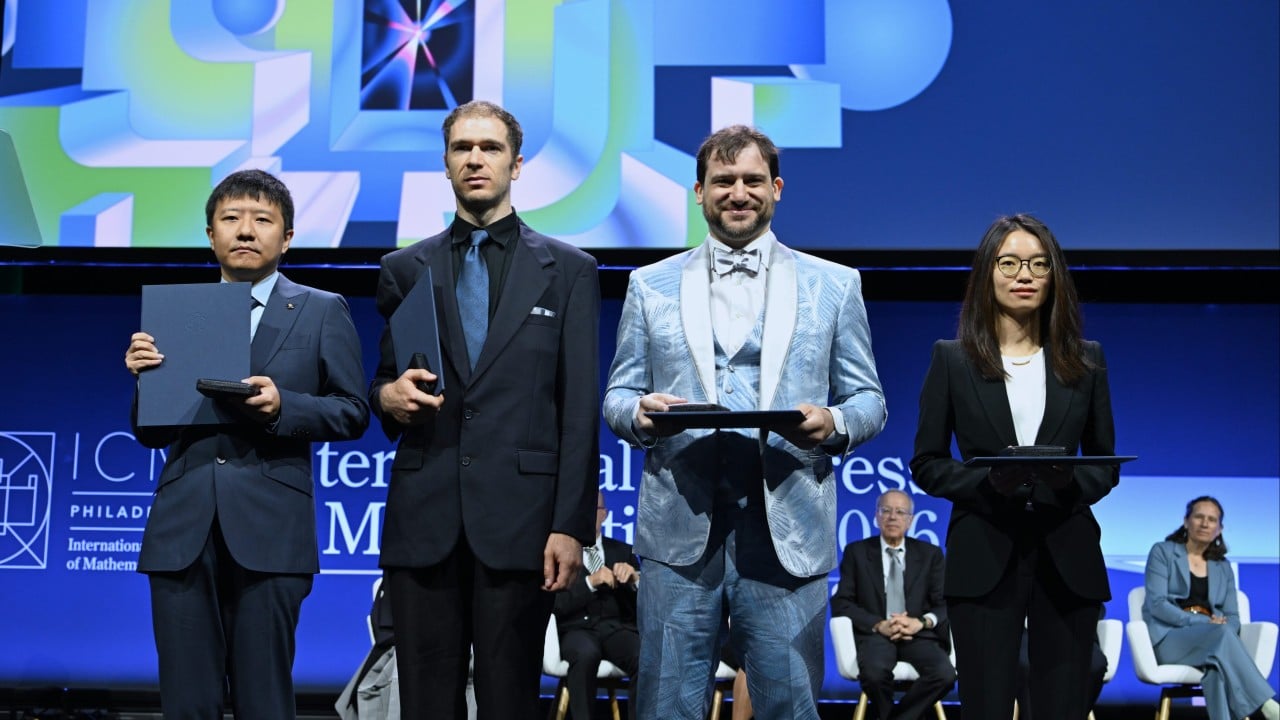
Mathematics does not make headlines the way political campaigns or stock market crashes do. Abstract geometry lacks a marketing department. Yet, the recent wave of Fields Medal winners—the mathematical equivalent of the Nobel Prize—signals a seismic migration. A generation of brilliant Chinese mathematicians, trained at the world's most prestigious Western institutions, is returning home, bringing back the sharpest intellectual edge on Earth.
This is not merely a story about academic prestige. It is about who writes the underlying code of the future.
The Weight of a Golden Medallion
To understand what is happening, you have to understand the Fields Medal itself.
It is awarded only once every four years, and only to mathematicians under the age of forty. That age limit introduces a brutal, ticking-clock element to the endeavor. You cannot win it for a lifetime of steady, reliable work. You must produce a lightning bolt of sheer brilliance while you are still young enough to feel immortal.
Imagine spending your late twenties staring at a single equation. You wake up with it. You walk to the grocery store with it. You miss birthdays, anniversaries, and sleep, all to solve a problem that only forty other people on the planet even understand.
When a young scholar achieves that breakthrough, they become more than an academic. They become a national asset.
For decades, the trajectory of these young prodigies was linear. A mathematical prodigy born in Chengdu or Hangzhou would excel at Peking University, earn a doctorate at Harvard or MIT, secure a tenured professorship at a top American university, and stay. The brain drain was a reliable feature of global academia. Western research labs offered unmatched funding, total academic freedom, and access to the greatest minds of the previous generation.
Then the math changed.
The Turning Tide
Consider the mechanics of a career shift. It rarely happens because of grand geopolitical speeches. It happens because of quiet, practical shifts in human motivation.
A young professor sits in a drafty faculty office in Massachusetts. She has spent fifteen years abroad. She has achieved tenure, published in top journals, and secured her place in the global community. But when she looks at the next twenty years, the math looks different than it did to her mentors.
In Beijing, Shanghai, and Shenzhen, entire research institutes are being erected not over decades, but over months. Funding for pure, curiosity-driven science—the kind that produces no immediate commercial product—is surging. Western universities, meanwhile, face tightening budgets, administrative gridlock, and an increasingly hostile climate for international research collaboration.
"Pure mathematics is the ultimate long game," a veteran topologist once noted. "If you want to keep the best minds, you don't just offer them money. You offer them an ecosystem where they can think without distraction for thirty years."
When figures like Shing-Tung Yau—a Fields Medallist who spent decades as a pillar of Harvard’s mathematics department—decide to pivot their full energy toward nurturing talent inside China, the ripple effects are profound. It creates a gravitational well. Where the masters go, the most ambitious students follow.
Why Abstract Math Rules the Real World
It is easy to look at theoretical mathematics as an ivory-tower obsession, totally detached from daily life. That is a dangerous illusion.
Every time you buy something online, your credit card number is shielded by number theory—a branch of math once considered the most useless, abstract subject in existence. The artificial intelligence models currently reshaping global industry rely entirely on linear algebra and high-dimensional geometry developed decades ago by people who were just playing with abstract shapes in their heads.
When a nation builds a critical mass of world-class mathematicians, it is not just winning academic trophies. It is securing the foundational architecture for:
- Quantum-Resistant Cryptography: The math needed to secure national infrastructure before quantum computers render current encryption obsolete.
- Next-Generation AI Architectures: Moving beyond brute-force computing power toward elegant algorithms that require a fraction of the energy.
- Advanced Aerodynamics and Material Science: Modeling complex physical systems that cannot be simulated through standard engineering techniques.
If you control the hardware, you control the present. If you control the pure mathematics, you control the next fifty years of technological reality.
The Human Cost of the Great Divide
There is an invisible tragedy running beneath this story, one that rarely makes it into official press releases.
Science has always depended on borderless collaboration. The greatest breakthroughs in human history happened because a French topologist, a German analyst, an American statistician, and a Chinese geometer could sit in a room, trade scribbled napkins, and arrive at a truth none of them could have found alone.
As geopolitical tensions harden, that room is shrinking.
Scholars now find themselves caught between competing worlds. Visa delays, security clearances, and ideological suspicion are severing the delicate threads that connect the global scientific community. A young researcher should only have to worry about whether their proof holds up under peer review. Instead, they must weigh the political implications of where they publish, who they talk to, and where they choose to build a home.
The return of world-class talent to Chinese universities is a triumph for national pride and local academic infrastructure. But it also marks the end of an era—an era where the global mathematical community acted as a single, unified brain.
A Blackboard in Tsinghua
Walk through the halls of Tsinghua University on a rainy Tuesday evening.
The lights in the mathematics department are still bright. Inside one of the lecture halls, a young professor stands before a massive slate board, holding a piece of white chalk. He was educated in Boston. He made his name in Paris. But tonight, he is speaking to twenty-five undergraduate students in Beijing.
He writes down a complex string of symbols, steps back, and dusts the white powder from his fingers. The students do not look at their phones. They do not look at the clock. They stare at the board, searching for the crack in the logic, the hidden bridge between two seemingly impossible ideas.
The world outside the window is changing rapidly, driven by politics, economics, and military posturing. But inside this room, the quiet work continues. A new generation is learning how to think, supported by those who have already conquered the highest peaks of human thought.
The chalk hits the board again. The next breakthrough is already being written.