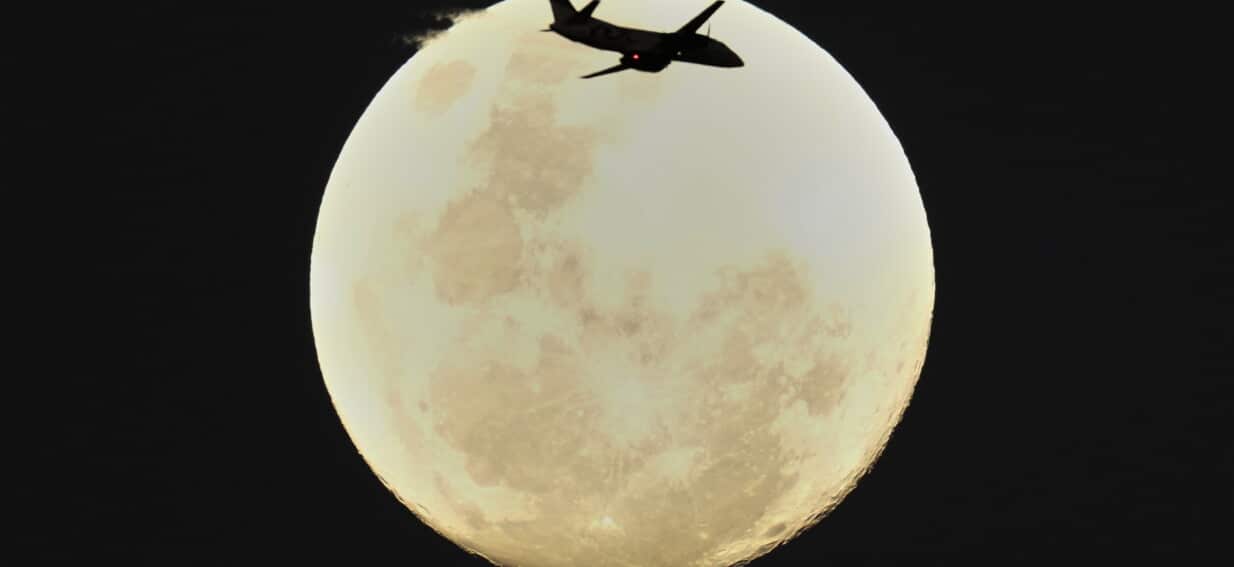
The night sky has always pretended to be empty. We look up from our porches, past the streetlights and the telephone wires, and we see velvet stillness. We see ancient pinpricks of light that our ancestors mapped into gods and beasts. We treat the sky as a ceiling, solid and eternal, a roof over our terrestrial home that keeps us safe from the chaotic machinery of the universe.
It is a comforting illusion.
Up there, past the whisper of the atmosphere, lies a cluttered attic. We have spent decades throwing our discarded ambition over the fence, leaving behind dead satellites, spent rocket boosters, and metal shards traveling at speeds that defy human comprehension. Most of it stays close, circling the blue marble in a tight, frantic dance. But sometimes, the garbage spills over. Sometimes, it reaches further.
Consider what happened when an abandoned four-ton piece of a SpaceX Falcon 9 upper stage finally stopped drifting and found a target.
For seven years, this rusted cylinder of metal—roughly the size of a school bus—tumbled blindly through the cislunar void. It was a leftover ghost from a 2015 deep-space launch, forgotten by the engineers who built it and the public who watched it lift off in a roar of fire and smoke. It drifted past the orbit of communication satellites. It swung out toward the gravity well of the Moon.
No one was watching it on the night it hit.
There were no flashing cameras or live broadcasts from the lunar surface to capture the moment. On March 4, 2022, the booster slammed into Hertzsprung crater on the far side of the Moon at roughly 5,800 miles per hour. It carved a double crater, throwing up pulverized gray dust that settled quietly back into the vacuum.
Silence. Then, equations.
Astronomers tracked the trajectory for weeks before the impact, running the numbers on chalkboards and through server racks. They knew where it was going because orbital mechanics is an unforgiving tyrant of math. What they could not calculate easily was the psychological weight of the event. For the first time in history, human-made space junk had unintentionally struck another celestial body.
We left our trash on our own front porch, and now we are tracking mud onto the neighbors' rug.
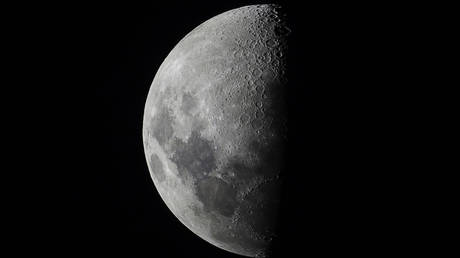
To understand why this matters, you have to look past the cold physics of kinetic energy and think about what the Moon represents to us. It is not just a rock. It is our oldest companion. It pulls our oceans into rhythmic breaths, illuminates our darkest nights, and serves as the ultimate mirror for our own fragility. When we throw things at it haphazardly, we violate an unwritten covenant. We turn a pristine monument of natural history into a junkyard for our technological overflow.
Bill Gray, the independent astronomer who first raised the alarm about the incoming collision, spent years refining the tracking data for these derelict objects. He did not do it for fame. He did it out of a growing, nagging dread. He realized that as humanity pushes further into the solar system, our debris is coming along for the ride.
We are sloppy pioneers.
Think about how we settled every frontier on Earth. We crossed the oceans and left behind sunken galleons, discarded barrels, and plastic packaging frozen in polar ice. We cleared forests and left stumps and ash. We climbed the highest mountains and left oxygen tanks and frozen tents behind in the snow. We assume that space is different because it is so vast. We tell ourselves that the void is infinite, that a few tons of aluminum and steel are nothing compared to the scale of the cosmos.
That is the arrogance of the short-lived.
The space around Earth is finite in the ways that matter. The orbits we use for weather forecasting, global positioning, and communication are congested highways. And beyond those highways lies the deep space transit route to the Moon and Mars. Every spent booster, every shattered payload fairing, and every loose bolt is a bullet waiting for a target.
Most people believe that space agencies track everything we launch. They picture a massive control room filled with screens, where men and women in crisp shirts monitor every screw orbiting the planet.
That picture is a myth.
We track the big things. We know where the International Space Station is, and we know where large defunct satellites wander. But the smaller debris—and even large spent upper stages that wander out of low Earth orbit—often slip through the cracks. Once an object leaves the immediate neighborhood of Earth, our radar systems struggle to maintain a lock. It becomes a ghost. It becomes a surprise.
The SpaceX booster that hit the Moon was one of those ghosts. It was lost in the shuffle of deep-space orbital dynamics, caught in a chaotic gravitational tug-of-war between the Earth and the Sun, until it finally intersected the path of the Moon.
When the news broke, the reaction was muted. A brief blip in the news cycle. People shrugged and went back to their coffee. After all, nobody was hurt. No buildings were flattened. The Moon has been taking hits from asteroids and meteoroids for 4.5 billion years; a piece of American engineering was just another rock in a long line of impacts.
That dismissal is dangerous.
The difference between a natural meteoroid and a piece of space junk is intent and origin. Meteoroids are the raw building blocks of the solar system, remnants of its chaotic birth. Space junk is our footprint. It is the physical manifestation of our lack of foresight, a tangible proof that we expand faster than we clean up.
As we look toward the Artemis program and the permanent human settlement of the Moon, this incident is a warning shot. We are planning lunar bases, mining operations, and scientific outposts. We are building a lunar economy. If we treat the space between Earth and the Moon as a dumping ground, we will arrive at our new home only to find it surrounded by a minefield of our own making.
Imagine navigating a spacecraft through an orbital shell of shrapnel just to land on a world where the craters are scarred by our discarded fuel tanks.
It is not too late to change course. Engineers and entrepreneurs are beginning to talk seriously about active debris removal. Concepts that once sounded like science fiction—laser brooms, robotic capture arms, orbital tugboats—are moving from academic papers to funding proposals. But technology alone will not solve the crisis. We need a fundamental shift in how we think about our relationship with the cosmos.
We are no longer just inhabitants of a single planet. We are a spacefaring species, whether we are ready for it or not. And with that title comes a profound responsibility. The universe is not a boundless attic where we can toss our broken toys and forget about them.
The Moon absorbed our blow without a sound. It bore the scar quietly, rotating slowly in the dark, waiting for us to grow up. The next time we look up at its pale face, we should remember that we left a mark there. Not a footprint of wonder, like the ones boot-printed into the dust of Mare Tranquillitatis, but the jagged imprint of our carelessness.
The night sky is not empty anymore. It is a reflection of us. And it is getting crowded.