The bell above the door chimed, but nobody moved to greet it.
Inside a small, dimly lit kitchen in the Mapo district of Seoul, Kim Ji-hoon watched a mechanical arm plunge a metal basket of chopped chicken into bubbling oil. The hiss was deafening, predictable, and entirely devoid of human error. Ji-hoon, a fifty-four-year-old restaurateur whose family had fried chicken for two generations, sat on a plastic stool in the corner. His apron was spotless. His hands, once calloused and scarred from decades of splattering grease, were clean.
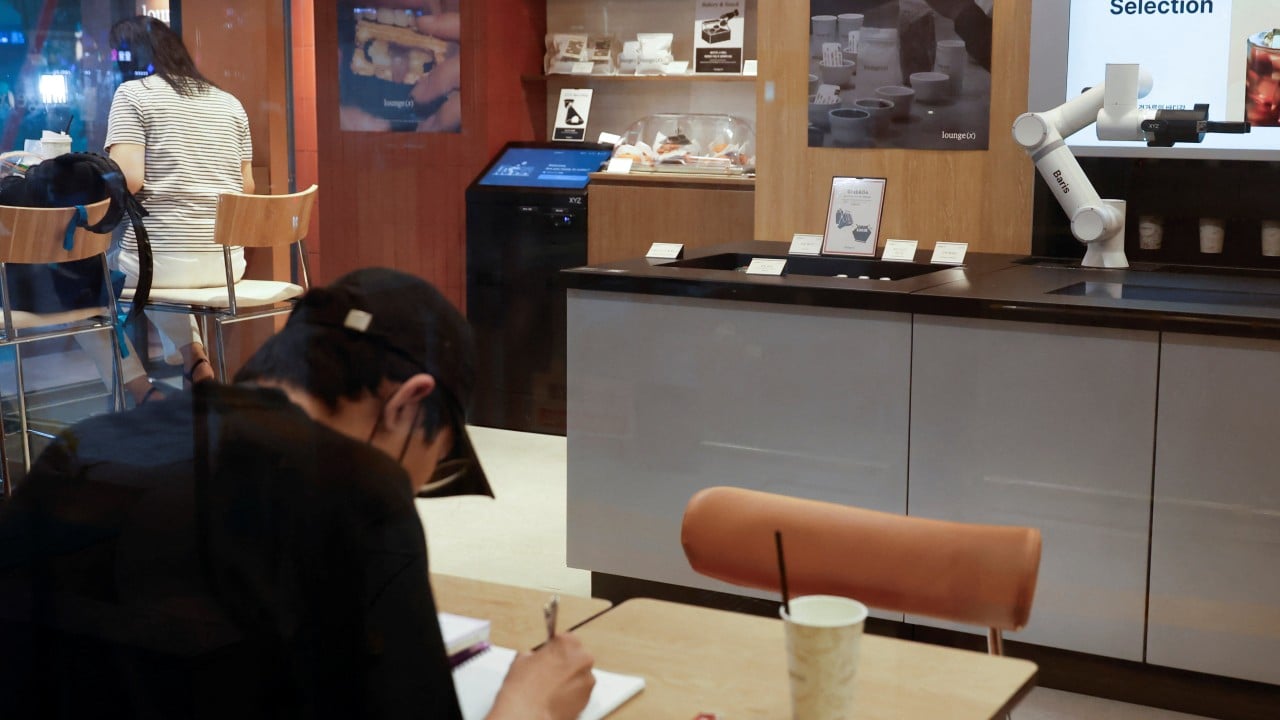
Three years ago, Ji-hoon employed four university students to run the evening shift. Today, the kitchen is populated by two articulated robotic arms and an automated kiosk at the front.
"People think I bought them to save money," Ji-hoon said, his voice barely carrying over the roar of the exhaust fan. "I bought them because nobody walked through that door looking for a job for eight months. The kids are gone. The neighborhood is growing older. If the machines weren't here, the lights would be off."
Ji-hoon’s quiet kitchen is not an anomaly. It is the frontline of an unprecedented existential crisis. South Korea is running out of people, and the nation is turning to silicon and steel to fill the vacuum before the entire economic engine grinds to a halt.
The Mathematics of Modern Emptiness
To understand why a fried chicken shop owner in Seoul needs industrial-grade automation, you have to look at the terrifying clarity of the country's demographic ledger.
South Korea holds a sobering global record. Its total fertility rate—the average number of children a woman expects to have in her lifetime—dropped to 0.72. In Seoul, that number has plummeted even lower, hovering around 0.55. For a population to remain stable without immigration, that number needs to be 2.1. The math is brutal and unforgiving. The country is shrinking from the bottom up.
For decades, economists warned of a distant gray horizon where an aging population would strain public resources. That horizon arrived early. The labor shortage is no longer a theoretical projection discussed in the glass towers of the economic ministries; it is a structural paralysis affecting every layer of daily life.
Shipyards in Ulsan cannot find welders. Farms in Gangwon Province watch fruit rot on the vine. Small manufacturing plants in Gyeonggi are turning down international orders because there are simply not enough physical bodies to operate the machinery.
The immediate reflex of the modern global economy is to turn to migrant labor. South Korea expanded its visa quotas, welcoming thousands of workers from Southeast Asia to fill the gaps in agriculture and heavy industry. But this is a temporary bandage on a deep, arterial wound. The systemic deficit of young, working-age people is too massive for immigration policies to solve alone.
This leaves the nation with a radical, high-stakes alternative: automate everything, immediately.
The Transformation of the Daily Bread
The push for automation has bypassed the traditional confines of heavy automotive manufacturing—a sector where South Korea has long been a global leader—and spilled directly into the service industry, health care, and agriculture.
Consider the neighborhood restaurant. The food service sector has traditionally been the safety net of the working class, a place where low-skilled labor could always find a paycheck. Now, it serves as a testing ground for a hyper-automated lifestyle. Walk into an eatery in the affluent district of Gangnam, and you are increasingly likely to be greeted by a rolling cylinder with a digital face that delivers your bowl of dolsot bibimbap without spilling a drop.
In the back, robotic systems handle everything from boiling noodles to precise measurements of soup broth. Companies like Doosan Robotics and HD Hyundai Robotics are no longer pitching their products exclusively to massive conglomerates like Samsung or LG. They are selling directly to franchise owners, small-scale bakers, and family run establishments.
The economic calculation shifted drastically. A few years ago, installing a robotic kitchen apparatus required a massive capital outlay that would take a decade to amortize. Today, with subscription-based models and hardware leasing options, renting a robotic assistant can cost less than a monthly minimum-wage salary, without the added complications of healthcare benefits, vacation time, or scheduling conflicts.
But the financial equation ignores the psychological shift.
"There is a loneliness to it," Ji-hoon admitted, watching the mechanical arm lift the chicken basket with mathematical precision, shaking off the excess oil exactly three times. "I used to chat with the students. I knew about their exams, their breakups, their dreams. Now, I talk to the technician from the robotics firm when the sensor needs calibration. The machine doesn't care how the day went."
The Deep Waters of Heavy Industry
Move away from the neon signs of the capital toward the southern coast, where the massive hulls of liquefied natural gas tankers rise like steel cliffs above the docks of Geoje Island. Here, the labor crunch is a matter of national economic security.
South Korean shipbuilders are locked in a fierce, existential competition with regional rivals for dominance over the global maritime trade routes. Winning those contracts requires immense speed and unyielding quality. But shipbuilding remains a notoriously punishing, labor-intensive endeavor. It requires humans to climb into suffocatingly hot, cramped double-hulls to weld seams that must withstand the immense pressure of the open ocean.
Young South Koreans, highly educated and increasingly urbanized, refuse to do this work. They call it part of the "3D" jobs: Dirty, Dangerous, and Difficult.
To prevent the collapse of its most vital export sector, Hanwha Ocean and HD Hyundai Heavy Industries have deployed an army of specialized droids. Small, magnetic-wheeled robots crawl inside the dark compartments of ships, performing intricate welding work guided by artificial vision systems. Vision algorithms inspect the seams for microscopic fractures, completing tasks in hours that used to take human teams days of grueling, sweat-soaked labor.
This is not a story of workers being displaced by greedy corporations. It is a story of corporations begging for workers who do not exist, and using technology to keep the factories from going dark. The union leaders who once marched against automation now sit at the bargaining table to discuss how quickly the companies can integrate these systems to relieve the crushing workload on an aging membership whose joints are failing them.
The Care Vacuum
Perhaps the most poignant battleground for this technological transition is not the factory floor or the kitchen, but the nursing home.
South Korea is on track to become a "super-aged" society faster than any other nation in modern history, with over twenty percent of its population projected to be over sixty-five within the decade. The math creates a terrifying paradox: who cares for the elderly when the young are missing?
In facilities across the country, a new class of companions is taking up the mantle. These are not the humanoid sci-fi constructs of popular fiction, but functional, soft-textured machines designed to assist with the exhausting physical realities of eldercare. Exoskeleton suits buckle around the waists of nurses, allowing a fifty-year-old caregiver to lift an eighty-year-old patient out of bed without destroying their own spine.
Meanwhile, pill-dispensing droids with soft, glowing eyes glide down hospital corridors, checking vital signs and offering basic conversation to residents whose families are too busy, or simply too small, to visit regularly.
This is where the boundary between utility and human necessity blurs. Can a machine truly comfort a human being who has outlived their peers?
Dr. Park Min-young, a sociologist studying the impact of automation on aging communities, views the development with a mixture of awe and deep anxiety. "We are conducting a vast, unplanned social experiment," Park noted. "We are outsourcing the most fundamentally human instinct—the act of caring for our vulnerable—to systems that operate on binary logic. It is magnificent that the technology exists to help, but it is deeply tragic that we have engineered a society where it is our only choice."
The Unintended Echoes
The rapid adoption of robotics is lauded by policymakers as a triumph of innovation, an example of how South Korea can pivot in the face of disaster. The country boasts the highest robot density in the world, with over one thousand industrial robots per ten thousand employees. It is a hyper-efficient wonderland.
But look beneath the polished surface, and the friction points appear.
The entire economic model of the twentieth century was built on a simple premise: work hard, earn a wage, spend that wage in the community, and support the next generation. When you replace the worker with a machine, that loop breaks. A robot does not buy a cup of coffee on its break. It does not pay income tax into the national pension fund. It does not rent an apartment or buy a car.
This creates a structural imbalance that the government is only beginning to acknowledge. The tax base is shrinking precisely at the moment when the financial demands of an aging populace are skyrocketing. Discussions around a "robot tax"—charging companies a levy for every human worker replaced by automation—have transitioned from academic fringe theories to serious policy debates in the National Assembly.
Furthermore, the digital divide is hardening into a economic caste system. Small business owners who can afford the upfront cost of automation survive and thrive. Those who cannot—the elderly street vendors, the traditional market stall owners, the mom-and-pop shops in rural areas—are being pushed out of the economy entirely, unable to compete with the speed, consistency, and low operating costs of automated rivals.
The View from the Corner Stool
Back in Mapo, the mechanical arm finished its cycle. It lifted the basket, let the grease drain, and tipped the golden-brown chicken pieces into a stainless-steel bowl with a metallic clang.
Ji-hoon stood up, dusted some flour from his trousers, and began seasoning the food by hand. This was the one part of the process he refused to automate. He liked the smell of the spices rising in the steam. He liked the feel of the wooden spoon in his hand.
"The customers like the speed," he said, packing the order into a cardboard box for a delivery driver who would likely be riding an electric scooter guided by an algorithmic route planner. "They get their food exactly twenty minutes after they press the button on the screen. It is perfect. Every piece of chicken is cooked identically."
He looked out the window at the quiet street outside. A few elderly residents walked past, pulling shopping carts behind them. There were no strollers. No sound of children laughing from the nearby playground that had been converted into a senior fitness park two years ago.
"It is perfect," Ji-hoon repeated softly, his eyes reflecting the cold blue light of the kitchen's control panel. "But sometimes, you want something to be a little imperfect, just so you know a person was there."
South Korea’s automated march is no longer an option; it is an absolute reality. The machines have arrived to save the economy, but they cannot replace the one thing the nation needs most: the messy, unpredictable, and beautiful presence of human life. The nation's future is being forged in steel, but the true test will be whether it can retain its soul along the way.