The earth does not roar with malice. It simply shifts, a tectonic shrug that reshapes human geography in less time than it takes to draw a breath.
When a magnitude 7.1 tremor struck the Kumamoto prefecture on a Tuesday afternoon, concrete structures that had stood for decades buckled into crumpled cardboard. Roads cracked open like dry clay. Power lines snapped, plunging tens of thousands of households into sudden, humming darkness. But the most terrifying consequence of the geological violence was not what fell down, but who remained trapped underneath. Also making waves in related news: Why the New Iraq and Turkey Energy Deal Changes Everything for Middle East Trade.
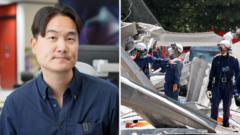
More than twenty hours bled into thirty. Prime Minister Sanae Takaichi stepped before reporters in Tokyo to utter a phrase that every emergency responder dreads: a race against time.
Consider what happens inside a collapsed building during those initial hours. Dust fills the air, thick and chalky, coating throats and stinging eyes. Darkness is absolute. For survivors pinned beneath heavy timber or sheared reinforced concrete, time loses its linear shape. Minutes stretch into agonizing epochs. Every shift of debris above sounds like a potential avalanche, a reminder that the earth has not finished its restless settling. More details regarding the matter are covered by TIME.
Rescue crews from the Self-Defense Forces, alongside elite canine units and local firefighters, deployed immediately to the worst-hit sectors on the southern island of Kyushu. Their mission was stark. Find the living.
Among the primary focal points of the search was a partially collapsed shopping mall in Kashima town. An hour after the initial shockwave triggered an evacuation, an explosion tore through the structure, compounding the structural disaster with fire and secondary hazard zones. Smoke drifted lazily against a gray sky as search teams combed through the wreckage. Miraculously, eight individuals were pulled alive from the concrete folds. Yet, uncertainty clung to the perimeter, where families waited with hands clenched tight against their pockets, counting names of the unaccounted.
Further north, at a paper manufacturing facility in Yatsushiro city, a massive industrial smokestack gave way, shearing through utility lines and burying parts of the complex under tonnes of rubble. Rescue workers navigated unstable terrain, listening intently for the faint tap of a metal pipe or a muffled voice calling out from the void.
Statisticians and disaster management experts often speak of the critical window. The first seventy-two hours represent the threshold where survival rates remain mathematically viable before dehydration, internal injuries, and secondary collapses stack the odds insurmountable. As the death toll climbed past thirteen, and thousands sought refuge in over five hundred designated evacuation centers, that window narrowed with every passing second.
Hospitals near the epicenter transformed into triage stations operating under auxiliary generators. In Uki city, medical staff treated streams of injured residents while structural engineers inspected building integrity overhead. The rhythm of daily life—semiconductor plants running their precise calibrations, automotive assembly lines humming, children walking home from school—halted entirely, replaced by the collective heartbeat of a nation holding its breath.
Back at the disaster sites, heavy machinery fell silent at periodic intervals. Rescuers raised their hands, signaling absolute quiet across the jagged landscape. They dropped to their knees, pressing their ears close to gaps in the debris, straining to catch the quietest proof that someone down there was still breathing.