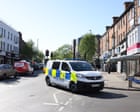
The coffee in Golders Green usually tastes like routine. It is the flavor of a neighborhood that knows itself—a blend of North London briskness and the deep, multi-generational roots of a community that has seen the world break and rebuilt itself here. But on a Tuesday afternoon that should have been unremarkable, the routine didn't just break. It shattered.
When the news filtered through the digital ether that an attack had occurred in the heart of this Jewish community, the reaction wasn't just a localized shock. It was a ripple that hit the walls of the Home Office and bounced back as a cold, official decree. The UK terrorism threat level has been raised from "Substantial" to "Severe." For a more detailed analysis into this area, we recommend: this related article.
Statistics are bloodless things. They live in spreadsheets and briefing notes. But a threat level is a living, breathing weight. To move from "Substantial" to "Severe" is to transition from a state of "an attack is likely" to the chilling certainty that "an attack is highly likely."
The Anatomy of a Warning
Think of the threat level as the ambient noise of a city. Usually, it’s a low hum in the background, something you know is there but don't actively listen to. When the Joint Terrorism Analysis Centre (JTAC) turns the dial, that hum becomes a piercing frequency. For additional context on this issue, in-depth analysis is available on NPR.
JTAC doesn't move that dial because of political whims or a desire to grab headlines. They are an independent body of analysts who spend their days staring into the darkest corners of human intent. They look at intercepted chatter, the movement of radicalized individuals, and the specific brutality of events like the Golders Green attack.
Consider a hypothetical shopkeeper named Elias. For twenty years, Elias has opened his deli, stacked the rye bread, and nodded to the same postman. Before the alert, Elias worried about inflation and the local parking wardens. After the alert, he looks at a discarded backpack on a bench and his heart rate spikes. He isn't being paranoid. He is reacting to a shift in the very atmosphere of his country. This is the invisible tax of terrorism: the loss of the right to be unobservant.
Why Golders Green Changed the Math
The attack in Golders Green acted as a catalyst because of its precision and its location. It wasn't just a random act of violence; it was a strike at a specific identity in a specific sanctuary. When a community that is already historically sensitized to security becomes the target of a fresh atrocity, the state’s duty of care shifts into an emergency gear.
Security isn't just about bollards and armed police. It is a psychological contract.
When that contract is breached in a place as symbolic as Golders Green, the intelligence services have to assume that the dam has cracked. The "Severe" rating is a public admission that the intelligence "chatter"—that ghostly, fragmented data of bad intentions—has reached a volume that can no longer be ignored.
The mechanics of this change are immediate and expensive. You will see more uniforms. You will see more "random" checks. You will see the heavy machinery of the state becoming visible in places where we usually prefer it to remain hidden. But the real work happens in the rooms we never see, where analysts try to determine if Golders Green was a "lone wolf" flashpoint or the first domino in a larger, orchestrated sequence.
The Human Cost of Hyper-Vigilance
Living under a "Severe" threat level does something to the collective psyche. It changes how we walk through a train station. We stop looking at our phones and start looking at faces. We become, briefly and intensely, our brother’s keepers, but we do so through a lens of suspicion.
It is an exhausting way to live.
The logic of the terrorist is not to kill everyone—that is impossible—but to make everyone feel like they are next. By forcing the government to raise the threat level, the attacker wins a secondary victory. They manage to alter the behavior of millions of people who were nowhere near the scene of the crime. They turn the simple act of commuting into an act of courage.
Imagine a young woman, Sarah, sitting on the Northern Line. She sees the posters: See it. Say it. Sorted. Before today, she might have rolled her eyes at the clunky alliteration. Today, she finds herself tracing the exits of the carriage. She isn't thinking about her 9:00 AM meeting anymore. She is thinking about the fragility of the glass and the weight of the steel.
This is the true objective of the extremist. They want to colonize our thoughts. They want to ensure that even in our moments of peace, we are calculating our survival.
The Logic of the Response
Some will argue that raising the threat level is an overreaction—a way for the government to look busy while failing to prevent the initial tragedy. But consider the alternative. If the intelligence suggests a follow-up is likely and the state says nothing, the silence becomes a form of complicity.
The "Severe" designation is a tool for mobilization. It clears the bureaucratic path for resources to be diverted. It allows police leave to be cancelled and surveillance budgets to be expanded without the usual friction. It is the sound of the state clearing its throat and preparing for a fight.
However, the state cannot be everywhere. The UK has thousands of miles of "soft targets"—shopping centers, schools, bus stops, and parks. We cannot live in a fortress. The strength of a democracy is its openness, and that openness is precisely what makes it vulnerable.
It is a paradox that has no easy resolution. To stay safe, we must be watchful. But if we watch too hard, we lose the very freedom we are trying to protect.
Beyond the Yellow Tape
The flowers at Golders Green will eventually wilt. The news cycle will find a new tragedy, a new scandal, or a new distraction. But for the people living there, the map of their neighborhood has been permanently redrawn. There is now a "before" and an "after."
The threat level might stay at "Severe" for weeks, months, or even years. We will get used to it. That is perhaps the most frightening part of the human condition: our ability to normalize the extreme. We will learn to walk past the armed officers without flinching. We will learn to ignore the sirens.
But beneath that normalization, the tension remains. It sits in the pit of the stomach when the tube stops unexpectedly in a dark tunnel. It lingers in the air when a car backfires on a crowded street.
The rise to "Severe" is a reminder that the peace we enjoy is not a natural state of affairs. It is a garden that must be tended, often at great cost, and sometimes with the admission that the weeds are currently winning.
We are told to go about our business. We are told not to let them win. And so, we buy our coffee. We board our trains. We walk our dogs through the parks of North London. We do these things not because we are unafraid, but because the alternative is to stop living before we are even dead.
The air in London has shifted, yes. It is heavier, sharper, and carries the scent of a warning that cannot be un-heard. We breathe it in because we have no choice, waiting for the day when the dial turns back down, and the silence of the city feels like safety once again.
The postman still rings the bell. The baker still lights the oven. The city continues, stubborn and scarred, refusing to be defined by the shadows that occasionally dance across its streets.