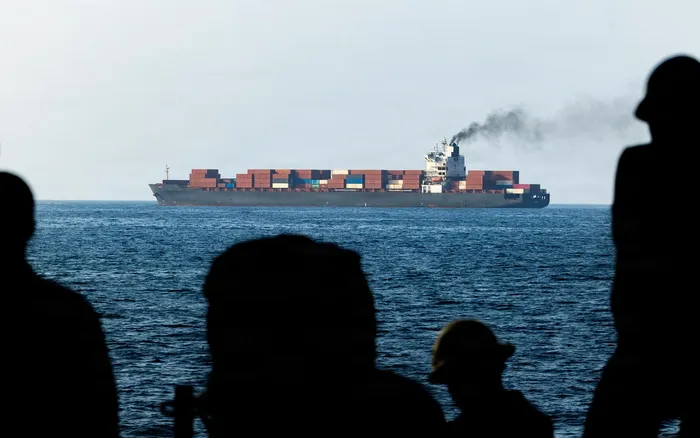
The steel hull of a Maersk container ship doesn’t feel like a political statement when you are standing on its deck. It feels like a mountain. But as that mountain of iron slides through the narrowest ribbon of the Strait of Hormuz, the air changes. It thickens. On one side, the jagged, sun-bleached cliffs of Oman; on the other, the silent, watchful coast of Iran. Between them lies a stretch of water barely twenty-one miles wide.
Through this single, fragile throat flows twenty percent of the world’s liquid energy. If you’ve ever filled a gas tank in London, powered a factory in Tokyo, or heated a home in New England, you have a stake in this water. You are part of the invisible thread that stretches from your front door to a grey expanse of sea where the world’s superpowers are currently holding their breath.
The United States has just announced a new naval mission. It sounds clinical. "Maritime security." "Freedom of navigation." But to the sailors on the water, it means something much more visceral: the arrival of more grey-hulled warships, more Aegis combat systems, and more eyes peering through thermal optics at the horizon.
Iran didn't take long to whisper back. Their message was stripped of diplomatic niceties. They warned of a "decisive response" to any American presence they deemed a threat. This isn't just a disagreement over borders. It is a high-stakes game of chicken played with billion-dollar assets and the global economy hanging in the balance.
The Invisible Engine of the Everyday
Consider a hypothetical officer named Elias. He’s third mate on an oil tanker carrying two million barrels of crude. To Elias, the Strait isn't a headline; it’s a math problem. He’s calculating the proximity of fast-attack craft—small, nimble Iranian boats that can swarm a massive tanker like hornets around a slow-moving bear.
He knows that if a single spark flies here, the ripples don't stay in the Persian Gulf. Within hours, algorithmic traders in Chicago and Singapore would panic. Oil prices would spike. By the time Elias finished his shift, the cost of transporting food, manufacturing plastics, and flying planes across the globe would have shifted upward.
We often think of the military as something separate from our lives, a force that operates in a vacuum of "national interest." In reality, the US naval presence in the Strait is an attempt to insulate the modern world from its own fragility. The mission seeks to provide a "protective umbrella," ensuring that the arteries of global trade remain unclogged.
But every action has an equal and opposite reaction. To Tehran, this isn't protection. It’s an intrusion. Imagine someone standing on your front lawn with a camera and a shotgun, claiming they are only there to keep the sidewalk safe. You wouldn't see a protector. You would see a target.
A History Written in Salt and Oil
The tension didn't start with a press release this morning. It is baked into the geography of the region. The Strait is a "chokepoint" in the most literal sense. It is the only way out of the Persian Gulf for the massive tankers coming from Kuwait, Saudi Arabia, and the UAE.
Historically, this water has been a theater of "Shadow Wars." In the 1980s, during the Tanker War phase of the Iran-Iraq conflict, both sides targeted commercial ships. The US eventually intervened with Operation Earnest Will, the largest naval convoy operation since World War II. We are seeing the echoes of that era today.
Today’s technology makes the stakes even more volatile. We aren't just talking about deck guns and torpedoes anymore. We are talking about loitering munitions—drones that can sit in the sky for hours before diving into a ship’s bridge—and electronic warfare suites that can "spoof" GPS signals, making a captain believe he is in international waters when he has actually drifted into a territorial trap.
The Mechanics of a Response
When Iran warns of a "military response," they aren't necessarily talking about a full-scale naval battle. They are masters of asymmetric warfare. They don't need a fleet of aircraft carriers to cause chaos. They have mines.
Sea mines are the "poor man's weapon," but they are terrifyingly effective. They are silent, patient, and incredibly difficult to detect in the silt-heavy waters of the Strait. A single explosion, even if it doesn't sink a ship, would effectively close the Strait. No insurance company on earth would allow a vessel to enter a waterway littered with "hidden" explosives.
This is the leverage Iran holds. They don't have to win a war; they just have to make the peace too expensive to maintain.
On the other side, the US Navy is deploying some of the most sophisticated technology ever built. The mission involves integrated sensors that can track everything from a drone the size of a bird to a submarine moving silently through the thermoclines. It is a technological shield intended to project a sense of order.
But order is a subjective concept.
The Human Cost of Miscalculation
Suppose a nervous young radar technician on a US destroyer sees a blip. It’s moving fast. It’s approaching from the Iranian coast. Is it a fishing boat? A stray drone? Or a suicide craft packed with high explosives?
He has seconds to decide.
If he fires and it was a mistake, he triggers a diplomatic nightmare and potentially a hot war. If he waits and it’s a real threat, his ship and his crew are lost. This is the "human element" that dry news reports omit. The geopolitical balance of the world rests on the shoulders of twenty-something-year-olds staring at green screens in the middle of a sweltering night.
The invisible stakes are the lives of those on the water and the stability of the world they serve. We live in a "just-in-time" economy. We don't keep massive stockpiles of goods anymore; we rely on the constant, rhythmic arrival of ships like the one Elias sails. If that rhythm breaks, the veneer of our organized, modern lives begins to peel away very quickly.
The Weight of the Horizon
The US mission is a gamble. It assumes that more force will lead to more stability. It assumes that by showing its teeth, it can deter the "decisive response" Iran has promised.
But there is a phenomenon in psychology called the "security dilemma." It suggests that when one side increases its security, it decreases the perceived security of its neighbor. This leads to an escalatory spiral where both sides feel they are acting defensively, while both sides appear to be acting aggressively.
The Strait of Hormuz is currently the epicenter of this spiral.
As the sun sets over the Gulf, the heat doesn't really leave. It just sits on the water, heavy and humid. The lights of the massive tankers begin to twinkle, a slow-moving constellation of commerce trying to navigate a minefield of politics.
We look at the maps and we see lines of red and blue. We read the statements and we see words like "hegemony" and "sovereignty." But if you could zoom in past the satellites and the headlines, you would see the white knuckles of a helmsman gripping a wheel. You would see the sweat on the brow of a sailor in a cramped engine room.
The ocean is indifferent to the flags flying from the masts. It only knows the weight of the steel and the salt in the wind. And right now, the ocean is carrying a weight that feels heavier than it has in decades.
The ships continue to move, for now. They slide through the narrow gap, passing between the warnings and the warships, carrying the lifeblood of a world that is too busy to notice how close it is to the edge. The real story isn't the mission or the warning. It is the terrifying realization that our entire way of life depends on a few miles of water staying quiet, even as everyone involved starts to scream.
The horizon remains empty, save for the flickering silhouettes of the tankers, moving through the dark, waiting for the first sign of a ripple that could change everything.


