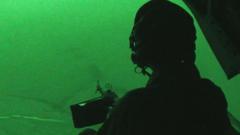
The desert wind at night does not care about insignia. It strips paint from armored hulls, scours through tactical fiber, and carries the faint, coppery scent of old iron across the cracked clay. In those hours, far from the parliamentary chambers of London and the polished oak desks of Whitehall, the war was measured not in geopolitical milestones, but in the heavy click of a safety latch and the breathless silence that followed a breach.
For years, the men who moved through those shadows operated under a particular kind of covenant. They were the tip of a spear forged in absolute secrecy, asked to do things in the dead of night that polite society preferred to ignore. They wore no conventional patches. They answered to callsigns rather than surnames. And above all, they operated with the unspoken, iron
The Shadow Over the Elite
news
The desk lamp in a drab London office hums, casting a small circle of harsh light across a stack of worn case files. Outside, the city moves in its usual hurried blur, indifferent to the quiet friction happening behind closed doors. Inside, investigators are looking at photographs of barren Afghan valleys, burnt-out compounds, and men who wore the uniform of Britain's most feared and secretive military unit.
For decades, the name of these special forces operated like a whispered shield. They were the ghosts sent into the dark to handle the impossible, returning silently before dawn. Nobody asked how the mission was accomplished. Nobody wanted to know the mechanics of survival in a war zone where the line between combatant and civilian frayed into nothingness.
Now, that shield is cracking.
Files compiled from years of operational reporting have crossed the threshold into the hands of civilian police. The legal machinery of the British state, long hesitant to look too closely at its own sword arm, is finally turning. And as the investigations deepen, a profound reckoning is taking shape. It is not just about what happened in the dust and heat of Helmand Province. It is about what happens to a society when the people it asks to break the rules on its behalf are suddenly told that the rules apply to them after all.
Consider what it takes to survive inside a theater of war where the enemy wears no badge.
Imagine a patrol moving through a mud-walled village at dusk. Every shadow is a potential threat. Every doorway could hide an ambush. The human brain, wired for self-preservation, reacts before logic can catch up. Split-second decisions dictate who draws breath and who does not. In those extreme conditions, ordinary morality warps.
Veterans have spoken of the crushing psychological weight, though usually only in the quiet of therapy rooms or over lukewarm pints long after discharge. They talk about the hyper-vigilance that never quite turns off. They talk about orders given by commanders who sat hundreds of miles away in air-conditioned command centers, demanding outcomes while remaining insulated from the blood on the ground.
When allegations of unlawful killings surface years later, they often arrive stripped of that sensory terror. They are reduced to cold timelines, forensic reports, and legal definitions drafted by lawyers who have never tasted desert dust mixed with cordite.
This disconnect lies at the heart of the current crisis.
The referral of Afghanistan evidence to the police is not merely a bureaucratic shift. It is a collision between two incompatible worlds. On one side stands the military ethos of operational necessity, absolute loyalty, and the defense of the realm. On the other stands the rule of law, which insists that accountability must be universal, regardless of the cap badge or the gravity of the threat faced.
For years, internal service inquiries moved at a glacial pace, often yielding little public clarity. Critics argued that the system was designed to protect the institution rather than uncover uncomfortable truths. Whistleblowers grew frustrated. Families of victims in Afghanistan demanded answers that never came. The pressure mounted until the dam finally broke, forcing civilian authorities to step into a domain they traditionally avoided.
What happens next will set a heavy precedent.
If prosecutions follow, they will send a shockwave through the armed forces. Commanders will look at their operational directives with new eyes, calculating not just tactical success, but legal exposure. Some argue this caution will paralyze elite units, making soldiers second-guess themselves in moments when hesitation means death. Others argue that true professionalism requires adherence to the law, and that ignoring abuses undermines the very democratic values these forces are sworn to protect.
The moral hazard is real, and it cuts both ways.
Allowing allegations of war crimes to go uninvestigated corrodes the soul of a nation. It breeds cynicism, destroys international credibility, and betrays the ethical framework that distinguishes a professional military from an occupying militia. Yet, prosecuting soldiers who acted under extreme duress without accounting for the systemic pressures placed upon them risks a different kind of injustice.
The investigators sorting through the evidence in London are carrying an immense burden. They are not just reviewing individual actions; they are examining the moral cost of a protracted, ambiguous conflict that ended in retreat and disillusionment.
The files will be read. Decisions will be made. Warrants may be signed, and courtrooms may fill. But no verdict, whether acquittal or conviction, will fully restore the clean narrative that once surrounded Britain's elite operators. The myth of untouchable perfection is gone, replaced by a much harder, messier reality.
In the end, the light in that London office stays on late into the night. The papers rustle. The ghosts of Helmand remain, waiting to see if justice is capable of understanding the dark places where they were sent to fight.


