The fluorescent lights in a Malaysian nomination hall have a very specific hum. It is a low, persistent vibration that settles into your molars while you sit on a plastic chair, clutching a laminated receipt, waiting for a returning officer to decide whether your name gets printed on a ballot paper.
Outside, the air smells of diesel exhaust, sweet condensed milk from the makeshift tea stalls, and damp asphalt drying under an equatorial sun that shows no mercy by nine in the morning. Inside, democracy is reduced to stapled forms, ink-stained thumbs, and seventy-nine candidates cleared to fight over twenty-eight state assembly seats in Melaka.
Seventy-nine.
On a wire service ticker, that number looks like a routine administrative update. Seventy-nine candidates approved. Nomination day concluded without incident. Campaigning begins. A tidy test for Prime Minister Anwar Ibrahim’s unity coalition.
Read that wire copy twice and you can almost hear the yawn of an editor clearing space on page four. Yet if you have ever stood along the Strait of Malacca at dusk, watching the massive container ships queue up on the horizon like patient steel leviathans, you know that nothing in this small coastal state is ever merely local. Melaka is a magnifying glass. Whatever happens in its twenty-eight constituencies—from the heritage-soaked alleys of Bandar Hilir to the quiet rubber and oil palm stretches of Asahan—does not stay behind the state border. It echoes straight down the North-South Expressway into Putrajaya.
The Weight of a Number
Let us start with what actually happened when the nomination centers closed their doors.
Malaysia’s Election Commission cleared seventy-nine contenders to vie for the twenty-eight seats in the Melaka State Legislative Assembly. That average—nearly three candidates per seat—tells you immediately that this is no polite two-horse race. Multi-cornered fights have become the defining architecture of modern Malaysian politics, and Melaka is their purest laboratory.
In the previous state election back in November 2021, Barisan Nasional swept twenty-one of those twenty-eight seats in a landslide that stunned observers who thought the old coalition was finished. Back then, the political map looked entirely different. Pakatan Harapan and Barisan Nasional were bitter adversaries, tearing into each other across every constituency while Perikatan Nasional worked the Malay heartland to establish a foothold.
Fast-forward to this poll, and the old enemies are sharing the same campaign stage.
To understand how dizzying that shift feels on the ground, picture a hypothetical voter—let us call him Pak Salleh, a sixty-two-year-old retired civil servant living in a single-story terrace house in Bukit Katil. For thirty years, Pak Salleh voted for Barisan Nasional out of habit, gratitude, and quiet certainty. His neighbor across the drain, a younger teacher named Mei Ling, spent the last decade campaigning tirelessly for Pakatan Harapan, waving flags at highway junctions and arguing passionately at dinner tables about institutional reform.
Now, the party machinery tells both of them to pull the same lever.
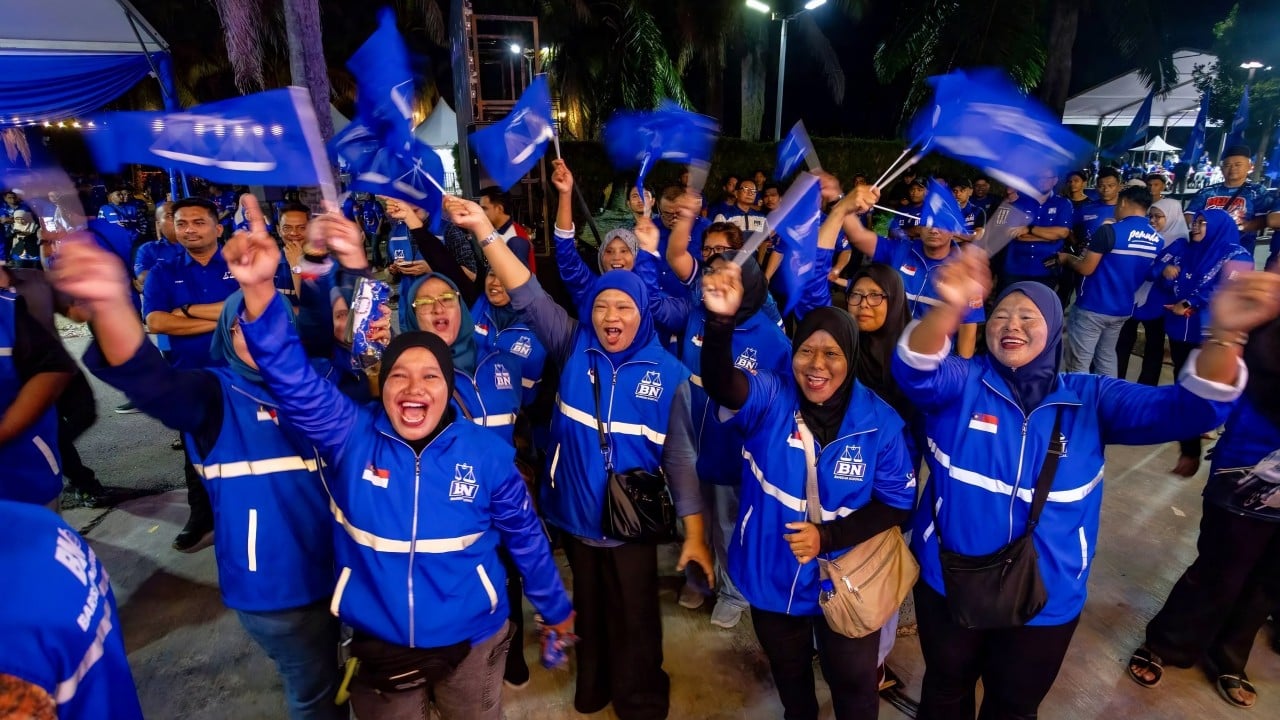
Consider what happens next: Pak Salleh stands at his gate looking at a campaign banner where the familiar blue scales of Barisan Nasional sit awkwardly beside the red-and-white insignia of Pakatan Harapan. Nobody has handed him an emotional manual for how to reconcile three decades of political rivalry overnight. Meanwhile, Mei Ling wonders whether the compromises required to keep this marriage intact have hollowed out the very reforms she marched for in Kuala Lumpur years ago.
This is the invisible stake behind those seventy-nine nominations. Politicians treat seat negotiations like a spreadsheet—trade a semi-urban constituency here, balance a Malay-majority seat there, calculate vote transferability to two decimal places. Voters do not live inside spreadsheets. They live inside memories, loyalties, and kitchen-table economics.
A Coalition Walking a Tightrope
Why does this specific state election carry so much national voltage for Anwar Ibrahim?
Because mid-term state polls in Malaysia function like an unvarnished medical scan. You can spin parliamentary speeches, you can polish fiscal budgets, and you can host diplomatic summits in Kuala Lumpur that look magnificent on the evening news. You cannot spin a ballot box in a semi-rural Melaka district when a voter decides the price of cooking oil, electricity tariffs, or targeted diesel subsidies has pushed their household budget past the breaking point.
Anwar’s unity government—an unprecedented alliance binding Pakatan Harapan with Barisan Nasional and East Malaysian partners—was forged out of necessity after the hung parliament of November 2022. Think of it like lashing two distinct vessels together mid-storm so neither sinks. It works remarkably well for staying afloat in rough seas, yet every wave tests the ropes between the hulls.
In Melaka, those ropes are pulled taut.
First, there is the question of vote transferability, a dry political science term that hides a deeply human dilemma. When Barisan Nasional steps aside in a constituency so a Pakatan Harapan candidate can run under the unity banner—or vice versa—will the grassroots actually show up? Party leaders can shake hands on stage and hoist each other's arms for the cameras, yet a local branch chief who spent twenty years fighting the other side cannot simply switch off muscle memory on command. If even fifteen percent of traditional loyalists stay home on polling day, or quietly park their protest vote with Perikatan Nasional, the math collapses.
Second, there is the shadow of Perikatan Nasional itself. Having consolidated immense strength across the northern and eastern states of Peninsular Malaysia, the opposition coalition views Melaka’s Malay-majority seats as prime territory to prove its momentum extends southward. In 2021, Perikatan Nasional won only two seats in Melaka, largely because Barisan Nasional still commanded overwhelming loyalty among older rural voters. Since then, the political tectonic plates have shifted. Every constituency in Melaka where Malay voters make up more than sixty percent of the electorate is now a frontline battleground.
And then there are the smaller parties and independents among those seventy-nine cleared names—the wildcards who rarely win outright, yet routinely siphon off two or three thousand votes in tight races, turning safe margins into nail-biters by midnight.
The Arithmetic of Everyday Survival
Walk through the central market in Melaka on a Sunday morning and you realize very quickly that nobody is debating constitutional theory over their plate of char kway teow.
They are talking about margins.
I remember speaking with a small-scale workshop owner in Cheng during an earlier campaign cycle, a man with grease permanently embedded under his fingernails and three children in secondary school. He pulled a crumpled fuel receipt from his shirt pocket and laid it on the plastic table between us like an exhibit in a courtroom. "I don't care whose face is on the poster," he told me, tapping the paper with one blunt finger. "Tell me whether my suppliers are raising prices again next month, and tell me why my son’s engineering degree still leaves him earning barely enough to rent a room in Shah Alam."
That is the real referendum unfolding across Melaka’s twenty-eight constituencies.
Anwar’s administration has spent its tenure making difficult, politically expensive fiscal decisions—rationalizing blanket subsidies to plug chronic budget leaks, tightening fiscal discipline, and pitching Malaysia to global semiconductor and data center investors. On macroeconomic charts, those policies look disciplined and necessary. The ringgit stabilizes; sovereign credit ratings hold firm; foreign direct investment announcements make headlines.
Yet macroeconomic discipline arrives at the household level like a slow tide, and the immediate sensation is almost always the pinch before the payoff. When diesel prices adjust or service taxes widen, the lorry driver hauling vegetables from Cameron Highlands to Melaka passes that cost to the wholesaler, who passes it to the stallholder, who passes it to the grandmother counting out small bills at seven in the morning.
Opposition campaigners understand this visceral gap between national statistics and household reality. Their message does not require complex charts. It requires only pointing at the grocery bill and asking whether life feels easier today than it did two years ago.
For the unity coalition, defending its record in Melaka requires a far harder communication feat: convincing voters that short-term discomfort is buying long-term stability, and that fracturing the governing alliance now would return Malaysia to the revolving-door prime ministers and political paralysis that haunted the country between 2020 and 2022.
History’s Long Shadow Over a Small State
To appreciate why Melaka reacts the way it does, you have to respect its peculiar geography and temperament.
Melaka is small enough that you can drive from its northern border with Negeri Sembilan to its southern boundary with Johor in roughly an hour if the highway is clear. Yet within that compact footprint sits a remarkably dense cross-section of Peninsular Malaysia’s demographic soul.
Along the coast and around the historic town center, urban Chinese, Indian, and Peranakan communities have shaped commerce and civic life for centuries. Move inland toward Alor Gajah, Masjid Tanah, or Jasin, and the landscape opens into traditional Malay villages, FELDA settlement schemes, and quiet town centers where the mosque and the local coffee shop remain the twin pillars of public opinion.
Historically, Melaka has functioned as a bellwether—not because it always mirrors the exact national seat split, but because it reveals the mood of middle Malaysia. Unlike Kelantan or Terengganu, where ideological identity runs deep and unchanging, or urban Selangor, where opposition sentiment has long been entrenched, Melaka is pragmatic. Its voters reward competence, punish arrogance, and possess a long memory for broken promises.
Think back to the political turbulence that triggered the 2021 state election in the first place: four assemblymen withdrawing support from their own chief minister, collapsing the state administration mid-term and forcing voters back to the polls during a pandemic recovery. People in Melaka still talk about that episode with a mixture of irritation and cynicism. They dislike political theater when it interrupts governance.
Which brings us back to those seventy-nine candidates.
Among them are seasoned party warlords who know every village headman by first name, earnest young professionals stepping onto a political stage for the very first time, and serial independents driven by personal conviction or local grievances. Over the next two weeks, they will walk thousands of kilometers through night markets, attend hundreds of wedding feasts, shake tens of thousands of hands, and deliver speeches into crackling loudspeakers under canvas tents as evening rainstorms roll in off the strait.
What Happens When the Noise Fades
There is a moment in every Malaysian election—usually around three in the afternoon on polling day—when the frantic noise suddenly stops.
The party workers sitting under their colored canopies outside the school gates run out of flyers to hand out. The traffic slows down. The heat begins to soften, casting long shadows across the schoolyard basketball courts where voters have queued since morning. Inside the classrooms, election clerks sit beside translucent ballot boxes sealed with numbered plastic ties, waiting for the clock to strike five.
In that quiet hour, all the grand narratives of Putrajaya—the coalition math, the leadership tests, the regional geopolitical calculations—shrink down to a stack of folded paper slips inside a plastic box.
If Anwar’s unity coalition holds its ground and translates its combined vote share into decisive victories across Melaka’s twenty-eight seats, the message to Kuala Lumpur will be unmistakable: the unlikely marriage between old rivals is durable enough to survive grassroots friction, and voters are willing to give the government runway for its economic reforms.
If the coalition stumbles—if Malay heartland seats peel away toward Perikatan Nasional while urban supporters stay home out of quiet disillusionment—the tremors will shake every ministry in Putrajaya before the final tally is even certified. Cabinet ministers will recalculate their political survival. Coalition partners will start eyeing the exits or demanding steeper concessions to stay onboard.
Seventy-nine names are now printed on the official candidate rolls. Seventy-eight of them will spend millions of ringgit and countless sleepless nights building toward a single Saturday that will end in either celebration or silence.
And somewhere in Bukit Katil, on that Saturday morning, Pak Salleh will lock his front gate, walk down the street past the fluttering blue and red flags, and step behind a cardboard voting booth where no party boss, no pollster, and no prime minister can see where his pencil falls.