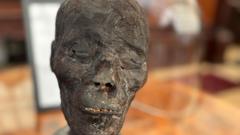
Putting a price tag on ancient human bodies is a bizarre obsession that just won't die. Recently, a public outcry erupted when an auction house put a 3,000-year-old Egyptian mummy head on the auction block. People are rightfully angry. It forces us to confront a uncomfortable reality. Our modern antiquities market still behaves like a nineteenth-century colonial looting operation.
Selling ancestral remains as decorative curiosities for wealthy private collectors is flat-out wrong. It treats a dead person as mere property. This isn't just about legal loopholes. It's about basic human decency and respect for the dead. If you found value in this piece, you might want to check out: this related article.
The Ethics of Trading the Dead
Museums worldwide are actively trying to return looted ancestral remains to their origin countries. Yet, private auction houses seem to operate in an entirely different ethical universe. When a private collector buys a mummy head, that piece of history vanishes into a secure living room or a private vault. Scholars lose access to it forever.
Museum curators and archaeologists have spent decades fighting the illicit antiquities trade. For example, institutions governed by national museum guidelines usually follow strict ethical codes regarding human remains. They require proven provenance and respect for cultural heritage. Private auctions frequently bypass these rigorous standards. They rely on old, sketchy documentation that often papers over colonial-era theft. For another angle on this event, see the recent coverage from The New York Times.
This issue goes beyond Egypt. Indigenous communities globally, from Native American tribes to Māori groups in New Zealand, have fought for decades to bring their ancestors home. The market for Egyptian artifacts often escapes this scrutiny because the remains are thousands of years old. But age shouldn't erase our empathy. A 3,000-year-old body is still a human being.
Where the Law Fails
You might wonder how this is even legal. The truth is messy. International laws like the 1970 UNESCO Convention target the illicit import and export of cultural property. However, these laws don't always apply retroactively to items brought into Western countries over a century ago.
In places like the United Kingdom, the Human Tissue Act 2004 regulates the storage and display of human remains. But it contains major exemptions for specimens that are more than one hundred years old. This creates a massive legal loophole. It allows auctioneers to trade ancient body parts legally, provided the items entered the country before modern border restrictions tightened up.
The Problems with Private Provenance
Auction houses often defend their actions by pointing to paperwork. They claim the item comes from an old private collection, sometimes dating back to the grand tours of the Victorian era. During the nineteenth century, wealthy Europeans traveled through Egypt, buying up antiquities like cheap souvenirs. They literally unwrapped mummies at high-society parties for entertainment.
Relying on these historical collections as a stamp of legitimacy is highly problematic. For instance, consider an illustrative example where a seller produces a vague diary entry from 1890 stating they bought an antiquity in Cairo. That paper trail doesn't prove an ethical purchase. It simply documents a historical theft that occurred during a period of colonial occupation.
Private collectors often argue they're preserving history. That argument is fundamentally flawed. True preservation involves scientific study, climate-controlled environments, and public accessibility. Storing a mummified head on a shelf next to modern art pieces isn't preservation. It's commodification.
The Damage to Archaeological Science
When human remains enter the private market, science suffers a massive blow. Modern archaeological tech can extract incredible data from ancient tissues. We can learn about ancient diets, diseases, genetic lineages, and even migration patterns using advanced DNA analysis and CT scanning.
That potential knowledge disappears the moment the auction hammer falls. Private buyers don't invite research teams into their homes to run carbon dating tests. The item becomes an inert trophy, stripped of its context and its ability to teach us about our shared past.
What Needs to Change Right Now
We can't keep relying on the conscience of auction houses to fix this. The financial incentives to sell rare items are simply too strong. True reform requires a multi-pronged approach that changes how society views and regulates the trade of cultural property.
First, governments must close the historical loopholes in human tissue legislation. If it is illegal and socially unacceptable to sell a modern human body part, the exact same rules should apply to ancient remains. Age shouldn't dictate legal protection.
Second, online platforms and physical auction rooms need to implement blanket bans on the sale of human remains, regardless of their origin or age. Major online marketplaces have already banned the sale of human bones and artifacts. It's time for traditional fine art auction houses to follow suit.
If you want to support ethical preservation, stop patronizing businesses that profit from the sale of ancestral remains. Support local museums that actively participate in repatriation efforts. Educate others about the colonial histories behind these private collections. We need to send a clear message to the art market. Human beings are not home decor. Turn away from these sales, voice your objections to local representatives, and demand stricter oversight for antiquities trading in your region.


