Tectonic Mechanics and Tectonic Plate Convergence
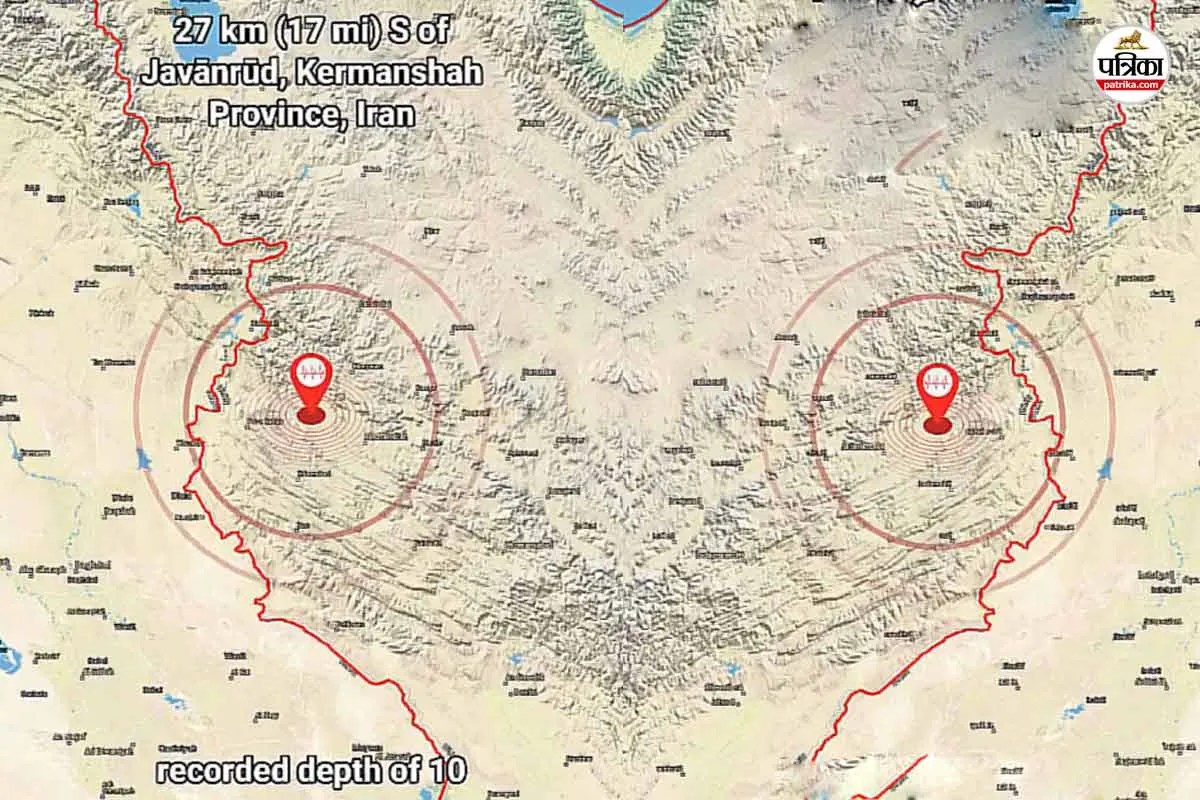
A 5.5 magnitude earthquake striking western Iran at a focal depth of 10 kilometers illustrates the ongoing structural instability along the convergent boundary between the Arabian and Eurasian tectonic plates. The Arabian Plate moves north-northwest relative to the Eurasian Plate at an average rate of approximately 20 to 25 millimeters per year. This continuous collision compresses the continental crust across western Iran, driving crustal shortening and uplifting the 1,500-kilometer-long Zagros Fold-and-Thrust Belt.
[Image of Arabian and Eurasian plate tectonics map]
Seismic events in this corridor are rarely isolated incidents. They represent incremental strain releases along blind thrust faults and strike-slip systems embedded within the regional basement rock.
Arabian Plate (NNE Motion ~20-25 mm/yr)
                 │
                 ▼
  ┌─────────────────────────────┐
  │ Zagros Fold and Thrust Belt │  <-- Crustal Shortening & Strain Accumulation
  └─────────────────────────────┘
                 │
                 ▼
       Shallow Focal Event (10 km Depth)
                 │
  ┌──────────────┴──────────────┐
  │                             │
  ▼                             ▼
High Surface Acceleration   Broad Energy Attenuation Radius
Understanding the impact of a magnitude 5.5 event requires analyzing three distinct physical variables:
- Focal Depth Mechanics: At a depth of 10 kilometers, the energy release is classified as shallow. Shallow focus earthquakes exhibit minimal geometric attenuation before the seismic shock waves reach the Earth's surface, resulting in higher peak ground acceleration (PGA) directly above the hypocenter compared to deeper events of equivalent magnitude.
- Moment Magnitude ($M_w$) vs. Local Energy Release: The Moment Magnitude Scale operates logarithmically. An increase of one whole step on the scale corresponds to roughly 31.6 times more energy release. A $M_w$ 5.5 event releases approximately $1.12 \times 10^{13}$ Joules of energy. While this is modest compared to major rupture events above magnitude 7.0, a shallow 5.5 event generates localized surface motion capable of exceeding structural tolerance thresholds in substandard buildings.
- Fault Geometry: The complex interaction of reverse faulting and strike-slip faulting within the Zagros network produces asymmetrical wave propagation. Rather than radiating uniformly in concentric circles, ground shaking aligns along the strike of the active fault line.
Amplification Mechanisms and Soil Interactions
The severity of surface damage during a mid-magnitude seismic event is governed by local site effects, primarily soil amplification and sediment resonance. The Western Iranian terrain features valleys filled with alluvial sediment deposited over centuries from mountain erosion.
When shear waves ($S$-waves) transfer from high-density basement rock into low-density, uncompressed alluvial soil, the physical law of conservation of energy forces an increase in wave amplitude to compensate for the decrease in wave velocity.
High-Velocity Basement Rock (Dense) ──► Low-Velocity Alluvial Soil (Uncompressed)
                                            │
                                            ▼
                                   Kinetic Compensation
                                            │
                                            ▼
                                  Amplified S-Wave Amplitude
This impedance contrast creates a localized hazard multiplier. The primary structural risks stem from two distinct soil-structure interaction phenomena:
Resonance Matching
Structures possess a natural frequency of vibration determined by their mass, height, and stiffness. Low-rise masonry buildings typically exhibit natural frequencies between 2 Hz and 10 Hz. Unconsolidated alluvial soils often amplify seismic waves within this exact frequency band. When the dominant frequency of the ground shaking matches the natural frequency of the structure, resonance occurs, multiplying the dynamic loads exerted on structural walls.
Liquefaction Potential
In valley bottoms with high water tables, cyclic shearing from primary seismic waves causes pore-water pressure within loose sandy soils to rise rapidly. When pore-water pressure equals overburden pressure, the effective stress of the soil drops to zero. The soil loses shear strength entirely and behaves like a dense liquid, causing foundation instability, differential settlement, and structural collapse even in moderate-intensity earthquakes.
Infrastructure Vulnerability Dynamics
Evaluating earthquake impact requires measuring structural vulnerability across building classes. In western Iran, rural and urban settlements present starkly contrasting risk profiles due to differences in construction standards and material properties.
Unreinforced Masonry (URM) Systems
A significant proportion of non-metropolitan structures consist of adobe, unreinforced brick, or stone bonded with weak mortar. These systems possess high mass and stiffness but extremely low tensile and shear strength.
During an earthquake, lateral accelerations generate horizontal shear forces that URM walls cannot absorb. Failure follows a predictable progression:
- In-plane diagonal tension cracking forms in load-bearing walls.
- Out-of-plane bending causes exterior walls to detach from roof diaphragms.
- Total collapse occurs due to the loss of gravity load support.
Reinforced Concrete Frame Structures
Modern urban centers utilize reinforced concrete frame construction. While designed to withstand lateral forces, non-ductile detailing presents severe structural failure vectors. Inadequate transverse reinforcement (stirrups) near beam-column joints allows shear failure under cyclic loading.
Short-column effects, created by non-structural infill walls partially blocking concrete columns, concentrate stress and cause brittle shear failure before the structure can deform elastically.
  +-------------------------------------------------------------+
  |                   SEISMIC HAZARD FACTORS                    |
  +------------------------------+------------------------------+
                                 |
        ┌────────────────────────┴────────────────────────┐
        ▼                                                 ▼
┌──────────────────────────────┐        ┌──────────────────────────────┐
│  Unreinforced Masonry (URM)  │        │     Reinforced Concrete      │
├──────────────────────────────┤        ├──────────────────────────────┤
│ • High mass, low elasticity  │        │ • Beam-column joint stress   │
│ • Out-of-plane shear failure │        │ • Short-column shear force   │
│ • Low tensile resistance     │        │ • Soft-story displacement    │
└──────────────────────────────┘        └──────────────────────────────┘
Disaster Response Logistics and Risk Mitigation Frameworks
Managing the aftermath of a magnitude 5.5 earthquake demands strategic resource allocation based on actual physical damage patterns rather than initial panic responses. Emergency operations require a phased framework focused on immediate stabilization and long-term risk reduction.
Phase 1: Immediate Field Assessment (0-72 Hours)
 ├── Rapid visual screening of transportation corridors
 ├── Deployment of satellite radar interferometry (InSAR)
 └── Search and rescue prioritized by structural collapse profiles

Phase 2: Secondary Hazard Mitigation (72 Hours - 2 Weeks)
 ├── Landslide dam clearing in mountainous passes
 ├── Water and power utility isolation to prevent fires
 └── Temporary shelter positioning outside structural fall zones

Phase 3: Structural Retrofitting & Policy Implementation (Post-Event)
 ├── Shotcrete application on existing URM walls
 ├── Steel bracing retrofits for soft-story frame buildings
 └── Strict enforcement of seismic building codes (Iranian Standard 2800)
Rapid Assessment and Primary Response
Initial operational priority must center on mapping the rupture zone and verifying critical infrastructure integrity. High-resolution satellite radar interferometry (InSAR) combined with ground reconnaissance teams provides rapid surface displacement data, identifying regions where peak ground acceleration exceeded critical safety limits.
Emergency medical and search-and-rescue assets must prioritize unreinforced masonry zones where complete structural collapse is most probable. Transportation corridors through mountainous passes in the Zagros range must be continuously cleared of earthquake-induced landslides to ensure supply chains remain functional.
Structural Retrofitting Imperatives
To minimize vulnerability against inevitable future shocks, structural retrofitting must address the existing building stock:
- Masonry Stabilization: Applying engineered cementitious composites or shotcrete layers reinforced with carbon-fiber or steel mesh directly to URM walls increases out-of-plane shear strength by up to 300 percent.
- Concrete Frame Ductility Enhancements: Wrapping beam-column joints with fiber-reinforced polymers (FRP) provides confinement, preventing brittle failure and allowing the structure to absorb energy through plastic deformation.
- Diaphragm Anchorage: Securing floor and roof slabs to vertical load-bearing elements prevents premature structural detachment during lateral displacement.
Policy Enforcement and Building Regulations
Upgrading physical structures is effective only when paired with rigorous enforcement of seismic engineering codes, such as Iranian Standard 2800. Municipal authorities must implement third-party structural auditing during construction, eliminating non-ductile detailing and substandard concrete mixes before buildings are occupied.
Strategic Play: Deploying Targeted Seismic Vulnerability Metrics
Municipal planners and emergency management agencies must immediately execute a three-step operational program to mitigate future seismic risks across vulnerable zones:
Conduct Microzonation Mapping: Mandate high-resolution geophysical surveys across all urban expansion areas to identify shear wave velocity profiles ($VS_{30}$) and map soil amplification zones. Prohibit high-density construction on unconsolidated alluvial soils without deep foundation engineering.
Implement Structural Audit Mandates: Institute compulsory seismic safety evaluations for public structures, schools, and hospitals built before modern code updates. Require immediate structural bracing or retrofitting for any facility exhibiting short-column vulnerabilities or soft-story configurations.
Establish Automated Utility Shutoff Systems: Integrate real-time seismic sensor networks with regional gas and power distribution grids. Automated shutoff valves triggered by initial P-wave detection eliminate post-earthquake fire hazards, preserving critical infrastructure and reducing immediate post-shock casualties.